AI Voice Generator Statistics 2026: Market Trends and Revenue

That friendly voice on your last support call? There is a fair chance no human ever recorded a single word of it.
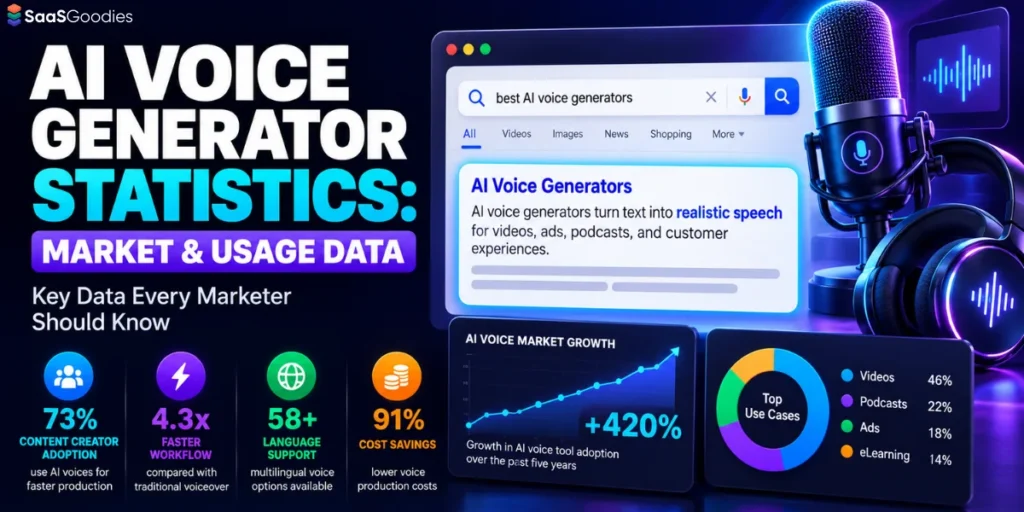
Bottom line: the AI voice generator market sits near $5.44 billion in 2026 by our maths, on course for $20.71 billion by 2031.
ElevenLabs runs at roughly $600 million in annual recurring revenue and now carries a $22 billion valuation.
Meanwhile, ordinary listeners flag a cloned voice only about 60% of the time, so voice fraud keeps booming too.
We have tracked AI tools and affiliate programmes since 2023, and these AI Voice Generator Statistics come checked, sourced and hype free.
AI Voice Generator Statistics 2026 at a Glance
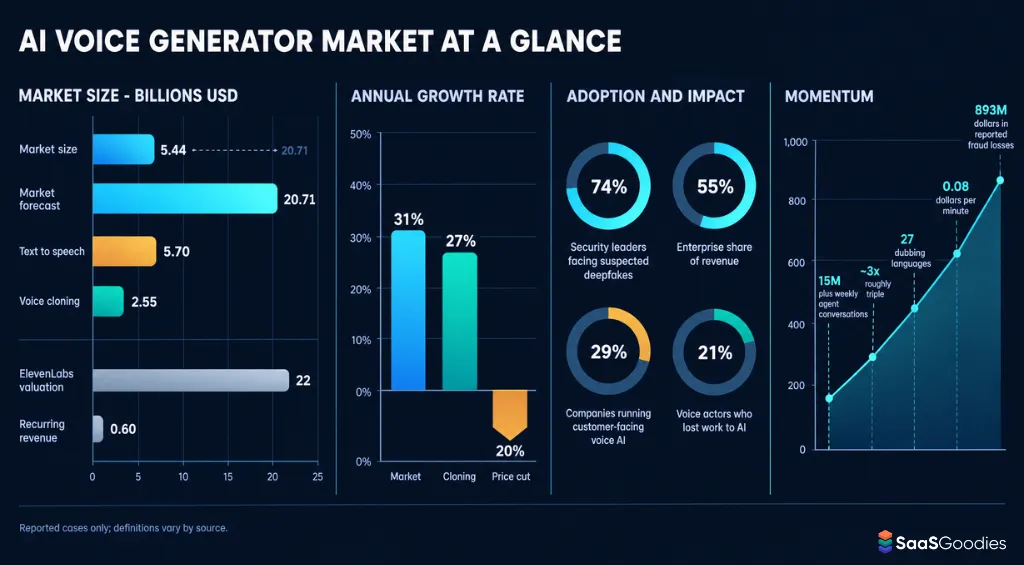
Short on time Scan the table first, then jump to whichever section your funnel needs most.
| Metric | 2026 Figure | Why Marketers Should Care |
|---|---|---|
| AI voice generator market size | About $5.44 billion (our estimate) | Spending grows close to 31% every year |
| AI voice generator market forecast | $20.71 billion by 2031 | Almost four times bigger within five years |
| Text to speech market size | $4.36 billion to $5.7 billion | Definitions differ, but demand keeps rising |
| Voice cloning market size | $2.55 billion | Cloning grows roughly 27% a year |
| ElevenLabs annual recurring revenue | About $600 million | Up from $350 million at the close of 2025 |
| ElevenLabs valuation | $22 billion | Doubled from $11 billion inside one year |
| ElevenLabs revenue from large organisations | 55% | Enterprise buyers now outspend creators |
| ElevenLabs agent conversations | 15 million plus every week | Roughly triple the early 2026 level |
| ElevenLabs voice agent price | $0.08 per minute | A 20% cut from the previous $0.10 rate |
| Companies running customer facing voice AI | 29% | Most businesses are still testing |
| US security leaders facing a suspected deepfake | 74% | Voice fraud now sits on every risk register |
| Voice actors who lost work to AI | 21% | Up from about 14% a year earlier |
| YouTube auto dubbing languages | 27 | Free dubbing raises the bar for paid tools |
| Reported US losses from AI linked fraud (2025 data) | $893 million | Reported cases only, so real damage runs higher |
How the SaaSGoodies Desk Checked Every Number on This Page
SaaSGoodies has covered SaaS tools, affiliate programmes and tested deals since 2023, and AI voice tools land on our desk constantly.
We watch pricing pages, payout terms and product launches closely, because our readers promote these tools for a living.
Too many stat roundups recycle stale figures with a fresh date slapped on top. We refuse to play along with such a lazy game.
Our house rule stays simple: no receipts, no stat. Every figure below passed these checks before making the cut.
All references sit together at the bottom of the page, so you can verify any figure yourself in seconds.
How Big Is the AI Voice Generator Market in 2026?
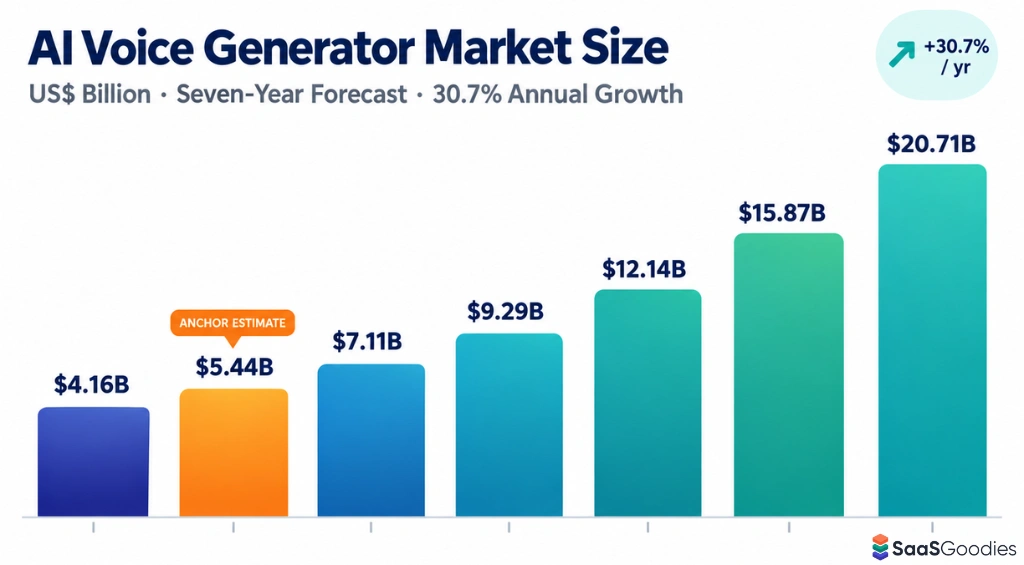
The AI voice generator market size reached $4.16 billion in 2025, according to the most widely cited industry forecast.
By 2031, the same forecast expects $20.71 billion, with spending growing 30.7% every single year.
Apply one year of growth, and 2026 lands at roughly $5.44 billion. We use $5.44 billion as our anchor throughout.
Media and entertainment held the largest share of spending in 2025, driven by dubbing, voiceovers, narration and game dialogue.
Fully synthetic voices are growing faster than recorded natural voices, and North America remains the biggest regional buyer.
2025 and 2031 are published forecast values. Bars for 2026 to 2030 are SaaSGoodies calculations at 30.7% yearly growth.
SaaSGoodies Estimate: Our maths puts the market past the $10 billion mark during 2029, closing that year near $12.1 billion.
Voice agents and dubbing should carry most of the climb, while plain narration grows at a calmer pace.
Text to Speech vs Voice Cloning: Which AI Voice Segment Grows Faster?
“AI voice” really covers several overlapping markets, and mixing them up produces messy, misleading headlines.
Classic text to speech software reads written words aloud. Voice cloning copies one specific human voice.
Modern AI voice generators bundle both jobs together with dubbing, editing and agents inside one subscription.
Research houses define each segment differently, so we lined up the major forecasts side by side below.
| Segment | 2025 Value | 2026 Value | Long Range Forecast | Yearly Growth Rate | Our Read |
|---|---|---|---|---|---|
| AI voice generators | $4.16B | $5.44B (our estimate) | $20.71B by 2031 | 30.7% | Fastest growing bundle, led by agents and dubbing |
| Text to speech (narrow definition) | $3.87B | $4.36B | $7.92B by 2031 | 12.66% | Counts mostly API reading tasks, so growth looks slower |
| Text to speech (broad definition) | $4.8B | $5.7B | $35.3B by 2035 | 22.4% | Adds services and newer uses such as healthcare |
| Voice cloning | $2.01B | $2.55B | $6.65B by 2030 | 27.1% | Creator and brand voices keep demand climbing |
| Generative AI overall (for context) | Not tracked here | About $399.7B | About $1.34T by 2032 | 22.36% | Voice is a small slice growing faster than its parent |
One pattern jumps out fast. The voice cloning market grows more than twice as quickly as the narrow TTS estimate.
Neural voices now dominate buying decisions, so older robotic engines keep losing share with every passing year.
Our Read on the Gap: The distance between $7.92 billion and $35.3 billion comes down to definitions, not disagreement.
Narrow reports count API calls. Broad reports add agents, dubbing suites and creator apps, where fresh money actually flows.
Where Text to Speech Revenue Sits: Regions, Big Cloud and Industries
Knowing where buyers sit helps you decide which languages, regions and industries deserve your next piece of content.
Big cloud vendors own the developer layer. Specialists such as ElevenLabs and Murf own the creator and brand layer.
Field Note From Our Keyword Work: English voice tool content keeps fighting over the same handful of crowded search terms.
Hindi, Spanish and Portuguese tutorials face far thinner competition, and regional growth numbers back our bet.
How Big Is AI Voice Inside the Wider Generative AI Market?
Context matters here, because a fast growing niche can still be a small slice of a much bigger AI pie.
The generative AI market as a whole is worth roughly $399.7 billion in 2026, heading for about $1.34 trillion by 2032.
Put our $5.44 billion voice estimate beside the bigger number, and AI voice generators account for about 1.4% of generative AI spend.
Voice grows near 31% a year, though, while generative AI overall grows at roughly 22% a year.
Our Projection: If both growth rates hold, voice climbs to nearly 1.9% of all generative AI spending by 2031.
A small slice growing faster than its parent market is exactly where early, honest content earns the most.
ElevenLabs Revenue in 2026: From $350 Million to $600 Million ARR
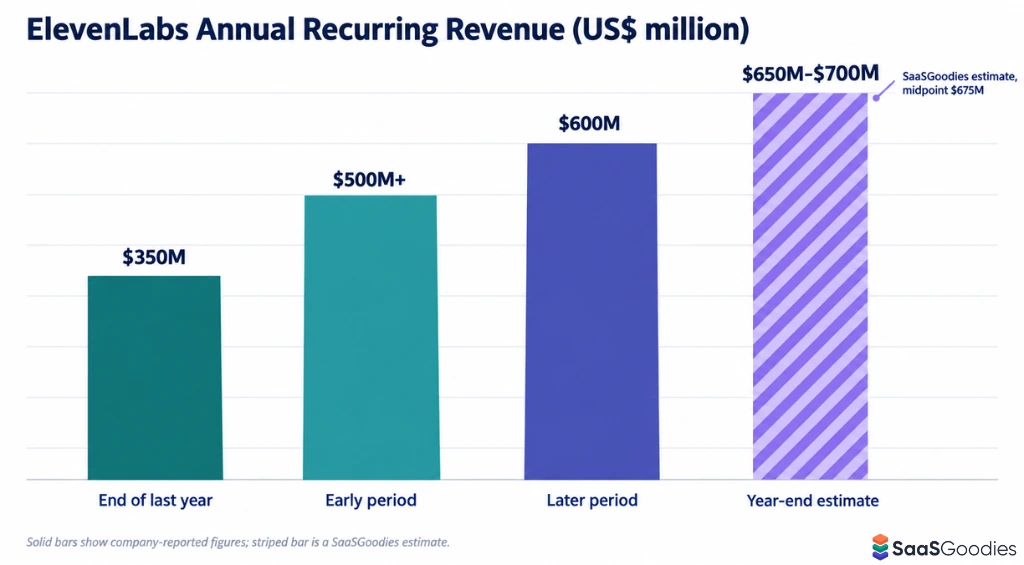
No single company shapes AI voice right now quite like ElevenLabs, which was founded back in 2022.
ElevenLabs annual recurring revenue closed 2025 at $350 million, then passed $500 million early in 2026.
Later in the year, its chief executive confirmed recurring revenue of roughly $600 million.
The striped bar is a SaaSGoodies estimate plotted at the $675 million midpoint. Other bars show company reported figures.
Revenue alone hides the real story, which sits in who pays and what they buy.
Stripe, Deutsche Telekom, Klarna and Revolut all run voice agent workloads on ElevenLabs today.
Desk Forecast: We expect ElevenLabs to close 2026 somewhere between $650 million and $700 million in ARR.
If agent volume keeps tripling, a $1 billion run rate during 2027 looks more likely than not.
ElevenLabs Valuation Hits $22 Billion: Our Maths Behind the Multiple
Valuation jumps show how much investors believe in the whole category, not only in one company.
Valuations from priced funding rounds and employee share sales. Twenty times growth in roughly two years.
A $500 million Series D led by Sequoia Capital set the $11 billion price earlier in 2026.
Later, a $300 million employee share sale led by Wellington and T. Rowe Price doubled the price to $22 billion.
Headcount rose from 530 to more than 800 people during the same stretch.
Leadership also says a stock market listing could be ready within two to two and a half years.
We ran a few numbers of our own, because headline valuations rarely tell marketers anything useful by themselves.
One caveat matters a lot. ElevenLabs revenue includes agents and music, which some market reports leave out entirely.
Our Reality Check: Thirty seven times revenue prices in several more years of very fast growth.
Any slowdown in agent volume would hit such a multiple hard, so watch enterprise share more closely than creator buzz.
Voice AI Funding in 2026: Who Raised, How Much and Why You Should Care
ElevenLabs grabs most headlines, but serious money now flows into every layer of the voice stack.
We grouped the key names by what they actually sell, because product type decides which buyers your content can reach.
| Company | What It Sells | Latest Round | Valuation | Traction Signal | Why Affiliates Should Care |
|---|---|---|---|---|---|
| ElevenLabs | Voice creation, dubbing and agents | $500M Series D plus $300M share sale (2026) | $11B, then $22B | ARR from $350M to about $600M | Biggest brand search demand in the niche |
| Parloa | Enterprise customer service agents | $350M Series D (2026) | $3B | Valuation tripled from $1B, ARR above $50M | Proof that enterprise voice budgets are huge |
| Deepgram | Speech to text, TTS and agent APIs | $130M Series C (2026) | $1.3B | 200,000+ developers and 1,300+ organisations | Developers form a fast growing buyer group |
| LiveKit | Real time voice and video infrastructure | $100M Series C (2026) | $1B | Powers ChatGPT Advanced Voice Mode | Agent builders need this layer first |
| Vapi | Developer platform for voice agents | $50M Series B (2026) | About $500M | More than 1 billion calls handled | Strong fit for agency and no code audiences |
| PolyAI | Enterprise voice assistants | $86M round (2025 baseline) | $750M | Expected $40M ARR at the end of 2025 | Another sign that phone automation pays well |
Add up the 2026 primary rounds alone, and five voice companies pulled in more than $1.1 billion of fresh capital.
That total excludes share sales, so it reflects new money going straight into products, people and voice AI funding for growth.
Where We Would Put Our Money: Infrastructure rarely trends on social media, yet it pays agencies and affiliates for years.
Agency owners building voice bots for clients form a quiet, high value audience worth targeting right now.
Developer Platforms Quietly Powering the Voice Boom
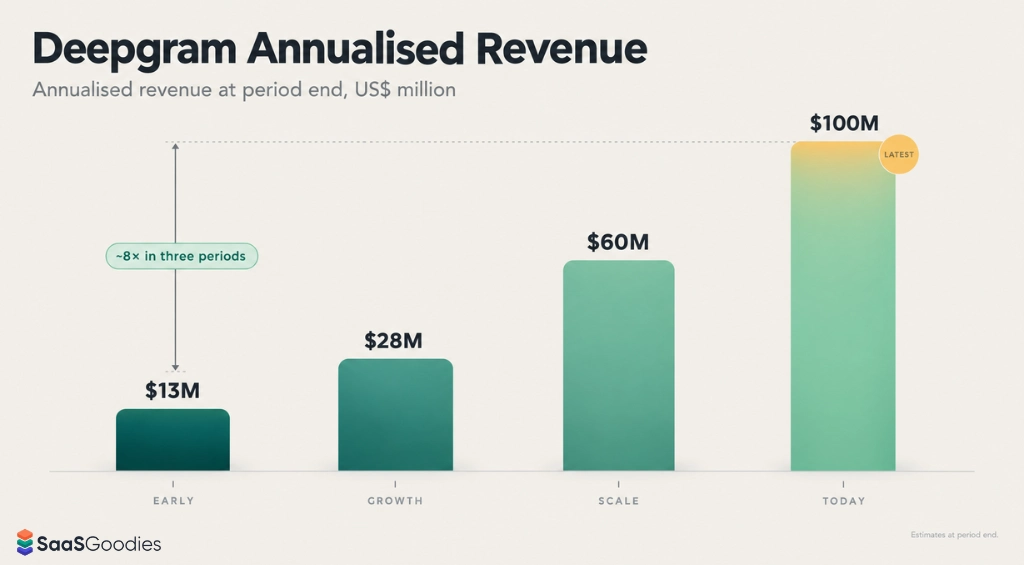
Developer platforms sit underneath many consumer voice apps, so their growth confirms real traffic rather than flashy demos.
Deepgram offers the cleanest whole year growth curve we found, with figures stretching back to 2023.
Annualised revenue estimates at year end, with 2026 showing the latest reported run rate.
Partner Desk Note: Deepgram grew nearly eight times in three years, which tells us voice agents have left the pilot stage.
When developer platforms grow this quickly, consumer and agency tools built on top usually follow within a year or two.
Voice Agent and API Price Cuts: The Race to Cheaper Speech
Developer pricing fell hard in 2026, and cuts like these usually reach consumer plans a little later.
Our working: 1,000 minutes of agent calls now costs about $80, before telephony and language model fees.
Cheaper minutes widen the buyer pool fast, especially among clinics, agencies and small local service businesses.
What We Expect Next: Mainstream tools should fall below $0.10 per included minute on standard plans during 2027.
API rates already halved this year, and free dubbing from YouTube keeps squeezing paid creator plans from below.
AI Voice Agent Adoption: Consumers Are Ready, Companies Are Still Testing
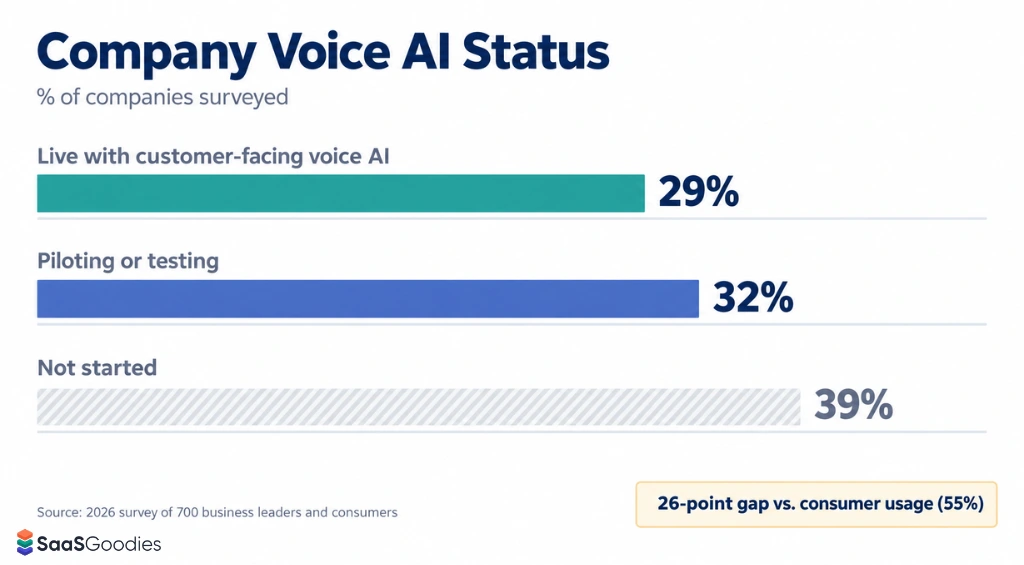
Voice generation started life as a narration tool. In 2026, AI voice agents that answer and place calls drive the real growth.
A 2026 poll of 700 business leaders and consumers shows a striking gap between everyday habits and business rollout.
Deployed and piloting shares come from a 2026 survey. The striped bar is the SaaSGoodies remainder.
A 26 point gap between consumer behaviour and business deployment is, for us, the most telling number on this page.
Our Bet for 2028: Customer facing voice AI should reach roughly half of all companies by 2028.
Today's 32% in pilots is the pipeline. Converting even 60% of them lifts adoption to about 48%.
What Customer Service Leaders Actually Plan to Spend on AI
Hype says AI will replace whole support teams overnight. Spending data tells a calmer and far more useful story.
Put simply, budgets for voice tools are growing alongside human teams rather than replacing them outright.
Our Read on the Numbers: Content selling voice agents as total human replacements will age badly.
Position them as overflow, after hours and first line support tools, and buyers will trust your reviews far more.
YouTube Auto Dubbing Statistics Every Creator Should Know
Creators feel AI voice faster than almost anyone, mostly through free dubbing built straight into YouTube.
YouTube auto dubbing now runs by default for eligible creators, after starting life as a small test with partner channels.
Lip sync remains a pilot for selected channels, so most dubbed faces still move in the original language.
Where We Land: Free dubbing kills the basic translation pitch for paid tools almost overnight.
Paid platforms must now win on voice matching, lip sync, editing control and commercial rights, so test all four in every review.
AI Narrated Audiobooks: Spotify, Audible and the Indie Author Boom
AI narrated audiobooks grew from a curious experiment into a serious publishing channel within about three years.
Spotify launched an audiobook creation tool for authors in 2026, powered by ElevenLabs voices.
Fresh listeners plus cheap narration create a rare window for indie authors, coaches and online course creators.
Content Idea From Our Desk: “Turn your ebook into an audiobook” tutorials carry very clear buyer intent.
Pair them with honest voice tool comparisons, and one guide can carry several affiliate links naturally.
Can Your Ears Catch a Cloned Voice? Synthetic Voice Detection Data
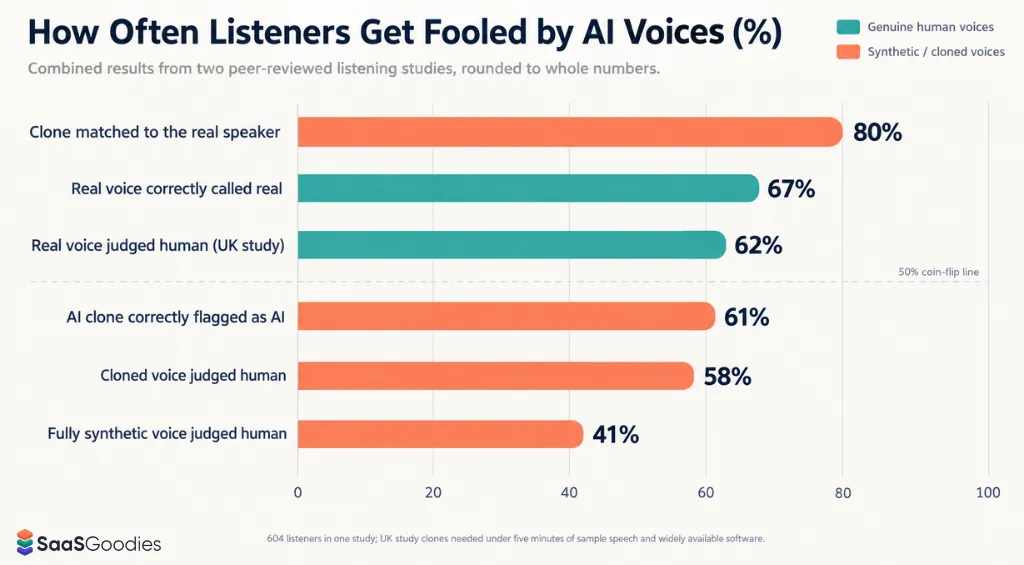
Short answer: not reliably. Two peer reviewed studies published in 2025 make the problem painfully clear.
In one study of 604 listeners, people matched an AI clone to its real speaker about 80% of the time.
Those same listeners correctly flagged a clone as AI only around 60% of the time, barely better than guessing.
A separate UK study found 58% of cloned voices passed as human, against 62% for genuine recordings.
Combined results from two peer reviewed listening studies published in 2025, rounded to whole numbers.
Each clone in the UK study needed under five minutes of sample speech and widely available software.
Some cloned voices were even rated as more trustworthy than the real people they copied.
The Honest Verdict: Human ears no longer work as a security check, full stop.
Brands using synthetic voices should disclose them openly, because listeners simply cannot tell on their own.
Deepfake Voice Fraud Statistics: The Dark Side of Cheap Cloning
Every growth stat above has a darker twin. Cheap, convincing voices also power cheap, convincing scams.
Deepfake voice fraud moved from rare headline to routine business risk inside two short years.
| Fraud or Trust Statistic | Figure | Data Year | What Brands Should Note |
|---|---|---|---|
| US security leaders reporting a suspected deepfake attack in the past year | 74% | 2026 | Attacks are now normal, not rare |
| Hit organisations losing over $1 million in a single incident | 1 in 4 | 2026 | One fake call can wipe out a year of profit |
| Security leaders worried their organisation is not prepared | 93% | 2026 | Readiness lags far behind awareness |
| Leaders relying on legacy tools for deepfake detection | 37% | 2026 | Purpose built detection remains a wide open market |
| Americans who received a deepfake voice call in the past year | 1 in 4 | 2026 | Clones now reach people at home, not only at work |
| Consumers unsure they could tell an AI voice from a human on a call | 24% | 2026 | Doubt alone erodes trust in phone channels |
| Average scam loss for victims aged 55 and over | $1,298 | 2026 | Roughly three times the losses of younger adults |
| Consumers wanting stricter rules on AI phone scams | 72% | 2026 | Regulatory pressure keeps building |
| AI related fraud complaints filed in the US | 22,364 | 2025 | Reported cases only |
| Reported US losses tied to AI related fraud | $893 million | 2025 | Real damage runs far higher than reports |
The consumer figures come from a survey of more than 12,000 people across the US, UK, Canada, France, Germany and Spain.
Three in four security leaders also admit an executive would need to be impersonated before boards treat deepfakes as a priority.
FBI Fraud Data Decoded: What Voice Cloning Scams Cost Americans
Reported US cybercrime losses hit a record $20.88 billion in 2025, spread across more than 1 million complaints.
Complaints with an AI element totalled 22,364, carrying $893 million in reported losses.
Our maths puts the average AI related complaint near $40,000, about double the roughly $20,000 average across all complaints.
Investment scams alone make up about 71% of AI linked losses, so impersonation driven investment pitches remain the costliest play.
AI cases still represent only about 4.3% of total reported losses, which points to heavy under reporting.
Red Flag We Are Watching: Voice tools and voice fraud grow from the same technology, so both curves will keep rising together.
Deepfake detection and voice authentication look like the next hot affiliate category, and our programmes directory is watching for new partner offers.
Voice Actors vs Synthetic Voices: Jobs, Royalties and Consent
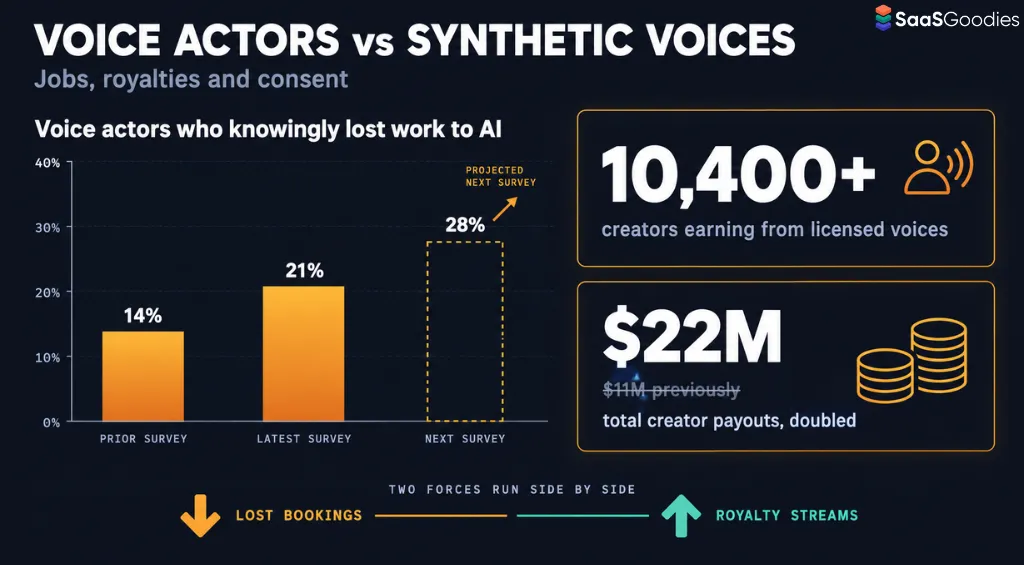
Professional voice actors give us the clearest view of how quickly synthetic speech replaces paid human work.
Two forces now run side by side. Some actors lose bookings, while others turn their voice into a steady royalty stream.
Our Projection: Repeat the seven point yearly rise, and roughly 28% of voice actors will report lost work in the next survey.
Licensed voice marketplaces, where actors earn whenever a clone gets used, look like the most likely middle ground.
Why Brand Buyers Now Pay a Trust Premium for Licensed AI Voices
Buyers no longer chase the cheapest robot voice. They want voices that sound real, stay legal and actually fit the brand.
The same 2026 poll of 700 business leaders and consumers shows how strongly authenticity shapes buying decisions.
Put simply, licensed AI voices now carry a trust premium bargain tools struggle to match.
From Our Review Desk: “Most realistic voice” no longer wins a review on its own merits.
Readers increasingly ask about consent, licensing and exclusivity, and reviews answering those questions earn more clicks.
AI Voice Regulation in 2026: EU AI Act Article 50 and the NO FAKES Act
2026 became the year voice rules stopped being theory and started carrying real penalties.
Transparency duties under EU AI Act Article 50 became enforceable this year, even as heavier rules were pushed back.
Across the Atlantic, the NO FAKES Act cleared the Senate Judiciary Committee with a unanimous vote in 2026.
Our Compliance Call: Built in watermarking and consent checks will be standard on mainstream voice platforms by 2027.
Tools that skip compliance will struggle to win enterprise deals, which hurts the affiliates promoting them too.
AI Voice Affiliate Programmes: The Commission Maths Nobody Shows You
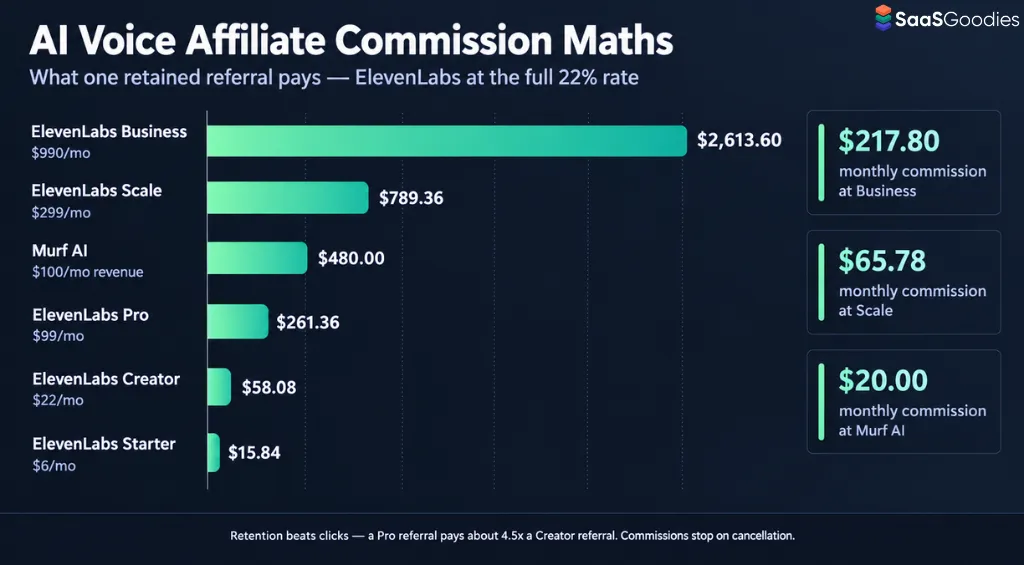
Now for the part our readers ask about most often. How much can promoting AI voice tools actually pay?
Two programmes dominate our niche, and both pay a recurring affiliate commission through PartnerStack.
We worked out what one retained referral pays on each plan, assuming the full 22% rate at ElevenLabs.
| Programme and Plan | Monthly Price | Commission Terms | Monthly Commission | Total per Retained Referral | Value of 100 Retained Referrals |
|---|---|---|---|---|---|
| ElevenLabs Starter | $6 | Up to 22% for one year | $1.32 | $15.84 | $1,584 |
| ElevenLabs Creator | $22 | Up to 22% for one year | $4.84 | $58.08 | $5,808 |
| ElevenLabs Pro | $99 | Up to 22% for one year | $21.78 | $261.36 | $26,136 |
| ElevenLabs Scale | $299 | Up to 22% for one year | $65.78 | $789.36 | $78,936 |
| ElevenLabs Business | $990 | Up to 22% for one year | $217.80 | $2,613.60 | $261,360 |
| Murf AI (per $100 of monthly revenue) | $100 | 20% for two years | $20.00 | $480.00 | $48,000 |
Murf's longer window changes the whole picture. Every $100 of retained revenue pays about 82% more there than at ElevenLabs.
Commissions stop when customers cancel, and refunds get clawed back, so retention matters every bit as much as clicks.
The Payout Reality: One Pro referral pays about 4.5 times more than one Creator referral across a full year.
Upgrade focused content, such as “when Creator stops being enough”, beats chasing raw sign ups. Run your own numbers through our commission calculator first.
Content Angles That Actually Convert in the AI Voice Niche
Years of promoting AI tools have taught our desk which voice content formats attract readers with real buying intent.
Generic “top 10 AI voice tools” lists still rank, but they convert poorly next to problem specific guides.
Our advice stays blunt: pick one buyer, one problem and one tool, then show real pricing maths every time.
SaaSGoodies Forecasts: Our AI Voice Predictions for 2027 to 2031
Time to put our own numbers on the table. Each call below builds on growth rates covered earlier on this page.
Our biggest call is simple. Voice agents, not narration, will drive most new spending through 2031.
Narration and dubbing keep growing, but phone and support automation carries far bigger budgets.
FAQs About AI Voice Generators in 2026
How big is the AI voice generator market in 2026?
We estimate the market at about $5.44 billion in 2026. Forecasts expect $20.71 billion by 2031, growing 30.7% each year.
How much revenue does ElevenLabs make in 2026?
ElevenLabs runs at roughly $600 million in annual recurring revenue, up from $350 million at the end of 2025.
How much does an AI voice generator cost per minute?
Paid ElevenLabs plans work out between $0.165 and $0.20 per included minute. Voice agents cost $0.08 per minute.
Can people tell AI voices from real ones?
Not reliably. Listeners correctly flag AI clones only about 60% of the time, and 58% of clones pass as human.
Is AI voice cloning legal in 2026?
Cloning with consent is generally legal. The EU now requires AI audio labelling, and the US NO FAKES Act advanced in 2026.
Final Word From the SaaSGoodies Desk
AI voice in 2026 is a $5 billion plus market growing near 31% a year, with one breakout leader and plenty of hungry challengers.
Enterprise voice agents now write the biggest cheques, while creators enjoy free dubbing and cheaper narration than ever before.
The risks feel just as real. Fraud keeps climbing, ears are easy to fool, and regulators finally have teeth.
For marketers, the mix spells opportunity. Cover the tools honestly, explain costs clearly and lean hard into trust.
We refresh these AI Voice Generator Statistics whenever new data lands, so bookmark the page and tell us when a number looks stale.

Sources
- MarketsandMarkets: AI Voice Generator Market Worth $20.71 Billion by 2031
- Mordor Intelligence: Text to Speech Market Size and Share
- Global Market Insights: Text to Speech Market Size, 2026 to 2035
- The Business Research Company: Voice Cloning Global Market Report 2026
- Statista Market Insights: Generative AI Worldwide
- ElevenLabs: Crossing $500M ARR and Welcoming New Investors
- The Next Web: ElevenLabs Doubles Its Valuation to $22bn in a $300m Share Sale
- Tech.eu: ElevenLabs Valuation Doubles to $22bn With $300m Employee Tender Offer
- NewsBytes: ElevenLabs Calls India Its Second Biggest Market at a $600 Million Run Rate
- Sacra: ElevenLabs Revenue, Valuation and Funding
- ElevenLabs: $22 Million Earned by Voice Creators
- TechCrunch: Parloa Triples Its Valuation to $3B With a $350M Raise
- Business Wire: Deepgram Raises $130M Series C at $1.3B Valuation
- Sacra: Deepgram Reaches $100M in Annualised Revenue
- SiliconANGLE: LiveKit Raises $100M at a $1B Valuation
- TechCrunch: Vapi Hits $500M Valuation After Amazon Ring Deal
- Voices: Amplified 2026 Annual State of Voice Report
- Gartner: Conversational AI Will Reduce Contact Centre Agent Labour Costs by $80 Billion in 2026
- Gartner: Over 50% of Customer Service Organisations Will Double Technology Spend by 2028
- Gartner: Half of Companies That Cut Service Staff Due to AI Will Rehire by 2027
- PPC Land: YouTube Auto Dubbing Tops 6M Daily Viewers and Expands to 27 Languages
- TechCrunch: Spotify Launches an Audiobook Creation Tool Powered by ElevenLabs
- TechCrunch: Audible Expands Its AI Narrated Audiobook Library
- Scientific Reports: People Are Poorly Equipped to Detect AI Powered Voice Clones
- The Register: Voice Clone Detection Study From Queen Mary University of London
- Pindrop: 2026 Deepfake Readiness Index
- Infosecurity Magazine: Deepfakes Are Becoming a Costly Reality for Businesses
- TechRadar: One in Four Americans Received a Deepfake Voice Call (Hiya Survey)
- SecureWorld: FBI Reports AI Enabled Fraud Topped $893M in 2025
- National Association of Voice Actors: 2026 State of Voiceover Survey
- Enterprise DNA: Voice Actors Report Rising Job Losses to AI
- Kingsley Napley: The EU AI Act Transparency Rules Are Now Live
- US Senate: NO FAKES Act Passes Senate Judiciary Committee