Keyword Research Statistics 2026: SEO Trends & Data

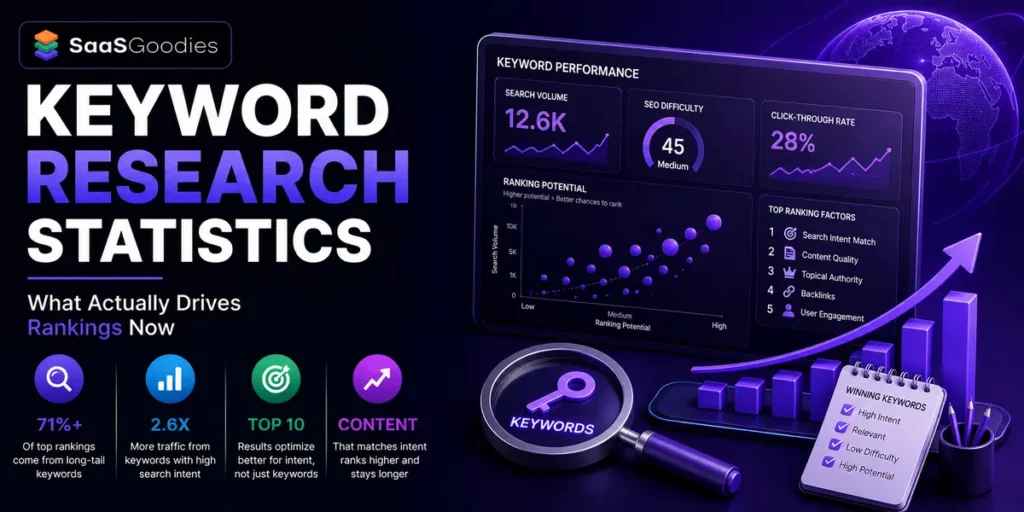
Quick answer up front: Keyword research in 2026 stopped being a volume game. Google now handles more than 5 trillion searches a year, yet close to 60% of them end with zero clicks.
About 91.8% of all queries are long-tail. Roughly 48% of searches fire an AI Overview, which quietly eats the click you used to earn. Intent beats volume now, full stop.
We pulled the freshest keyword research statistics for 2026, pressure-tested every figure, and added our own calls. No recycled 2021 numbers. Just what search looks like right now, and where the real wins still hide.
Search In 2026 Is Bigger Than Anyone Thinks
Let's set the stage with a raw scale. Search did not shrink when AI arrived. It grew.
Google published its first official volume update since 2016. The number was blunt: more than 5 trillion searches a year. That works out to roughly 13.7 billion searches a day.
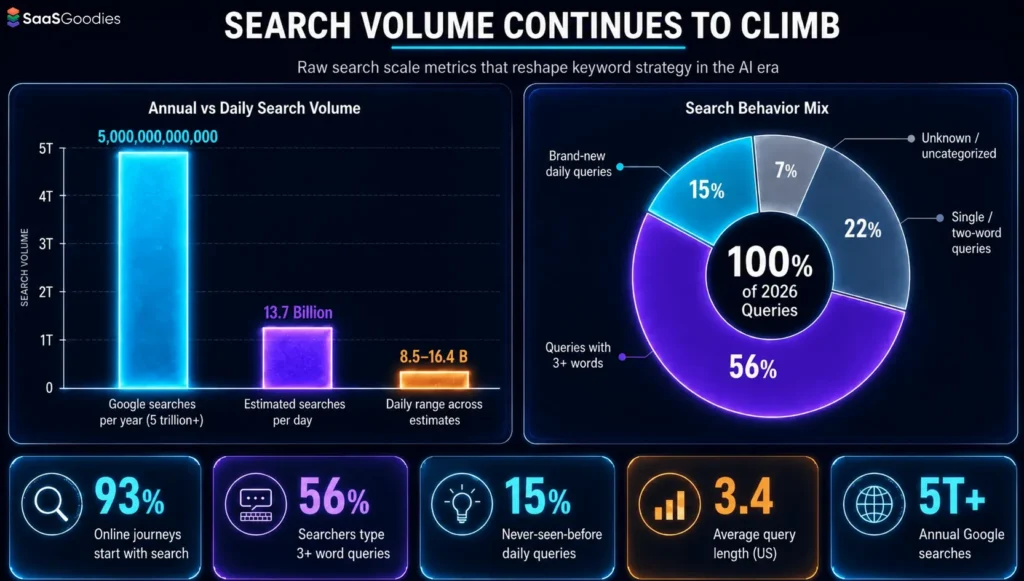
Some models put the daily figure between 8.5 billion and 16.4 billion. Nobody outside Google knows the exact count. The direction, though, is not in doubt. People search more, not less.
Here is the part every keyword researcher forgets. Around 15% of daily searches have never been typed before. That is over a billion brand-new queries every single day.
No keyword tool on earth has that data yet. Which is exactly why rigid, volume-only research keeps missing the biggest slice of demand.
| Search Scale Metric (2026) | Figure | Why It Matters For Keywords |
|---|---|---|
| Annual Google searches | 5 trillion+ | Demand keeps climbing, not falling |
| Daily searches (estimate) | 8.5 to 16.4 billion | Wide range, so treat volume as a guide |
| Brand-new queries each day | About 15% of all searches | Long-tail demand you cannot pre-plan |
| Average query length (US) | 3.4 words | Buyers phrase things, not just nouns |
| Searches using 3+ words | 56% of searchers | Short seed terms are the minority |
| Online journeys starting with search | 93% | Keywords still open most sessions |
Notice the query-length line. Only about 7% of people search with a single word. Most type a phrase, and phrases are where intent lives.
SaasGoodies read: Founders still ask us for the “high-volume keyword” list. We push back every time. A 500-search buying term often beats a 50,000-search browsing term on revenue. Volume feels good. Intent pays the bills.
Zero-Click Search: Ranking No Longer Equals Traffic
This is the stat that reframes everything. In the United States, close to 60% of Google searches now end without a single click to any website.
Some trackers put US zero-click at 58.5%. Others read it higher, near 65%. One study clocked the jump from 56% to 69% across a single year of AI Overview rollout.
The trend is old. Featured snippets and knowledge panels started this a decade ago. AI Overviews just poured petrol on it.
Google AI Overviews now appear on roughly 48% of tracked queries. That is up about 58% year on year. On informational queries alone, coverage runs even higher.
When an Overview shows up, the click maths gets ugly:
Then there is AI Mode, Google's full conversational layer. When AI Mode is active, up to 93% of searches send no click at all. AI Mode already crossed a billion monthly users.
| AI Overview Impact (2026) | Reading | Keyword Takeaway |
|---|---|---|
| Zero-click rate (US, all queries) | Close to 60% | Rankings no longer guarantee visits |
| Queries firing an AI Overview | About 48% | Half your terms face the summary |
| Position-1 CTR drop with Overview | 34% to 58% | Informational terms hit hardest |
| Organic click with Overview shown | 8% (vs 15% without) | The click gap is brutal |
| Session ends after Overview | About 26% | Users get the answer, then leave |
| Zero-click rate in Google AI Mode | Up to 93% | Citation, not ranking, wins here |
So does ranking still matter? Yes, but the goal shifted. You now research keywords to earn a citation and a click, not just a blue-link position.
One bright spot. The clicks that survive an Overview convert around 23% better. Fewer visitors, but warmer ones.
Our field note: We watched one of our own guides pull 111,000 impressions and a click-through under 0.2%. Ranked page one. Barely anyone clicked. The query got answered on the results page. That single report changed how we pick target terms.
Long-Tail Keywords Now Run The Whole Show
If one stat should rewire your keyword research statistics thinking, it is this. About 91.8% of all search queries are long-tail. That figure comes from an analysis of 306 million keywords.
And the tail is even longer than that. Roughly 94.74% of all keywords get 10 or fewer monthly searches. Around 2.3 billion keywords sit under 10 searches a month.
Read that again. The famous “head” terms everyone fights over are a rounding error. The real traffic lives in the messy, specific, low-volume tail.
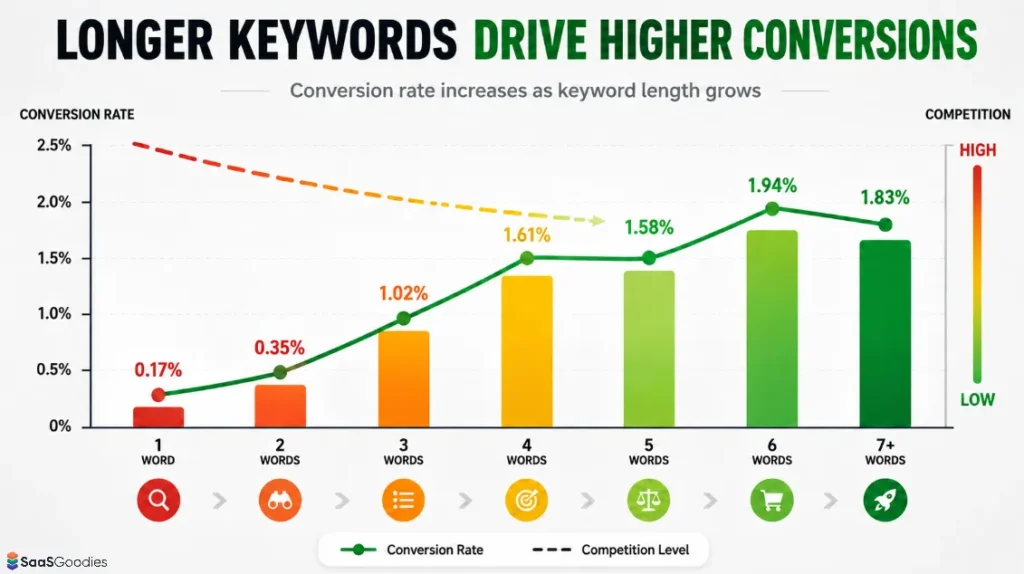
Long-tail terms also convert far better, because specific phrasing signals a decision-ready buyer. Look at how conversion climbs as the phrase gets longer.
| Keyword Length | Typical Conversion Rate | Competition Level | What The Searcher Wants |
|---|---|---|---|
| 1 word | 0.17% | Brutal | Just browsing, no clear intent |
| 2 words | 0.35% | Very high | Early research, still vague |
| 3 words | 1.02% | High | Narrowing down options |
| 4 words | 1.61% | Moderate | Close to a decision |
| 5 words | 1.58% | Low | Comparing specific choices |
| 6 words | 1.94% | Very low | Ready to act |
| 7+ words | 1.83% | Minimal | Highly specific, high intent |
A six-word phrase converts more than eleven times better than a single word. Same effort to target. Wildly different payoff.
There is a 2026 twist too. Long, conversational queries of 8 words or more now fire AI Overviews far more often. Growth in those long queries triggering an Overview jumped around 700% since AI answers rolled out.
SaasGoodies take: Stop building content around “best CRM”. You will lose to giants and get zero clicks anyway. Build around “best CRM for solo real estate agents under $30 a month”. Lower volume, real buyers, and a fighting chance to rank.
Search Intent Beats Search Volume, Full Stop
Google got scary good at reading intent. Content that mismatches intent now fails to rank, no matter how clean the on-page work is.
That flips the old process. You used to find a high-volume term, then write to it. Now you decide the intent you can serve, then find the terms that match it.
Four intent types still drive the map: informational, navigational, commercial, and transactional. The money sits heavily in the last two.
Here is the trap we see weekly. Teams chase a fat informational keyword, rank for it, then wonder why revenue never moves. The intent was never commercial to begin with.
Search intent mapping is now the first filter, before volume, before difficulty, before anything. Match the intent completely or expect to lose the click to an AI summary.
Our read: Intent is the cheapest edge in keyword research right now. Most competitors still sort spreadsheets by volume, top to bottom. Sort by intent instead and you will find the money terms they skipped.
Keyword Difficulty And The Long Race To Page One
Ranking is slower than the gurus admit. Most keyword research skips this part, then teams get blindsided.
For a moderately competitive term, cracking the top 10 takes about 6 to 12 months. Easy terms move faster. Even then, only around 14% of new pages reach the top 10 within a year.
Page two is a graveyard. Only about 0.44% of searchers ever click through to it. Rank eleventh and you may as well rank hundredth.
That is why difficulty scoring now sits right beside volume in every serious workflow. A term with 20,000 searches and fierce competition often loses to five terms with 400 searches each.
The pages that win also tend to earn more links and cleaner topical signals. The number-one result carries roughly 3.8 times more backlinks than pages ranking two through ten. Authority still counts, and it counts for AI citations too.
Our take: We tell every client the same thing. Do not open with the hardest keyword in your niche. Win ten easy ones first, build topical authority, then punch up. Momentum compounds, and page-one rankings feed each other.
AI Search Engines: The New Front Door For Buyers
Here is where 2026 gets spicy. Buyers no longer start every search on Google. A growing share opens ChatGPT, Perplexity, Gemini, or Claude first.
ChatGPT Search alone handles somewhere between 250 and 500 million queries a week. Perplexity runs around 50 million weekly. Those numbers did not exist four years ago.
Across informational queries, AI platforms now pull an estimated 15% to 20% of volume. Google still owns the bulk, but that slice is no longer a novelty.
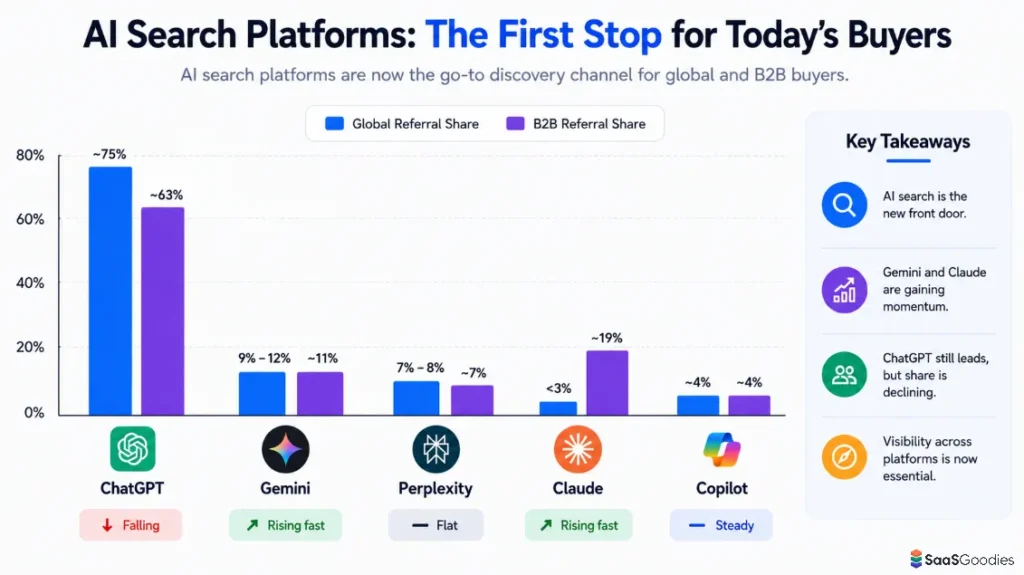
The share inside the AI category keeps shifting fast. ChatGPT still leads referral traffic, but its lead is shrinking as rivals grow.
| AI Search Platform | Global Referral Share (2026) | B2B Referral Share (2026) | Direction |
|---|---|---|---|
| ChatGPT | About 75% | About 63% | Falling from 84% |
| Gemini | 9% to 12% | About 11% | Rising fast |
| Perplexity | 7% to 8% | About 7% | Roughly flat |
| Claude | Under 3% | About 19% | Rising fast |
| Copilot | About 4% | About 4% | Steady |
Look at the B2B column. Claude punches around seven times above its global share there, because business buyers use it for longer research jobs. For SaaS brands, that gap is a gift.
Now the honest bit. The data does not all agree.
Some referral trackers show AI sending real, meaningful traffic. One large edge-network study, though, measured every AI chatbot combined sending just 0.29% of search referrals in 2026, against Google's 87.6%.
Both readings can be true at once. AI shapes buying decisions long before the final click, so its influence dwarfs its raw referral count. We treat AI visibility as a research signal, not a traffic stat.
SaasGoodies verdict: Optimise for citations, not just rankings. We now check which of our pages get quoted inside AI answers, then double down on that format: clear questions, direct answers, tidy tables. It is keyword research with a new finish line.
SaaS Keyword Research Hits Different
Now the part close to home. SaaS keyword research looks nothing like generic blog research. The money terms sit in a tight, commercial band.
Buyers researching software rarely type one broad word. They type comparisons, prices, alternatives, and use cases. Those phrases are gold, because the searcher already wants a tool.
We sort SaaS keywords into a few reliable buckets:
Around 66% of B2B buyers now research software through AI as well. So those same commercial phrases need to win citations inside ChatGPT and Perplexity, not only Google.
Volume on these terms looks tiny. Ignore that. A “best invoicing software for freelancers” term with 300 searches can beat a 40,000-search term like “invoicing” on every revenue measure.
SaasGoodies take: This is our whole game. We build stats posts and reviews around commercial, comparison, and alternative keywords. Lower volume, higher intent, and far friendlier to affiliate revenue. Volume vanity never paid a single invoice for us.
Branded And Transactional Keywords Still Send Clicks
Not every keyword lost its click. Some categories held firm right through the AI shift.
Navigational and transactional queries still push people to real websites. Someone searching a brand name or a buying term wants a destination, not a summary.
So the smart 2026 keyword mix leans on both ends at once. Informational content earns citations, while commercial and branded terms earn the click. Cover both and you own the whole buying journey.
How Marketers Actually Run Keyword Research Now
Theory aside, how do real teams do the work in 2026? Mostly with AI riding shotgun.
Around 86% of SEO professionals have folded AI into their workflow. That climbed from 65% a year earlier, the steepest tooling jump on record.
Yet only about 1% call their work fully automated. Humans still make the calls. AI drafts, suggests, and speeds things up, but people decide.
Enterprise teams juggle roughly 4.2 AI tools across research, briefs, and optimisation. And about 60% of marketers now lean on AI for idea generation and keyword research specifically.
| AI In The Keyword Workflow (2026) | Figure | What It Signals |
|---|---|---|
| SEO pros using AI in their workflow | About 86% | AI is default, not experimental |
| Teams describing work as fully automated | About 1% | Human judgement still runs the show |
| AI tools used per enterprise team | About 4.2 | Stacks are getting crowded |
| Marketers using AI for keyword research | About 60% | Research is a top AI use case |
| Biggest reported limitation | 70% cite bad output | Hallucination keeps humans in loop |
| SaaS teams using gen AI in a workflow | About 94% | Near-universal in software teams |
That 70% figure is telling. Most teams still babysit AI output, because bad or made-up data is the top complaint. Speed went up. Trust did not, at least not yet.
Our take: We use AI to expand seed lists and cluster topics in minutes, then verify every number by hand. Anyone shipping raw AI keyword data without a human check is playing with fire. We learned that the boring way.
The Keyword Tools Market Is Quietly Booming
Follow the money and you see how serious keyword research got. The SEO software market keeps swelling, even as free AI tools multiply.
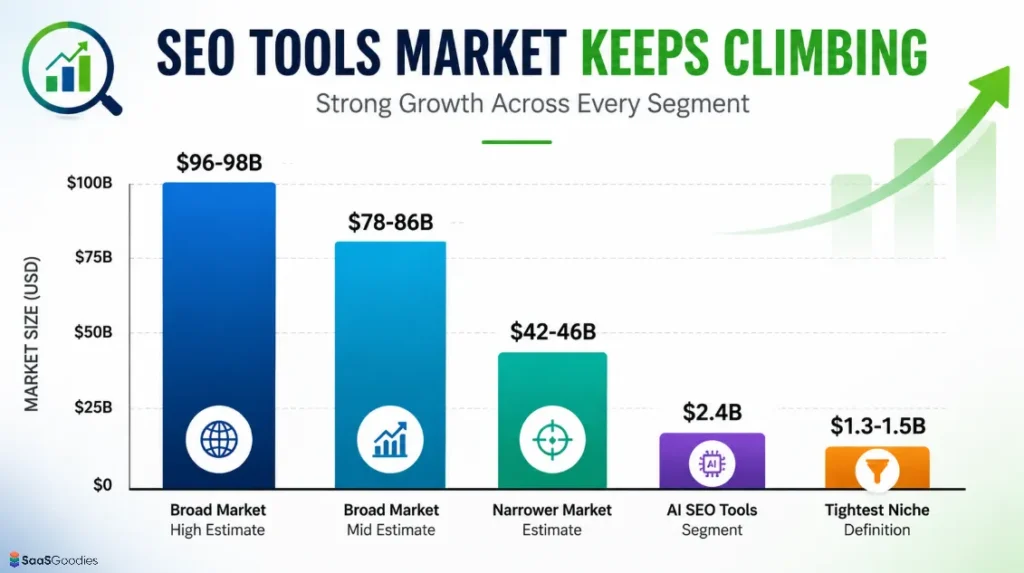
Estimates vary a lot, and we will not pretend they agree. Different analysts define the category differently, so figures stretch from tens of billions to under two billion.
We document the conflict rather than pick a single tidy number. Here is the honest range for 2026.
| SEO Software Market (2026 Estimate) | Value | Projected CAGR |
|---|---|---|
| Broad market, high estimate | $96 to $98 billion | About 13.6% |
| Broad market, mid estimate | $78 to $86 billion | About 13.4% |
| Narrower market estimate | $42 to $46 billion | About 12.0% |
| AI SEO tools segment | $2.4 billion | About 10.5% |
| Tightest niche definition | $1.3 to $1.5 billion | About 12.6% |
So which is right? Probably none exactly. The broad figures bundle content and analytics suites. The tight ones count only pure keyword tools.
Our reading is simple. The category is large, growing double digits, and consolidating fast. About 68% of digital marketers already pay for AI-based SEO tools.
The AI SEO tools slice is the fastest riser. It could more than double before the decade ends. Free AI did not kill paid tools. It made verified data more valuable, not less.
SaasGoodies read: We test a lot of these tools for reviews. The honest pattern: AI features are now table stakes, not a bonus. Any keyword tool without intent scoring and AI-answer tracking already feels a step behind in 2026.
Voice And Question Search Keep Growing Up
Voice never went away. It got quieter in the headlines and bigger in the data.
There are now more than 8.4 billion active voice assistants worldwide. That is more devices than people on the planet.
Voice queries behave nothing like typed ones. A spoken query averages around 29 words. A typed one runs 4 to 6.
People also phrase voice searches as full questions. Roughly 70% of voice queries are complete questions, against about 12% of typed searches.
That reshapes keyword targeting in two clear ways:
Only about 8% of all searches are phrased as questions today. But question phrasing punches above its weight, because it wins snippets, voice reads, and AI citations at once.
Our field note: We restructure stats posts around real questions now, each with a tight 40 to 60 word answer up top. Snippet wins climbed, and those same blocks keep showing up inside AI Overviews. One format, three payoffs.
What Keyword Research Actually Pays Back
Let's talk return, since that is what founders really want to know. Done right, keyword research still posts some of the best numbers in marketing.
B2B companies running strategic keyword research report SEO returns between 702% and 1,389%. Organic search still drives about 53% of all website traffic.
The click concentration is stark, too. The top three organic results grab about 68.7% of clicks. Only 0.44% of searchers ever reach page two.
And a sobering one to keep you honest. Around 96.55% of pages get zero organic traffic. Most of that failure traces back to weak or mismatched keyword targeting.
SaasGoodies verdict: Keyword research is not a chore you finish once. It is the map that tells you which content will earn back its cost. We treat every target term as a small bet, and intent tells us the odds.
Where Keyword Research Goes Wrong In 2026
We review a lot of content briefs. The same mistakes show up again and again.
None of these fixes are fancy. They are discipline most teams skip, which is exactly why the gap stays open for the ones who bother.
Here is the quiet truth from our own numbers. The brands winning organic in 2026 are not the ones with the biggest keyword lists. They are the ones matching intent completely and formatting for both search and AI answers.
Our field note: We keep a “do not chase” list as long as our target list. Knowing which keywords to skip has saved us more wasted content than any tool ever did. Restraint is an underrated keyword skill.
Keyword Research Statistics 2026: Our Projections And Calls
Time for our own read. We track these numbers across the tools and brands we run, so here is where we think 2026 lands. Treat them as estimates, not gospel.
One prediction we hold firmly. The winning keyword researcher in 2026 is not the one with the biggest volume list. It is the one who maps intent fastest and formats for both Google and AI answers.
That shift is already underway. Teams who make it early will quietly out-rank and out-earn the ones still sorting spreadsheets by search volume alone.
Our closing take: After years of running our own content and reviewing the tools, our lesson is plain. Keyword research rewards specificity and intent, not ambition and volume. Pick smaller, sharper terms. Answer them completely. Win the citation. The traffic follows.
Frequently Asked Questions
What is the most important keyword research statistic in 2026?
That about 91.8% of searches are long-tail. It tells you the traffic lives in specific, low-volume phrases, not in the head terms everyone fights over. Build for the tail and you compete far less for far warmer clicks.
How much has zero-click search grown?
Close to 60% of US Google searches now end without a click. When an AI Overview appears, organic clicks fall sharply, and in Google AI Mode up to 93% of searches send no click at all. Ranking alone no longer guarantees traffic.
Do keywords still matter with AI search?
Yes, more than ever, just differently. AI answers pull from content that matches clear intent and question phrasing. Good keyword research now aims to earn a citation inside AI answers, not only a blue-link ranking.
Are long-tail keywords really worth it?
The data says yes. A six-word phrase converts more than eleven times better than a single word, and long-tail terms carry far lower competition. Lower volume, higher intent, and a realistic shot at ranking.
How many marketers use AI for keyword research?
About 86% of SEO professionals now use AI somewhere in their workflow, and roughly 60% use it for keyword research specifically. Only about 1% run fully automated, since bad output keeps a human in the loop.
Is search volume dead as a metric?
Not dead, but demoted. Volume is a rough guide, not a target. Intent, conversion potential, and AI-citation odds now sit above raw volume when we pick which terms to chase.
The Bottom Line On Keyword Research In 2026
Keyword research in 2026 is not one scary shift. It is a set of new rules that reward sharper thinking.
Volume lost its crown. Intent wears it now. The tail carries the traffic, AI answers guard the click, and citations matter as much as rankings.
Fix the easy things first. Target long-tail phrases you can actually rank for. Match intent completely. Format answers for snippets and AI Overviews. Do that, and keyword research stops feeling like a gamble and starts working like a map.
That is the game in 2026. Smaller bets, clearer intent, better returns.
- Backlinko SEO and Keyword Research Data
- Ahrefs Long-Tail Keywords Study
- SparkToro Zero-Click Search Research
- Semrush AI Overviews and Search Studies
- Statista Search Engine Market Data
- Pew Research Center Search Behaviour Study
- BrightEdge AI Overviews Research
- Google Official Search Data and Blog
- First Page Sage SEO ROI and CTR Data
- Grand View Research SEO Software Market
- Fortune Business Insights SEO Software Market
- Similarweb AI Search Traffic Data