60+ Cold Email Statistics 2026: The Real 3.4% Reply Rate Truth

Everyone quotes a different cold email number. One blog says 1% reply rate is normal; another screenshots 40% like it is easy.
So here is the figure that holds up across the largest datasets: the average cold email reply rate in 2026 is about 3.4%, while top teams clear 10% and the best-targeted niche campaigns reach 15–25%. The gap between the average and the elite is not copy — it is data quality, targeting and deliverability.
Cold email is targeted, relevant outreach to a specific person — chosen by role, company or trigger — who has not opted in, distinct from spam, which is untargeted mass messaging. The distinction matters legally (under CAN-SPAM) and practically (deliverability now depends on relevance signals).
This roundup pulls together the verified cold email statistics on reply rates, open rates, follow-ups, personalisation, deliverability and conversion — drawn from platform datasets covering hundreds of millions of cold emails.
Essential Cold Email Statistics for Better Campaigns
What is Cold Email, and How is it Different from Spam?
Cold email is targeted outreach to a specific person with a clear business reason, sent without prior opt-in; spam is untargeted mass messaging with no relevance.
The line is not about volume alone — it is about relevance, and in 2026 the inbox providers enforce that line technically.
The channel is not dead — bad email is.
Translation for operators: the inbox is not dying, it is getting pickier. Relevance is the only thing that separates outreach from spam in the provider's eyes, not your intentions.
What is the Average Cold Email Reply Rate in 2026?
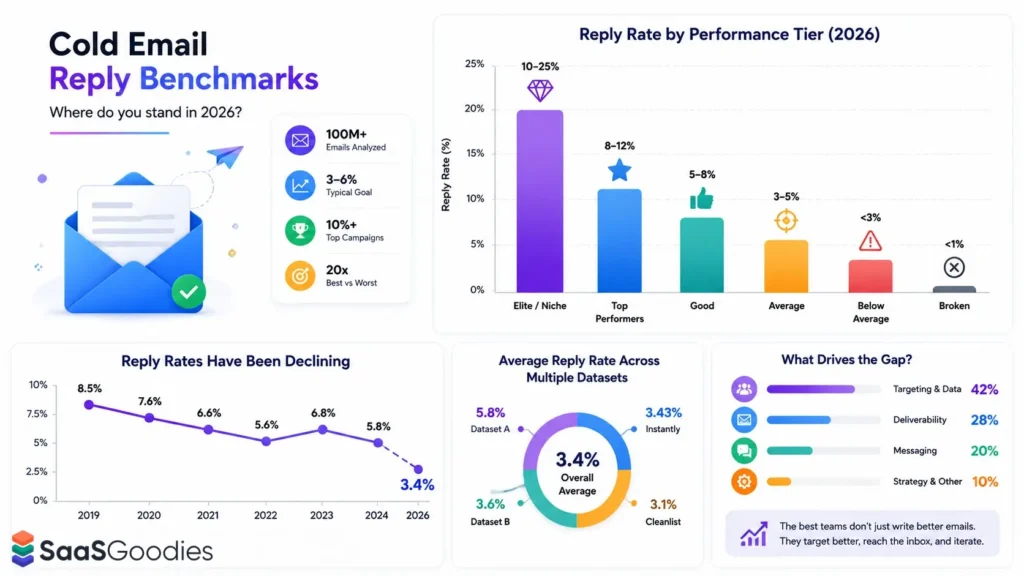
The honest average is about 3.4%, with a realistic well-run target of 3–5%, top performers at 8–12%, and elite niche campaigns reaching 15–25%. Reply rates have also been declining for years, which reframes what “good” means.
| Reply rate bracket | 2026 range | What it signals |
|---|---|---|
| Elite / niche | 10–25% | Tight ICP, intent signals, pristine reputation |
| Good | 5–8% | Solid targeting and messaging |
| Average | 3–5% | Competent team at scale |
| Below average | <3% | Deliverability or list problem, not copy |
| Broken | <1% | Spam placement or bad data |
Here is the reality check the screenshots skip: reply rate is the easiest metric to game and to misread.
Translation for operators: a 6% reply rate full of “remove me” is worse than a 2% positive rate that books meetings. Track positive reply rate and meetings per thousand sent — the headline number is context, not the goal.
What About Cold Email Open Rates — And Why Ignore Them?
Cold email open rates range from 27.7% to 44% in 2026, but Apple Mail Privacy Protection inflates them so badly that they are a directional signal at best. Optimising for opens in 2026 is optimising for an artefact.
Subject lines matter for the opens that count, but after Apple MPP the open rate measures Apple's servers as much as your prospects. Judge campaigns on replies and meetings, not opens.
How do Reply Rates Vary by Industry and Audience?
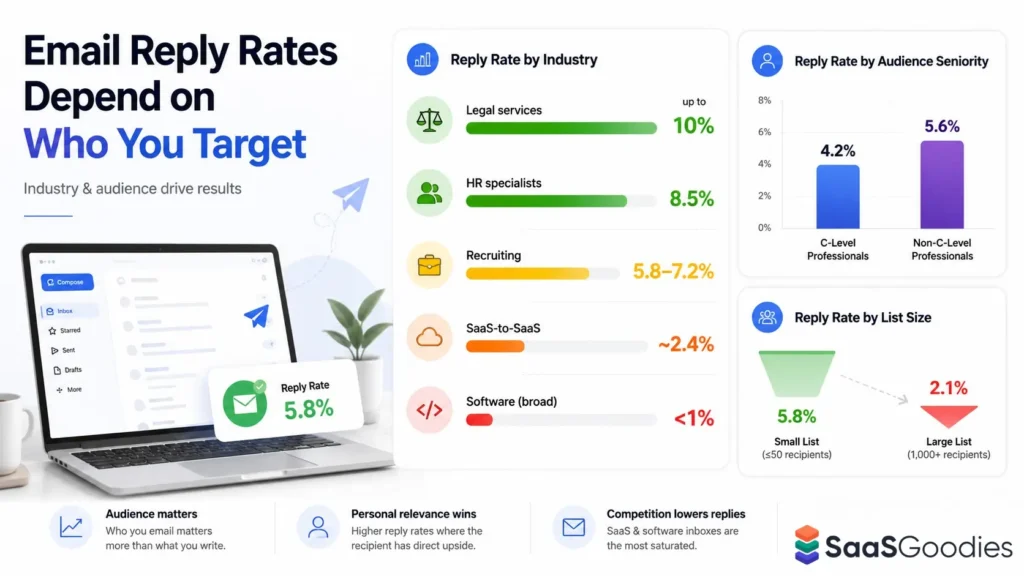
Who you email matters more than what you write — recruiting and HR see 5.8–8.5% reply rates while SaaS-to-SaaS sits near 2.4%. The variance by audience dwarfs the variance by copy.
| Audience / segment | Typical reply rate |
|---|---|
| HR specialists | ~8.5% |
| Recruiting | 5.8–7.2% |
| Legal services | up to 10% |
| SaaS-to-SaaS | ~2.4% |
| Software (broad) | <1% |
| List ≤50 vs 1,000+ | 5.8% vs 2.1% |
Shrinking the list often beats rewriting the copy for the fourth time. Smaller lists force the targeting that drives the reply rate.
Do Follow-ups Actually Work?
42% of all replies come from follow-ups, and the optimal sequence is four to seven touchpoints. Stopping after one email leaves nearly half the replies unclaimed.
The honest caveat: more follow-ups are not always better. Past the third touch, the marginal reply has to be weighed against rising spam complaints that damage the whole domain.
Build a 4–7 step sequence, but make every touch earn its place — repetition without new value just trains prospects to hit “report spam.”
How much do Personalisation and List Quality Matter?
These are the two biggest levers in cold email — a personalised email to a verified list can outperform a generic blast to a bought list by more than 15×. Copy is downstream of data.
Personalisation does not mean inserting a first name into a template — it means referencing specific projects, recent company news or a genuine trigger.
The cheapest reply-rate fix is cleaning the list — verifying 1,000 contacts costs a few dollars and beats another copy rewrite every time.
What Deliverability Rules Decide Whether Cold Email Lands?
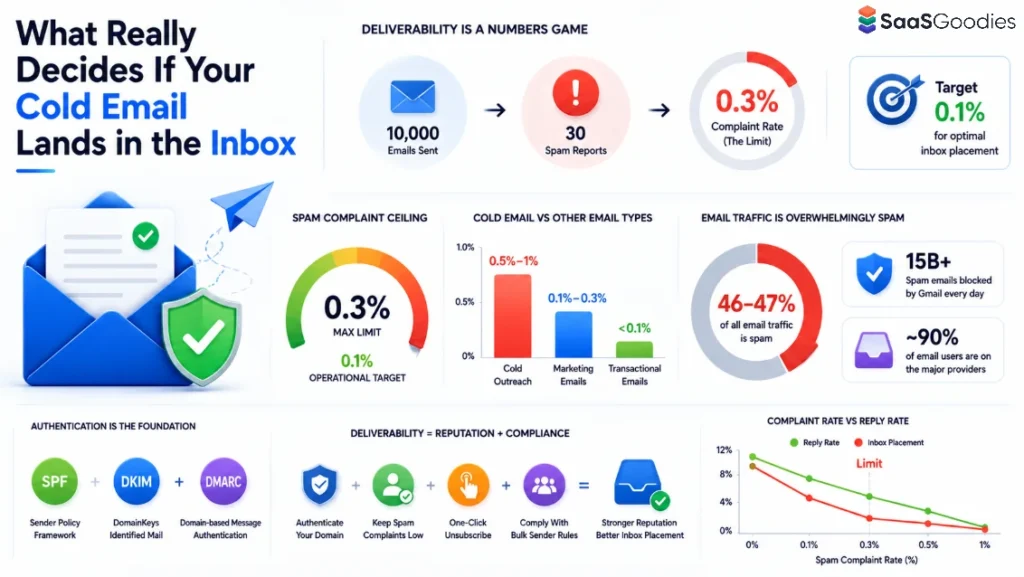
Since February 2024, the major inbox providers enforce authentication and a 0.3% spam-complaint ceiling — and cold email routinely runs right up against that line. Deliverability is no longer optional plumbing; it is the gate.
| Provider | Authentication required | Spam threshold | Bulk trigger |
|---|---|---|---|
| Google (Gmail) | SPF + DKIM + DMARC | <0.3% (target 0.1%) | 5,000+/day (Feb 2024) |
| Yahoo | SPF + DKIM + DMARC | <0.3% | 5,000+/day (Feb 2024) |
| Microsoft (Outlook) | SPF + DKIM + DMARC | reputation-based | 5,000+/day (May 2025) |
| Apple | SPF + DKIM + DMARC | reputation-based | Early 2024 |
The structural problem for cold email is stark: the 0.3% ceiling sits below the 0.5–1% complaint rate cold campaigns naturally generate.
Translation for operators: domain warmup and list hygiene are not best practices any more — they are survival. One unverified blast can tank a domain's deliverability for months.
What is the Conversion Rate of Cold Email?
Cold email converts from send to deal at roughly 0.2–2%, averaging about 0.7% — meaning a mid-performing campaign produces one outcome per ~142 emails. The funnel is wide at the top and narrow at the bottom, which is why volume and targeting both matter.
The irony worth naming: AI makes elite outbound sharper and average outbound worse at the same time. AI's edge in 2026 is research and targeting, not generating more generic emails faster — that just accelerates the channel's decline for everyone using it that way.
What These Cold Email Statistics Reveal About 2026 Outreach
The data points one direction, with three honest caveats.
Precision beats volume, decisively: The winning teams send less to better-fit people, and the reply-rate gap between elite and average is a data-and-targeting gap, not a copy gap.
The caveat: “precision” has a floor — below a certain list size there are not enough prospects to build a pipeline, so targeting and reach have to be balanced.
Reply rate is the wrong headline metric: Positive reply rate and meetings booked per thousand sent predict revenue; raw reply rate is easy to game.
The caveat: reply rate still has uses as a relative A/B measure on the same audience — it is just useless as an absolute success number.
Deliverability is the real bottleneck: With 17% of cold emails never landing and a 0.3% complaint ceiling that cold campaigns routinely breach, infrastructure decides outcomes before copy does.
The caveat: perfect deliverability still fails against a bad offer — authentication gets the email seen, it does not make it worth replying to.
- Instantly — 2026 Cold Email Benchmark Report (100M+ emails; reply rate, follow-ups, timing, AI).
- Snov.io — Cold Email Statistics 2026 (10M+ emails; open rates, by role/industry, subject lines).
- Cleanlist — 2026 cold email response-rate statistics (verified vs unverified lists, bounce, industry).
- Prospeo — B2B cold email reply rates (4-dataset analysis; list size, decline, deliverability).
- Backlinko / Woodpecker (via Whali) — large-sample reply rate and personalisation studies.
- Apollo — expected reply rate for a well-run outbound campaign (2026 convergence).
- Cleverly — cold email statistics 2026 (conversion funnel, multichannel).
- Google/Yahoo sender guidelines (via dmarcian) — bulk-sender authentication and spam thresholds.
- Emailwarmup — Gmail/Yahoo bulk-sender requirements (cold-email complaint reality).
- AutoSPF — Google/Yahoo bulk-sender mandate two years on (Microsoft, Apple, ~90% of inboxes).
- Reachoutly — cold email response-rate guide (long-term decline; AI flooding).
- LeadHaste — cold email reply-rate benchmarks 2026 (vanity vs positive reply rate).
- Mailforge — average cold email response rates (personalisation, length).