Voice Search Statistics 2026: AI Voice Shift Data

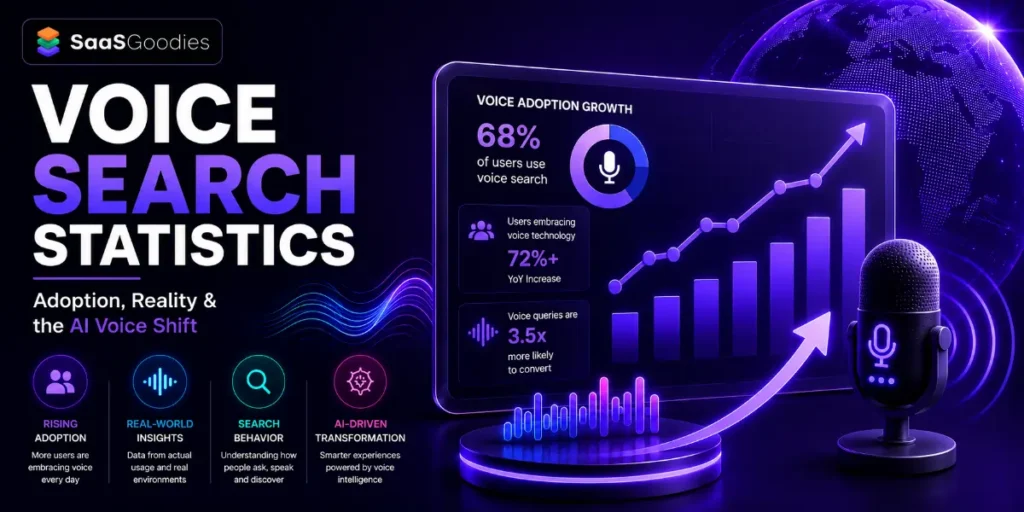
Voice search is the most over-forecast channel in SEO history, so start with the number that punctures the hype: US smart-speaker ownership has sat at about 35% of Americans aged 12 and over for four straight years, and the famous prediction that “50% of all searches would be voice by 2020” simply never came true.
Voice is real, useful and widely used — but it plateaued as a search channel, and the genuine 2026 story is generative AI, not smart speakers.
Voice search is the use of spoken queries to a digital assistant — on a phone, smart speaker, car or app — to get an answer or complete a task.
This roundup pulls together the verified voice search statistics on adoption, devices, voice commerce, use cases and the AI shift, and flags the zombie stats that still circulate. Where forecasts have repeatedly overshot, that gets said plainly.
Top Voice Search Statistics You Need to Know
What is Voice Search, and How Many People Actually Use it?
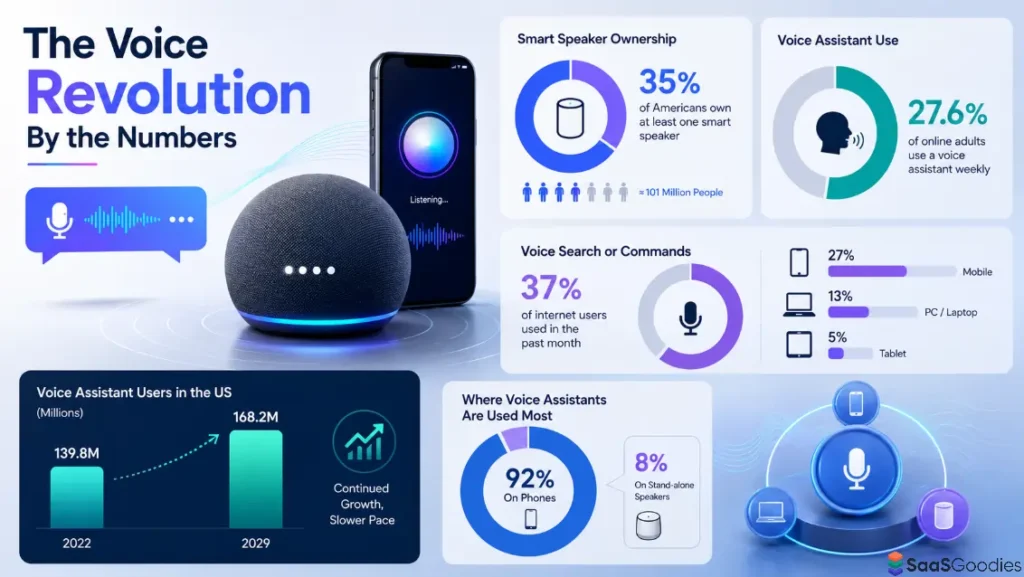
Voice search is spoken interaction with a digital assistant, and a meaningful minority of people use it regularly — but “use a voice assistant” and “run a web search by voice” are not the same thing. That distinction is where most voice stats go wrong.
SaasGoodies Take: voice assistant adoption is broad, but a lot of that is setting timers and playing music, not searching the web. The slice that matters for SEO — spoken queries seeking information — is smaller than the headline ownership numbers suggest.
Has Voice Search Adoption Stalled or Grown?
The voice story has split in two: dedicated smart speakers have plateaued, while voice on phones, in cars and inside apps keeps climbing. Treating “voice” as one rising line is the core mistake.
| Voice adoption signal | Figure |
|---|---|
| US smart-speaker ownership | 35% (flat 4 years) |
| Weekly global assistant use | 27.6% |
| Global voice-search peak | 22.5% (Q2 2022) → ~19–20% |
| Tasks per speaker/week | 12.4 (from 7.5 in 2017) |
The deceleration is the signal. Plan for voice as a steady feature layer on mobile and local, not as a fast-growing channel that needs its own budget line.
What About the “50% of Searches will be Voice” Claim?
This is the zombie stat of SEO — the prediction that half of all searches would be voice by 2020. It did not happen, and it keeps getting requoted as if it did. Being honest about it is the whole point.
Which Devices and Assistants Lead?
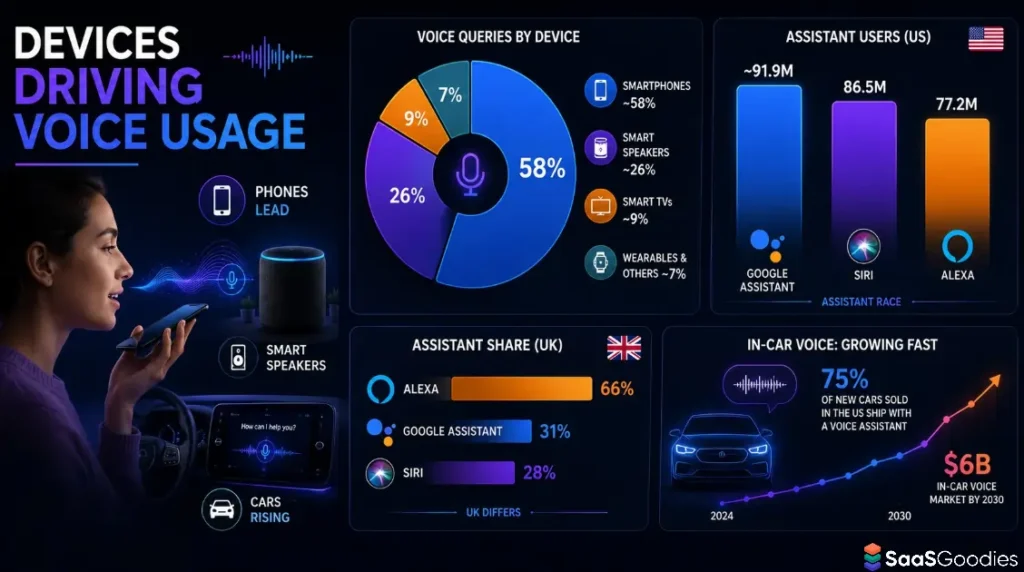
Phones dominate voice, not speakers — and the assistant market is a three-horse race in the US with a different leader in the UK. Device share decides where voice optimisation actually pays.
| Assistant (US) | Users | Note |
|---|---|---|
| Google Assistant | ~91.9m | Transitioning to Gemini |
| Siri | 86.5m | Apple devices |
| Alexa | 77.2m | Leads smart-speaker base |
If a “voice SEO plan” is only about building an Alexa skill, it misses where voice actually happens — phones flowing into Google Search, Maps and local results.
How Big is Voice Commerce, Really?
Voice commerce is real but far smaller and slower than the forecasts promised — and those forecasts have a long record of overshooting. Temper the projections against actual behaviour.
| Voice commerce metric | Figure |
|---|---|
| Forecast range | $40bn (2026) → $186bn (2030) |
| Shoppers who've bought by voice | ~24% |
| Use voice to reorder | ~17% |
| Speaker owners shopping monthly | ~11–12% |
Pure-voice purchases remain a niche — most “voice commerce” is reordering known items, not discovery shopping.
Translation for operators: voice commerce is a retention and convenience channel for existing customers, not a new acquisition funnel. Build for reorders and lists, not for closing first-time sales by voice.
How do People Use Voice, and On What?
People use voice for fast, hands-free, low-stakes tasks — weather, music, timers and local lookups — far more than for considered searches or purchases. The use-case mix explains the ceiling.
The heavy use cases are utilities, not commerce. For local businesses, the near-me angle is real but the exact “76% local” figure is unreliable — optimise the Google Business Profile because it helps anyway, not because of one contested percentage.
What Does Voice Mean for SEO?
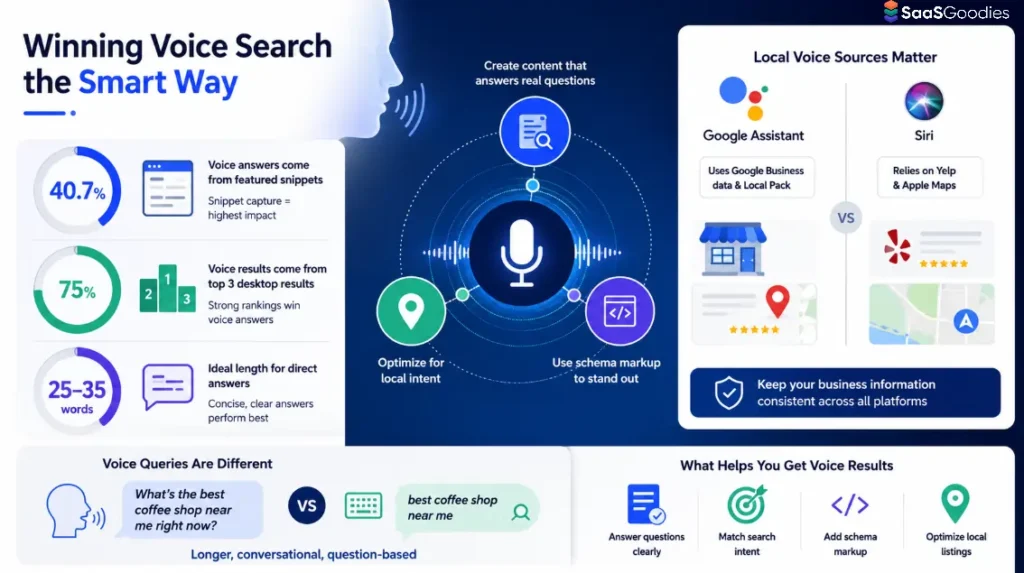
Voice SEO is mostly just good SEO with a snippet-and-local emphasis — there is no separate “voice algorithm” to game. The data behind voice answers is reassuringly familiar.
| Voice-SEO factor | Figure |
|---|---|
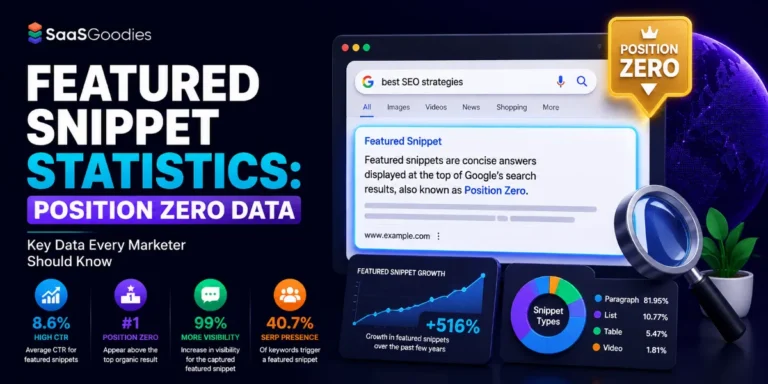
| Voice answers from snippets | 40.7% |
| Voice results from top-3 desktop | 75% |
| Ideal direct-answer length | 25–35 words |
There is no voice-SEO silver bullet. Win featured snippets, rank in the top three, answer questions concisely, keep local listings clean — the same work that wins typed search wins voice
How is Generative AI Changing Voice?
This is the actual 2026 development: large language models are turning voice assistants from command-takers into conversational agents — reviving voice in a way smart speakers never did for search. The hardware plateaued; the intelligence layer is what changed.
It is far too early to quantify how LLM voice changes search behaviour — these are launch-stage figures. But the direction is the real headline.
The meaningful voice shift in 2026 is conversational AI, not smart-speaker sales. The question is whether spoken queries to ChatGPT, Gemini and Alexa+ start citing content the way AI Overviews do — and structuring content for AI citation is the hedge.
Final Takeaways from the 2026 Voice Search Statistics
The data points one direction, with three honest caveats.
Voice adoption is broad but plateaued as a search channel: US smart-speaker ownership has been flat at one-third for four years, and global voice-search usage peaked in 2022.
The caveat: the plateau is in dedicated hardware — mobile and in-car voice keep growing, so the channel is steady, not dying.
The forecasts have overshot, repeatedly: Voice-commerce projections span $40 billion to $186 billion and actual purchasing remains a niche.
The caveat: real value sits in reorders and convenience, not first-time-buyer acquisition — so model it conservatively.
Generative AI is the genuine shift: Alexa+ on Anthropic models, Gemini replacing Google Assistant, and sub-300ms voice APIs are turning assistants conversational.
The caveat: it is launch-stage, so treat engagement figures as early signals — but the move from command to conversation is the story worth tracking.
- Edison Research — Infinite Dial 2025 & NPR/Edison Smart Audio (US smart-speaker ownership, daily use, tasks per speaker; via SQ Magazine).
- DataReportal — Digital 2025 Global Overview (weekly global voice-assistant use; via SQ Magazine).
- GWI / GlobalWebIndex — voice device split, demographics (via Yadav Bikash).
- eMarketer — US voice-assistant user counts and 2029 forecast (via SQ Magazine).
- Ofcom — Audio Listening in the UK 2025 & Communications Market Report 2025 (UK voice/speaker data; via SQ Magazine).
- Pew Research Center — foundational US voice-assistant survey (2017; via SQ Magazine).
- Backlinko — voice search study of 10,000 results (snippets, top-3 share; via Marketing LTB).
- Grand View Research / VoiceBot / Fortune Business Insights — voice-commerce and smart-speaker market sizing (via SeoProfy & Yadav Bikash).
- NarVar / G2 — voice-commerce behaviour (reorders, purchase share; via SeoProfy).
- DemandSage / Yaguara / BloggersPassion — voice-search usage compilations (global share trend, accuracy, device base).