Chatbot Statistics 2026: Users, ROI and Market Size

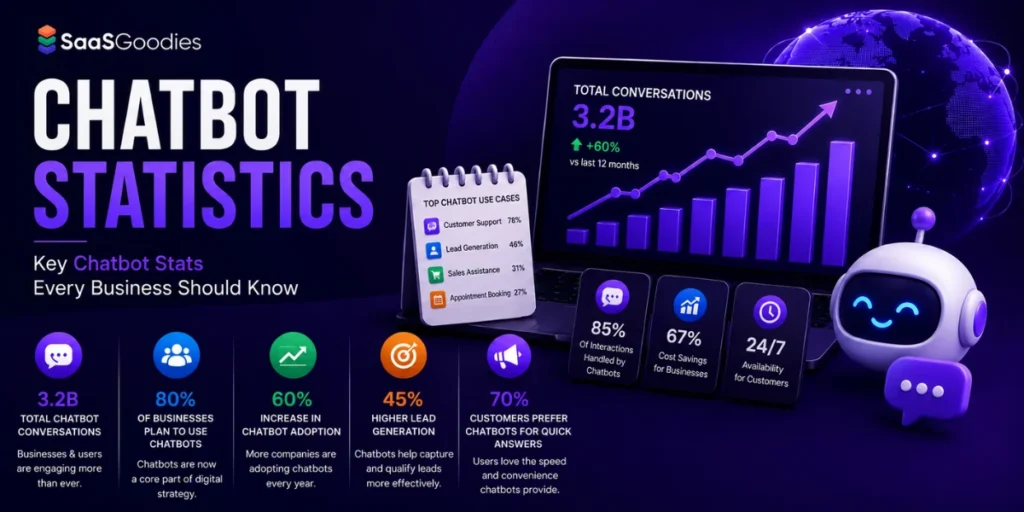
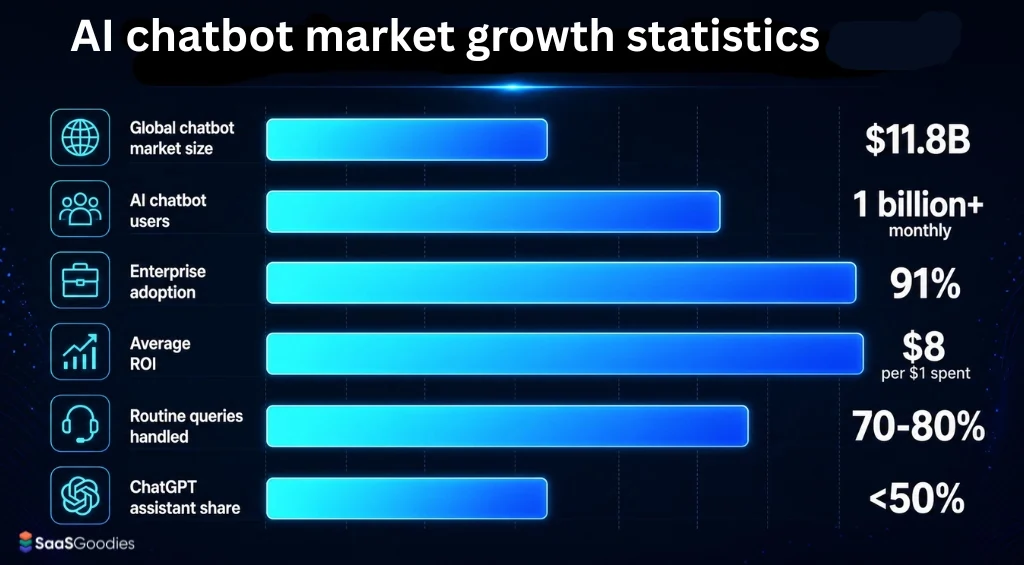
Quick answer before you scroll: The global chatbot market sits at roughly $11.8 billion in 2026, and more than a billion people now talk to AI bots every month.
ChatGPT still leads, but its grip has loosened hard, sliding below 50% of assistant users for the first time.
Businesses report around $8 back for every $1 spent, and bots handle 70 to 80% of routine questions on their own.
We have tracked this space for years, and 2026 is the year chatbots stopped being a novelty widget and became plumbing. Here are the latest chatbot statistics that matter, minus the fluff.
Why these Chatbot Numbers Hit Different this Year
We read every roundup so you do not have to. Most recycle the same tired 2023 numbers and slap a “2026” on the title. We do not play that game.
Everything below reflects data pulled and cross-checked in 2026. Where the research firms disagree, we say so. Where we have our own read from working with SaaS teams, we tell you what we think.
The short version: adoption crossed the tipping point. The debate is no longer about deploying a bot. The real question is if yours actually resolves anything.
Here is a fast snapshot of where things stand right now.
| Metric | 2026 Figure | What It Signals |
|---|---|---|
| Global chatbot market size | about $11.8 billion | Up from $9.6bn in 2025 |
| AI chatbot users worldwide | 1 billion+ monthly | Mainstream, not niche |
| Enterprise adoption (50+ staff) | 91% | Now standard infrastructure |
| Average ROI over 12 months | $8 per $1 spent | Profit centre, not cost line |
| Routine queries bots can handle | 70 to 80% | Big labour offload |
| ChatGPT global assistant share | Below 50% | First time since launch |
Key Insight: the 91% enterprise adoption stat is the one we keep circling back to. When nine in ten mid-size and large firms run bots, the laggards are not cautious. They are exposed.
Chatbot Market Size 2026: How Big The Money Really Is
Let us start with the headline number, because everyone asks about it first.
The global chatbot market reached about $11.8 billion in 2026, up from $9.6 billion in 2025. Grand View Research puts the 2026 figure at $11.78 billion. Mordor Intelligence lands close, at $11.45 billion.
Growth forecasts cluster around 19 to 24% a year. By 2033, the market is set to hit roughly $41 billion.
A few firms run hotter. One projection sees $15.5 billion in 2026 and $42 billion by 2030. The generative AI chatbot segment alone is valued near $13 billion this year, growing faster than the wider market.
| Research Source | 2026 Market Size | Future Projection | CAGR |
|---|---|---|---|
| Grand View Research | $11.78 billion | $41.2bn by 2033 | 19.6% |
| Mordor Intelligence | $11.45 billion | $32.45bn by 2031 | 23.15% |
| Fortune Business Insights | $10.42 billion | $41.2bn by 2033 | around 20% |
| Higher-end estimate | $15.5 billion | $42bn by 2030 | 23 to 25% |
Why the spread? Firms define “chatbot” differently. Some fold in voice agents and conversational AI. Others keep it narrow.
Our projection: we expect the market to clear $13 billion during 2026 once agentic and voice deployments get counted properly. The narrow definitions are already lagging reality.
One vertical worth flagging: healthcare bots are set to reach around $543 million in 2026, and healthcare is the fastest-growing segment on a percentage basis.
Who Actually Uses Chatbots In 2026
User counts got wild this year. More than a billion people now use AI chatbots each month across the major platforms.
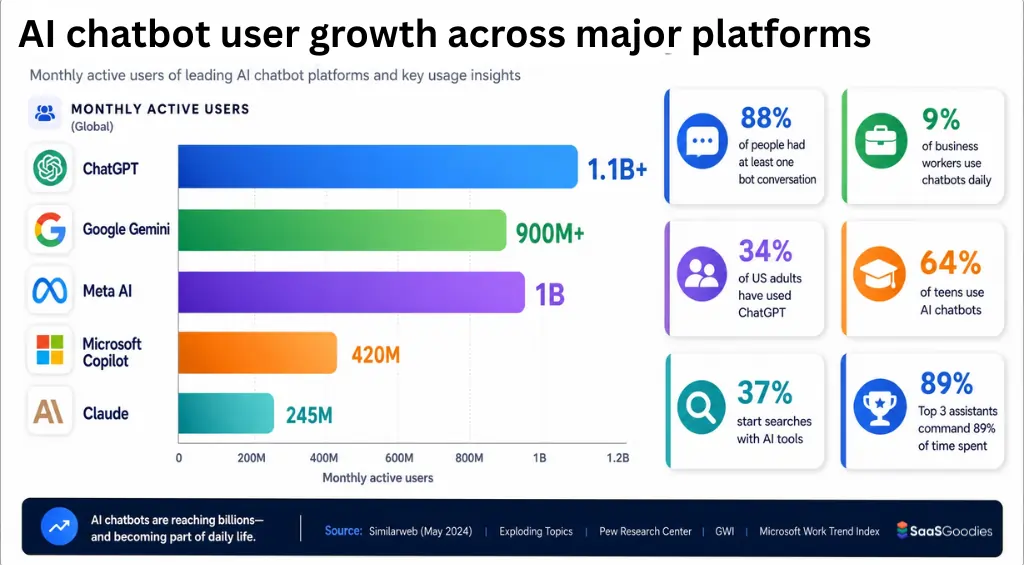
The consumer assistants tell the clearest story. ChatGPT crossed 1.1 billion monthly users, the fastest app in history to get there. Google Gemini hit over 900 million monthly app users. Meta AI reports around a billion across its apps.
On the business side, adoption looks slightly different. Roughly 88% of people have had at least one bot conversation in the past year. Yet only about 9% of business workers use chatbots daily.
That gap is the whole game. Consumer comfort is baked in. Business deployment has not caught up.
Here is how usage splits across the headline platforms in 2026.
A quick note on comparing these. Weekly and monthly counts are not the same yardstick. OpenAI reports weekly actives. Google reports monthly. Treat cross-platform league tables with a pinch of salt.
There is a deeper usage signal too. Hours spent on AI apps roughly doubled year on year, and the top three assistants command about 89% of that time. People are not just signing up. They are living in these tools.
Demographics are shifting fast as well. Around 34% of US adults have used ChatGPT, roughly double the 2023 share. Among teens, about 64% now use AI chatbots. The under-25 crowd treats bots as a default, not a novelty.
Search behaviour is moving too. Around 37% of consumers say they now start some searches with an AI tool instead of a traditional engine. That number was rounding-error small two years ago.
Our Estimate: based on the growth curves we have watched all year, total unique AI chatbot users likely pass 1.3 billion monthly before 2026 closes. Distribution deals are the fuel.
The Platform Shakeup: ChatGPT's Slipping Crown
This is the biggest storyline of the year, and it is not about growth. It is about who owns the market.
ChatGPT's share of global assistant users fell below 50% for the first time since launch, dropping to around 46% by late May 2026. Rewind twelve months and it sat near 87%.
On web-visit share specifically, ChatGPT holds roughly 54% worldwide, down from 79% a year earlier. Its visit count stayed flat while rivals grabbed all the new growth.
Gemini is the obvious winner. Worldwide web-visit share climbed to about 28%, up from under 9% a year ago. That is roughly 450% year-on-year growth.
Claude posted the fastest growth in the set, up around 855% year-on-year to reach 9% of web visits. Grok, Perplexity, and DeepSeek split the rest.
| Assistant | Worldwide Web Share (2026) | Year-on-Year Move |
|---|---|---|
| ChatGPT | 53.9% | Down from 79% |
| Google Gemini | 27.9% | Up around 450% |
| Claude | 9.2% | Up around 855% |
| DeepSeek | 4.1% | New entrant surge |
| Grok | 2.4% | Slight decline |
| Perplexity | 1.3% | Slight decline |
| Microsoft Copilot | 1.3% | Flat on web |
One deal reshapes everything. Apple picked Gemini to power a rebuilt Siri, worth around $1 billion a year. That puts Gemini in front of billions of devices across Android and iPhone.
Chatbot ROI Stats: What The Money Comes Back As
Now the part your CFO cares about. The ROI numbers are strong, but they hide a split.
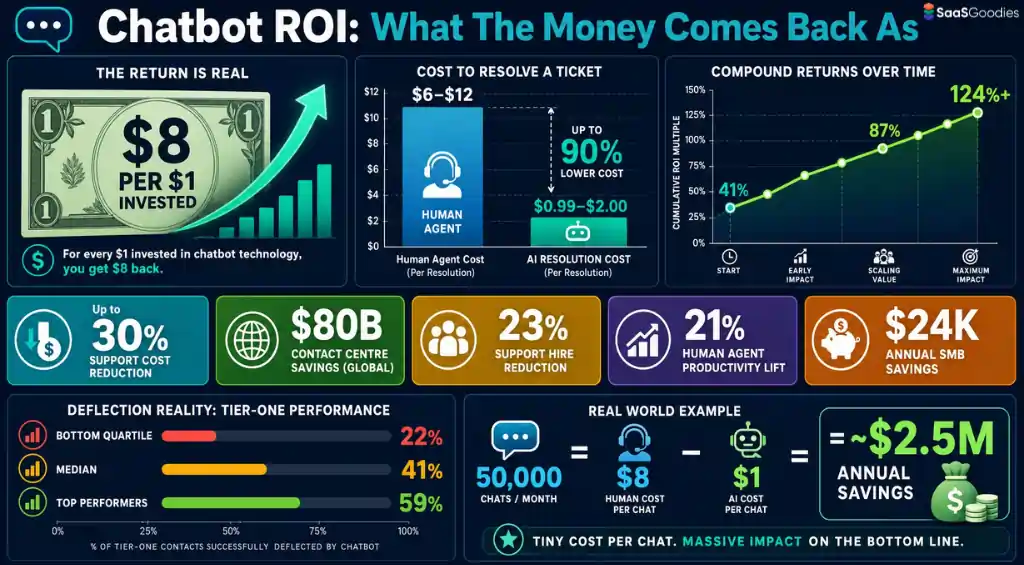
Businesses report an average return of $8 for every $1 invested over twelve months. ROI ranges from 148% to 200% depending on how well the bot is built.
The returns compound. First-year returns average around 41%, climbing to 87% by year two and past 124% by year three as the system learns your product.
The cost gap drives all of it. A human agent interaction runs $6 to $12. An AI resolution costs $0.99 to $2.00. When a bot actually closes a ticket, the per-ticket economics do not improve a little. They collapse.
One documented case pushed automation to 89%, cut cost per ticket from $5.50 to $2.00, and dragged response times from hours to under a minute.
| ROI | Benchmark (2026) |
|---|---|
| Average return over 12 months | $8 per $1 spent |
| Year-one return | around 41% |
| Year-three return | 124%+ |
| Human agent cost per interaction | $6 to $12 |
| AI resolution cost | $0.99 to $2.00 |
| Contact centre savings (global, 2026) | $80 billion projected |
| Support cost reduction | Up to 30% |
Here is the catch nobody prints on the sales deck. The wins depend entirely on resolution, not deflection. A customer who gives up is not the same as a customer whose problem got solved.
Median tier-one deflection across enterprise programmes sits at about 41% in 2026. Top performers hit 59%. Bottom quartile scrape 22%.
The pricing model matters as much as the tech. A vendor charging per interaction bills you even when the bot fails. A vendor charging per outcome only bills when the problem gets solved. For a firm running 100,000 monthly chats, that choice can swing costs by over $1.5 million a year.
Run the maths on a real example. A company handles 50,000 chats a month at $8 per human interaction. Shift 60% to AI at roughly $1 each, and annual savings land near $2.5 million. That is not a rounding gain. That is a headcount decision.
There is a labour angle too. AI can trim support hires by around 23%. Half of companies say bots let them run leaner teams. Human agents also get a productivity lift of around 21% when bots handle the triage first.
SMBs win here more than people expect. Small firms save around $24,000 a year on average through automation. The no-code tools that used to need six-figure budgets now cost a flat monthly fee.
SaaSGoodies Take: measure resolution, or the $8 figure is a fantasy. We have seen too many teams celebrate a “deflection” that was just a frustrated customer rage-quitting the chat. Track outcomes, not exits.
Chatbot Statistics By Industry: Who Deploys Where
Adoption is not even across sectors. Some moved first. Others earn the most.
Tech and media lead on adoption at 69%. Retail and ecommerce hold the largest market slice at roughly 21 to 30%, depending on the report.
Customer support remains the top use case across every industry, at about 42% of chatbot revenue. That makes sense. Password resets and shipping timelines are the predictable, high-volume stuff bots eat for breakfast.
Banking has gone deep. Around 88 to 92% of North American Tier 1 banks now run bots. Banks using digital assistants report up to 25% revenue lifts.
Healthcare is stricter but growing fastest. About 68% of healthcare firms use AI and bots in operations. Voice AI alone is projected to save the US healthcare economy $150 billion in 2026.
| Industry | Adoption / Share (2026) | Standout Stat |
|---|---|---|
| Tech and media | 69% adoption | Highest adoption rate |
| Retail and ecommerce | 21 to 30% market share | Largest vertical |
| Banking (NA Tier 1) | 88 to 92% use bots | Up to 25% revenue lift |
| Healthcare | 68% adoption | $150bn US savings potential |
| Financial services | 72% deploy for inquiries | Legacy integration a hurdle |
| Insurance | 83% customer satisfaction | Bots handle around 80% inbound |
Ecommerce deserves a callout. Bots lift conversions by up to 30%, and proactive chat can trigger a 40% conversion bump. Around 71% of Gen Z shoppers use bots to find products before they buy.
How People Actually Feel About Talking To Bots
The sentiment data is messier than vendors admit. People like speed. They still want a human on standby.
Around 82% of customers would rather use a bot than wait in a queue. About 62% prefer a bot over waiting for a human agent. Speed wins for simple stuff.
But 79% of Americans still say they prefer a human overall. And 89% want a human option always available. Both things are true at once.
Satisfaction hinges on one factor: did the bot solve it? When a bot resolves an issue in seconds, people are happy. When it cannot and hands off badly, satisfaction craters.
The friction point is the handoff. The single most enraging support moment in 2026 is a customer who knows they need a person and cannot find the door.
Performance Benchmarks: Speed, Resolution, And Handoffs
Let us get specific on what “good” looks like in 2026.
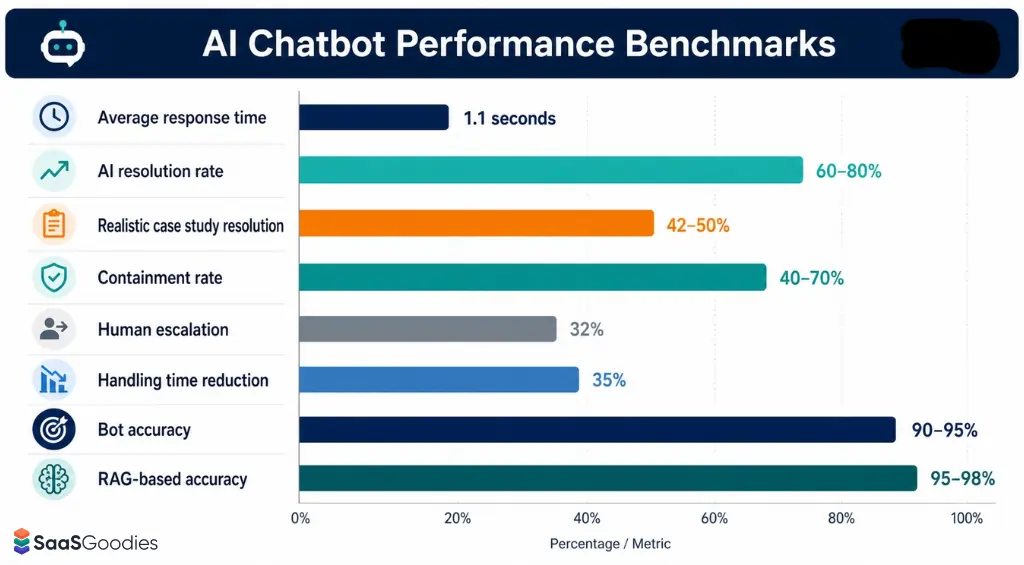
Average bot response time is about 1.1 seconds. High performers resolve cases in under 60 seconds. Businesses see a 35% cut in average handling time.
Resolution rates vary a lot by bot type. AI bots resolve 60 to 80% of conversations without a handoff. Rule-based bots trail badly, which is why firms keep retiring them.
One leading support agent reports a 76% average resolution rate, though real-world case studies often land in the 42 to 50% range. The honest range matters more than the vendor headline.
| Performance Metric | Target / Benchmark |
|---|---|
| Average response time | around 1.1 seconds |
| AI bot resolution rate | 60 to 80% |
| Realistic resolution (case studies) | 42 to 50% |
| Containment / deflection rate | 40 to 70% |
| Escalation to human | around 32% average |
| Handling time reduction | 35% |
| Well-trained bot accuracy | 90 to 95% |
Accuracy jumped this year thanks to grounding. RAG-based bots pull from your own knowledge base first, then answer, hitting 95 to 98% accuracy with near-zero hallucination in enterprise builds.
Voice And Agentic Bots: Where The Next Wave Lands
Text bots are old news. The action moved to voice and agents.
Voice AI is growing nearly twice as fast as the text-chatbot market, at roughly 35% a year versus 20%. The voice-agent market is set to run from $2.4 billion in 2024 to $47.5 billion by 2034.
Around half of consumers have already used a voice AI. Production voice AI grew 340% in 2025. Funding jumped from $315 million in 2022 to $2.1 billion in 2024.
Agentic bots are the bigger shift. These do not just answer. They act, processing refunds, updating accounts, and running multi-step workflows on their own.
The move from “chatbot as information layer” to “agent that completes work” is the real 2026 story. A bot that reschedules your delivery beats a bot that tells you how to reschedule it.
Regional Chatbot Data: Where Growth Concentrates
Geography still shapes adoption. North America leads. Asia-Pacific grows fastest.
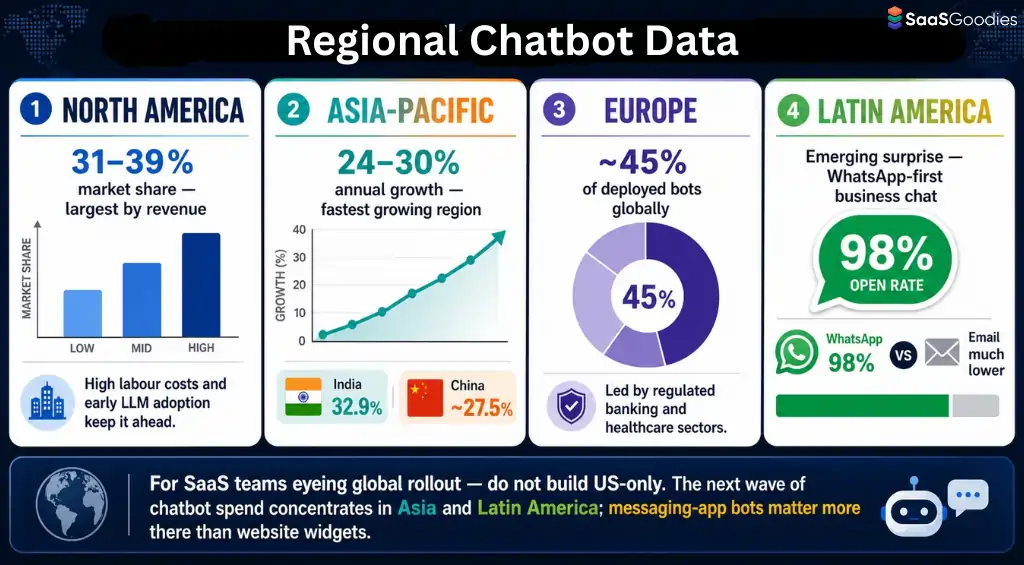
North America holds roughly 31 to 39% of the global market, depending on the firm. High labour costs and early LLM adoption keep it ahead.
Asia-Pacific is the fastest-growing region, expected to grow around 24 to 30% a year. India, China, and Japan drive it. India alone is forecast at a 32.9% growth rate through 2034.
Europe leads on sheer number of deployed bots, near 45% globally, with strong pull from regulated banking and healthcare.
Latin America is the sleeper. WhatsApp-first business communication drives adoption there, and WhatsApp messages carry a 98% open rate. Compare that to email, and the gap is not close.
India stands out even inside Asia-Pacific. The country is forecast at a 32.9% growth rate through 2034, the highest of any major market. China follows at around 27.5%.
Chatbots As Sales And Marketing Engines
Support gets the headlines. But the money story is moving toward sales.
Bots are not just deflecting tickets anymore. They qualify leads, nurture prospects, and recover carts. Around 58% of firms using bots report increased sales.
The conversion data is strong. Bot-led funnels convert around 2.4 times higher than traditional web forms. Proactive bots lift website conversions by up to 38%. Conversational upsells add roughly 14% revenue on average.
Lead generation is where SaaS teams see the fastest payback. Bots produce 20 to 35% more leads and cut first-response time by up to 90%. A faster first reply is the mechanism behind most of that lift.
Channel choice shapes results. WhatsApp is the number one platform for business bots, with a 98% message open rate. SMS bots open around 36% higher than email.
SaaSGoodies Insight: If you only use your bot for support, you are leaving revenue on the table. The lead-to-meeting conversion range runs from 15% at the low end to 52% at the high end. The difference is configuration, not the model. Point it at your funnel.
The Real Problems Nobody Puts On The Sales Deck
We would be lazy analysts if we only sold you the upside. The failure data is just as instructive.
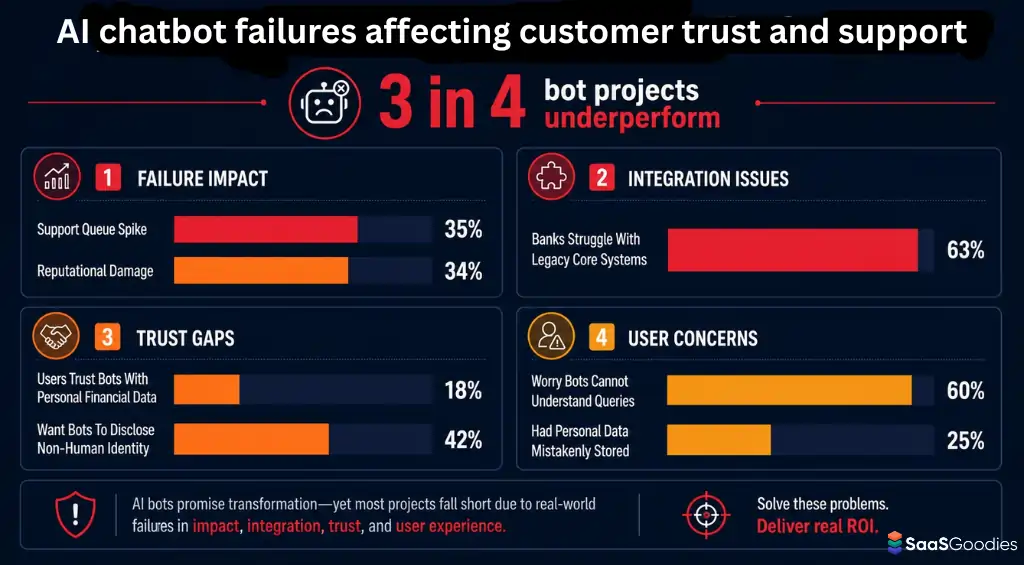
Three in four bot projects underperform, and the failures are loud. When a support bot breaks, it breaks in front of an already-annoyed customer.
Ask firms what happens when their AI agent fails, and two answers dominate. A spike in the support queue hits around 35% of them. Reputational damage to the brand hits around 34%.
Integration is the quiet killer. About 63% of banks report trouble connecting bots to legacy core systems. Old infrastructure and new AI do not shake hands easily.
Trust gaps linger too. Only around 18% of users trust bots with personal financial information. About 42% think bots should always disclose they are not human.
FAQs About Chatbot Market in 2026
How big is the chatbot market in 2026?
The global chatbot market is worth roughly $11.8 billion in 2026, up from $9.6 billion in 2025. Forecasts put it near $41 billion by 2033.
How many people use chatbots in 2026?
More than a billion people use AI chatbots each month. ChatGPT alone passed 1.1 billion monthly users, with Gemini and Meta AI close behind.
What is the ROI of a chatbot in 2026?
Businesses report about $8 back for every $1 spent over twelve months. Returns compound from roughly 41% in year one to over 124% by year three.
Which chatbot is most popular in 2026?
ChatGPT still leads but dropped below 50% of global assistant users for the first time. Gemini surged to second, and Claude grew fastest.
How much of customer support can chatbots handle?
Well-built AI bots resolve 60 to 80% of routine questions on their own. The rest should route cleanly to a human.
Are chatbots replacing human agents?
No. The 2026 model is an 80/20 split. Bots handle routine volume, humans take complex and emotional cases. Hybrid setups score highest on satisfaction.
What We Think Happens Next
Time for our read, based on years watching this space.
First, consolidation and splintering at once. The top two, ChatGPT and Gemini, hold about 82% of measured web visits. Yet the challengers took all the growth. Both trends run together.
Second, the resolution reckoning. The $8-per-$1 ROI is real, but only for teams that measure resolution. We expect a wave of quiet bot shutdowns in 2026 from firms that optimised for the wrong metric.
Third, agentic everything. Bots that take actions will pull budget away from bots that only chat. The FAQ bot you launched in 2023 is already legacy.
SaaSGoodies take: the winners in 2026 are not the firms with the fanciest bot. They are the ones who point it at the boring, repetitive 70%, build a fast door to a human, and forbid guessing. Simple beats clever.
Sources
- Grand View Research, Chatbot Market Size Report
- Mordor Intelligence, Chatbot Market Report
- TechCrunch, ChatGPT Market Share (Sensor Tower data)
- Momentic, Top Generative AI Chatbots (Similarweb data)
- First Page Sage, Generative AI Chatbots by Market Share
- Fin AI, ROI of AI Customer Service Benchmarks
- Gartner, Conversational AI and Agentic AI Forecasts
- Zendesk, CX Trends
- Statista, Chatbots Market Data
- Pew Research Center, AI Adoption Data
- McKinsey, State of AI
- DemandSage, Chatbot Statistics