AI SaaS Statistics 2026: Market Size, Adoption, Growth & ROI

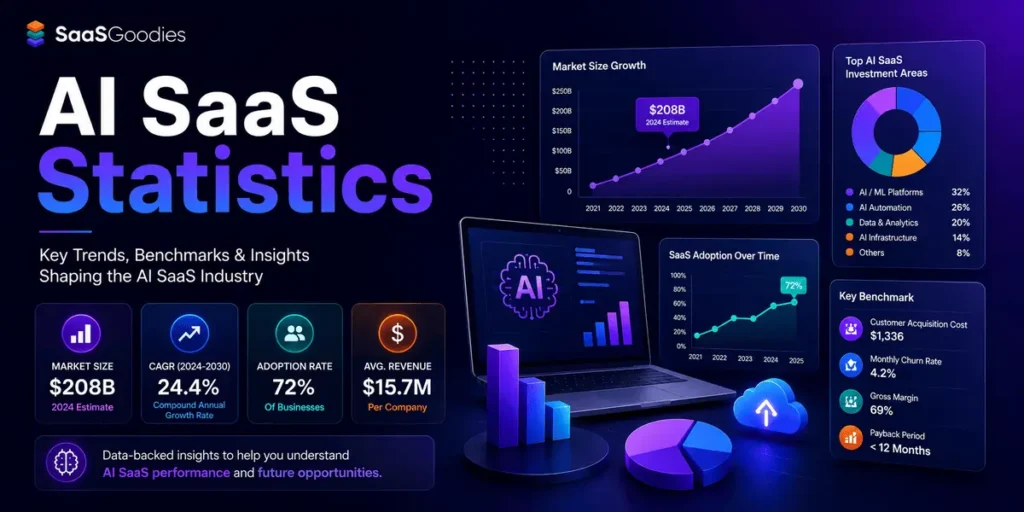
Quick answer: AI stopped being a SaaS side feature in 2026. It became the product. Almost 9 in 10 organisations now run AI in at least one workflow, and 92% of SaaS companies have shipped an AI feature or plan to soon.
The global SaaS market sits near $465 billion, while AI-built software races ahead at close to 39% a year. We run SaaSGoodies. We test tools daily and track this market for a living. These AI SaaS Statistics for 2026 are our own data study. No fluff, no recycled listicle, just the numbers that move money.
Here is the honest version. Most “AI SaaS” content online is a pile of stale figures copied from 2023. We built SaaSGoodies to fix that.
Our team sits across India, Dubai and Georgia, we buy and test software every week, and we publish data pages that other marketers cite.
So this is not a guess. It is what we see in real budgets, real invoices and real vendor moves. Grab a coffee. Let us walk through the money.
How Big is the AI SaaS Market in 2026?
The SaaS market did not slow down. It changed shape. Cash that once bought more apps now buys smarter ones.
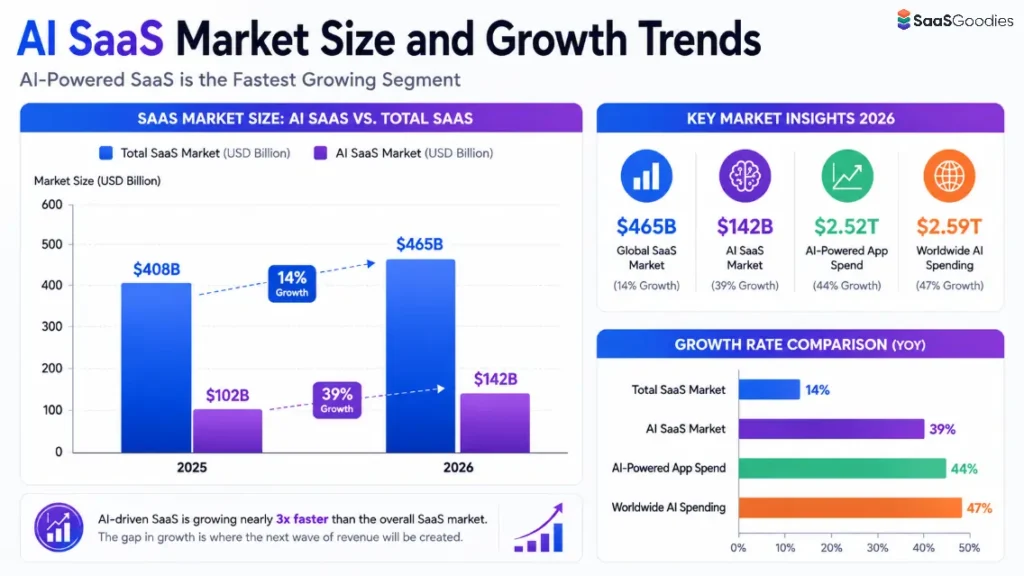
Here is where things stand this year:
The gap between plain SaaS and AI SaaS is the story. One grows in the teens. The other grows near 40%. That gap is where new revenue hides.
| Metric | 2025 | 2026 | Yearly growth read |
|---|---|---|---|
| Global SaaS market | $408B | $465B | about 14% |
| AI-built SaaS market | around $102B (our estimate) | $142B | close to 39% |
| AI-powered application spend | around $1.75T | $2.52T | 44% |
| Worldwide AI spending (all layers) | around $1.5T | $2.59T | about 47% |
| Global AI software revenue | $118.6B | around $165B (our call) | about 38% |
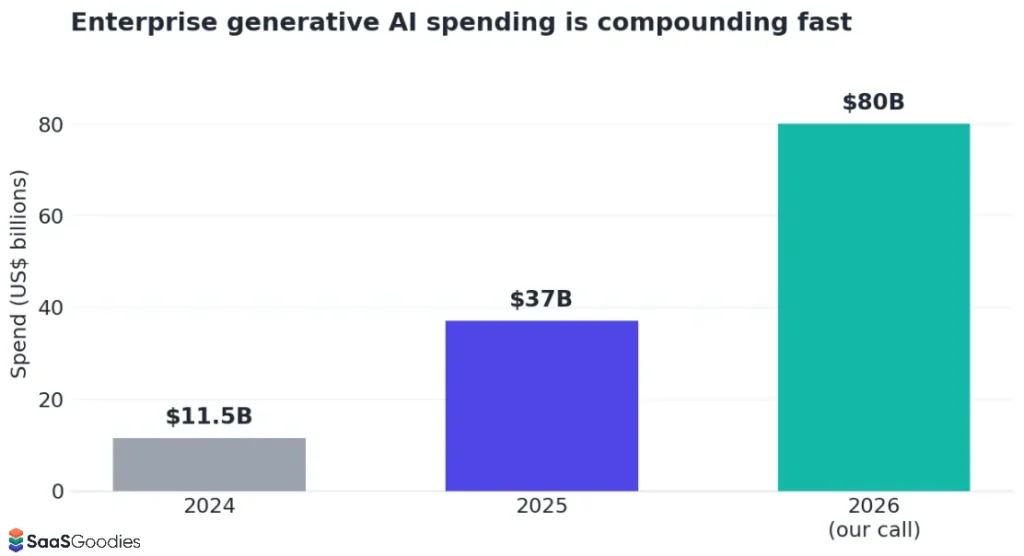
| Enterprise generative AI spend | $37B | around $80B (our call) | more than 100% |
SaaSGoodies take: Our call for the year is simple. AI-built SaaS clears $150 billion before 2027. The plain SaaS number matters less every quarter. What matters is how much of a vendor's revenue now rides on AI features. That share is the new health check we use when we rate a tool.
The Real Money Math Behind Generative AI Software Spending
Software spending alone tops $1.4 trillion in 2026. AI is the reason it keeps climbing.
Look at the growth split. General IT budgets crawl up by low single digits. Software spend rises near 15%. And spending on generative AI models grows about 81% in a single year. That is not a trend. That is a stampede.
One number stopped us cold. Generative AI software spending now makes up roughly 6% of the entire software market. It got there in three years. Cloud took a decade to reach that share.
The growth curve is steep too. Global AI software revenue climbed from $9.5 billion in 2018 to $118.6 billion in 2025. That is more than a twelvefold rise in seven years. The AI SaaS slice inside it grows near 38% a year through the early 2030s.
Enterprise spend on generative AI hit $37 billion in 2025. That was more than three times the 2024 figure. Our estimate for 2026 lands near $80 billion. Coding tools lead the pack, pulling the biggest single slice of enterprise use.
Key Insight: Here is our read. The money is moving from AI hardware toward AI application software. That second bucket is where SaaS founders and affiliates make a living. We expect application-layer AI to outpace raw model spend growth by 2027.
Who Actually Runs AI SaaS in 2026?
Short answer: almost everyone. The pilot phase is over.
Around 88% of organisations now use AI in at least one business function. Generative AI is live in 70% of companies. And 80% of large firms run apps with generative AI built in, up from under 5% a few years back.
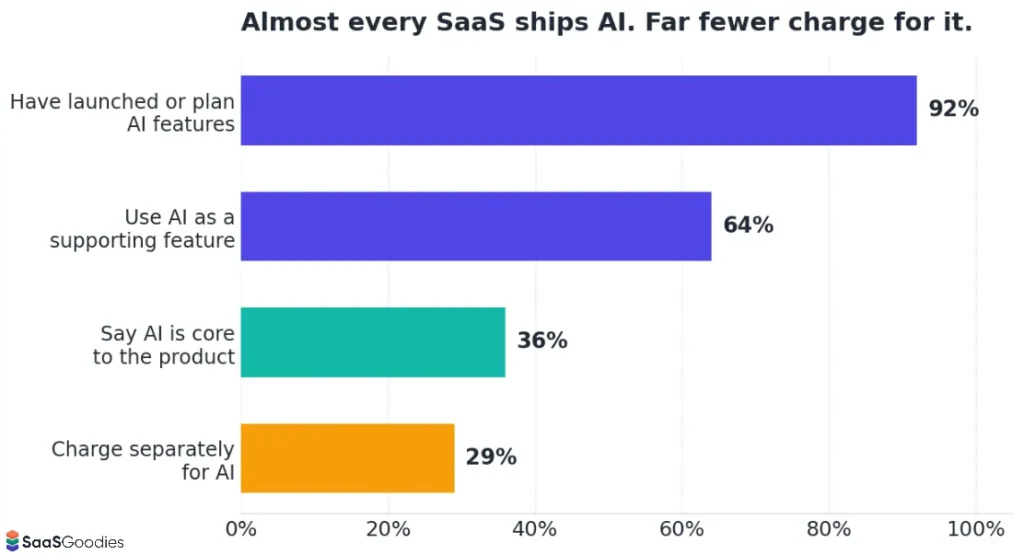
The vendor side tells the same story. Nearly 92% of SaaS companies have launched an AI feature or plan to. About 64% treat AI as a supporting feature. Only 36% say AI is core to the product. So AI-native applications are still the minority, even now.
One quiet number deserves your attention. Roughly 67% of workers use AI tools their company never approved. That shadow AI usage is a security and spend problem hiding in plain sight.
| Signal | 2026 reading | What it means for marketers |
|---|---|---|
| Orgs using AI in at least one function | 88% | AI is now table stakes |
| Companies with generative AI deployed | 70% | moved from pilot to daily use |
| Large firms running GenAI-enabled apps | 80% | up from under 5% not long ago |
| SaaS firms that shipped or plan AI features | 92% | almost nobody is opting out |
| SaaS firms with AI as a supporting feature | 64% | bolt-on is the common route |
| SaaS firms with AI core to the product | 36% | AI-native is still rare |
| CEOs raising AI budgets this year | 68% | spend keeps climbing |
| Workers using unsanctioned AI tools | 67% | a governance headache |
When we review a SaaS tool now, we ask one blunt question. Is the AI a real engine, or a chatbot bolted on the side?
Only 36% pass that test today. We expect that share to reach 50% by the end of 2026 as bolt-on features get rebuilt from the ground up.
Where AI Lands First Inside Your SaaS Stack
AI does not arrive everywhere at once. It lands in a few jobs first, then spreads out.
Coding is the clear front-runner. Developer tools pulled the single biggest slice of enterprise generative AI use, worth around $4 billion in 2025. That is more than five times the next department.
Here is the order we watch AI take hold across SaaS tools:
The pattern is boring on purpose. High volume, clear inputs, easy to measure. Those jobs convert first, and they pay back first. The flashy use cases come later, and they carry more risk.
Pick your AI SaaS niche where AI already earns its keep. Coding, support and marketing tools have the cleanest ROI story right now. We steer affiliates toward those before the unproven categories that look exciting but rarely convert.
The Pricing Shake-up: Seats Are Losing to Usage
This is the shift that hits your wallet. Old SaaS charged per seat. AI SaaS charges for what you burn.
The move has been fast. Some form of usage-based pricing models now sits inside close to 85% of SaaS firms. Back in 2019 that figure was around 30%. AI made the old flat fee impossible to hold.
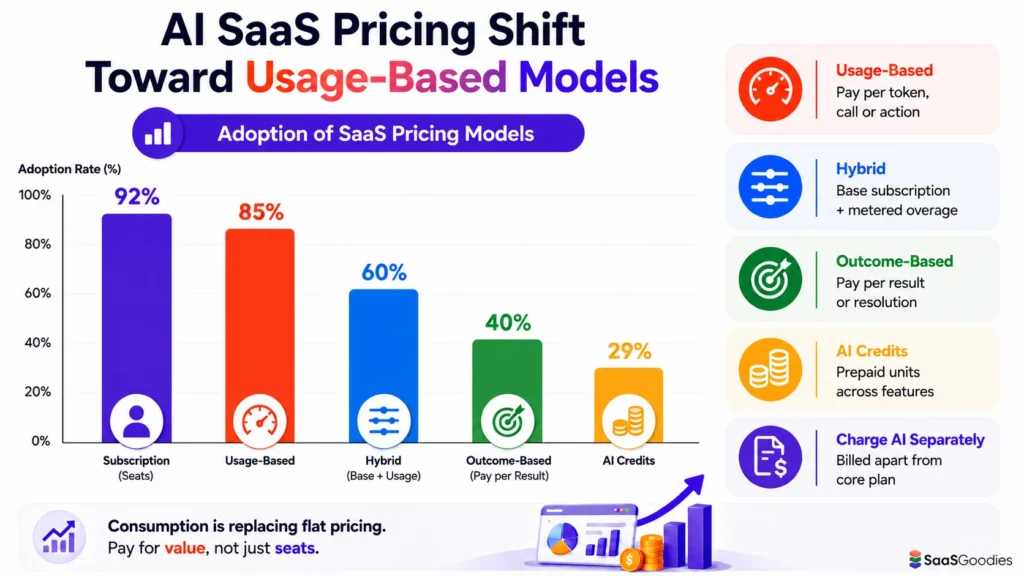
The maths is brutal. When a product runs on tokens and compute, a fixed $29 a month cannot absorb heavy use. So vendors repriced around consumption.
Today the default is the hybrid model. A base fee for predictability, plus metered use on top. More than 60% of AI SaaS companies now use some form of hybrid pricing models.
Then there is the new frontier: outcome-based pricing. You pay per result, not per login. A few live examples:
| Model | How it charges | 2026 adoption signal | Best fit |
|---|---|---|---|
| Subscription (seat-based) | flat fee per user | around 92% still use some subscription | collaboration tools |
| Usage-based | per token, call or action | close to 85% use a usage element | developer and AI APIs |
| Hybrid (base plus usage) | subscription with metered overage | more than 60% of AI SaaS default | most AI products |
| AI credits | prepaid units spent across features | around 29% adoption, grew 126% last year | multi-feature AI tools |
| Outcome-based | pay per result or resolution | 40% of enterprise SaaS to include it by 2026 | support and agents |
| Charge separately for AI | AI billed apart from the core plan | only 29% currently do it | a clear monetisation gap |
SaaSGoodies take: Two-thirds of AI-enabled vendors still give away the one feature buyers would happily pay for. That is money on the floor. Our forecast: separate AI billing climbs from 29% to around 45% by the end of 2026 as founders stop absorbing inference costs.
Big Vendor Pricing Moves You Should Know
The theory is neat. The vendor moves make it real. Early 2026 brought a wave of pricing changes from the biggest names.
Notice the pattern. Base fees hold or drop. Usage charges climb. That is the hybrid model playing out across the whole market at once.
Bill Shock is Real: The AI Cost Problem Nobody Warns You About
Here is the ugly side of consumption pricing. The invoice moves. A lot.
Around 78% of IT leaders got hit with surprise charges from AI or usage-based plans this year. And 90% of CIOs name cost forecasting as their hardest AI job.
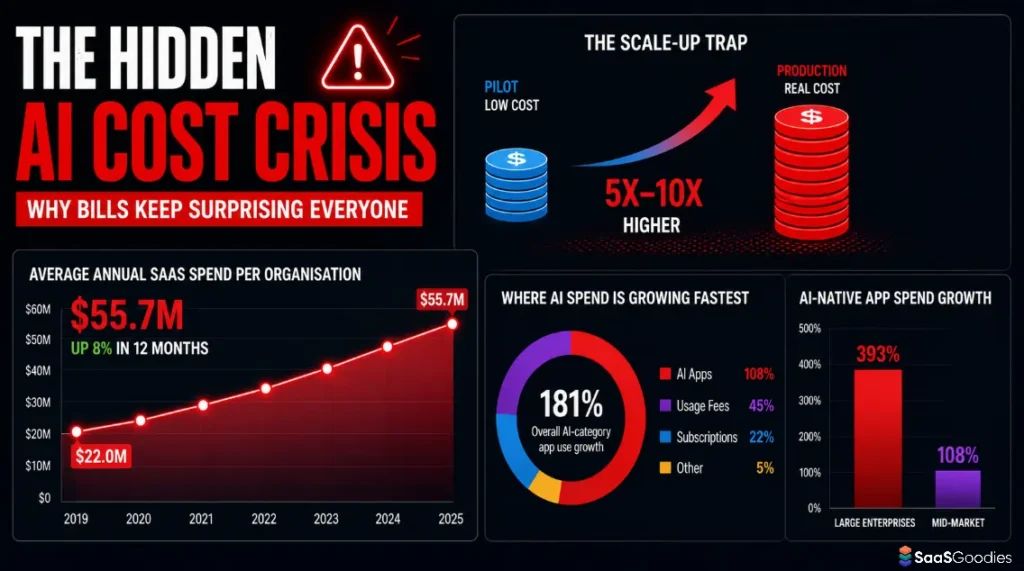
The scale-up trap is worse. Vendors hand out generous pilot credits. Then production use arrives, and real bills can run 5 to 10 times higher than the pilot suggested.
Spend data backs it up. The average organisation now pays around $55.7 million a year on SaaS, up 8% in twelve months. App counts stayed flat near 305. So the extra cost came from AI tiers and usage, not new tools.
| Signal | 2026 figure | Why it matters |
|---|---|---|
| Average annual SaaS spend per organisation | $55.7M | up 8% in a year |
| Apps in the average enterprise portfolio | 305 | count is flat, cost is not |
| Spend growth on AI-native apps | 108% | large enterprises jumped 393% |
| Growth in overall AI-category app use | 181% | fastest-rising line in the data |
| IT leaders hit by surprise AI or usage charges | 78% | bill shock is common |
| Firms that cut projects over unplanned SaaS costs | 61% | budgets are stretched thin |
| Orgs managing AI spend as a formal task | heading to 96% | cost tracking is now standard |
Key Insight: If you promote AI SaaS as an affiliate, sell the cost control angle. Buyers are scared of the bill, not the feature. Reviews that show real usage limits and pricing caps convert better. We have watched that pattern hold across our own review pages.
The Workforce Shift and The Shadow AI Problem
AI SaaS does not just change budgets. It changes how work gets done. These AI SaaS Statistics point to a shift, not a wipeout.
By 2027, close to 30% of older SaaS workflows get handled by AI-driven automation. Yet 76% of leaders agree AI will automate tasks, not erase whole roles. So the fear of mass job loss looks overblown for now.
The bigger near-term risk is control. By 2027, about 75% of employees are expected to buy or build tech without IT sign-off. That figure sat at 41% in 2022. The jump is steep.
Trust is split as well. Around 84% of IT leaders trust AI agents as much as humans for a given task. Only 31% of employees feel excited about it. That gap slows real rollouts.
Shadow AI is the sleeper story of the year. Staff adopt tools faster than IT can track them. Our call: governance and spend controls, not raw model power, become the top buying reason by 2027.
Agentic AI: The New Layer Living Inside Your Software
AI agents are the headline act of 2026. They do not just answer. They act.
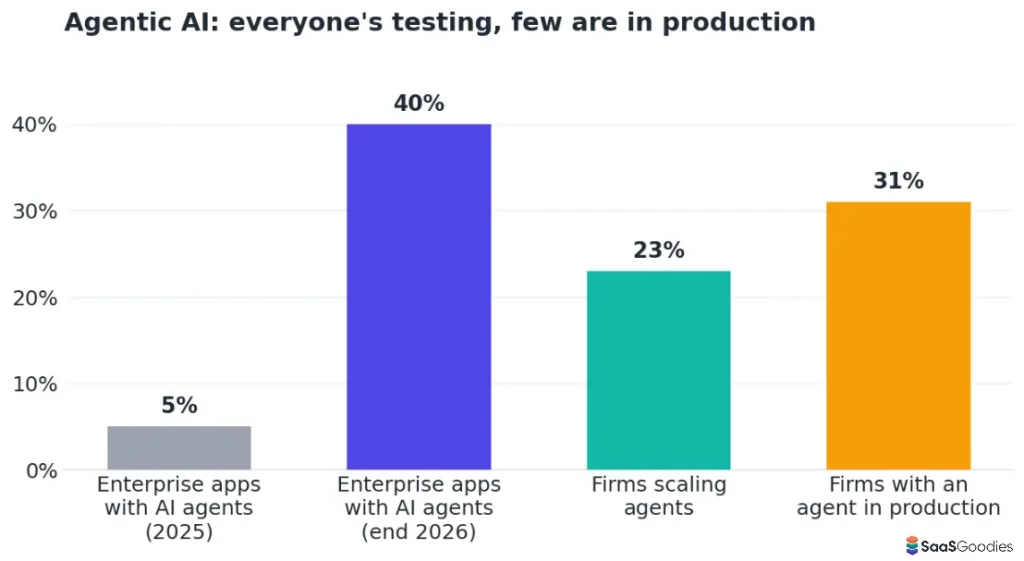
The pace of embedding is wild. About 40% of enterprise apps will carry task-specific AI agents by the end of 2026. That figure was under 5% in 2025. Few enterprise shifts have ever moved this fast.
The market for these agents sits near $9.9 billion this year, and it roughly doubles each year. Looking ahead, agents could drive close to 30% of enterprise application software revenue by 2035, worth more than $450 billion.
But agentic AI adoption hides a gap. Roughly 23% of firms are scaling agents. Only about 31% run even one agent in production. Banking and insurance lead, near 47%. Everyone else is still testing.
| Data point | 2026 figure | Direction |
|---|---|---|
| Enterprise apps with task-specific agents | 40% by end 2026 | up from under 5% in 2025 |
| Agentic AI market value | around $9.9B | roughly doubling each year |
| Firms scaling agents | 23% | most still in pilots |
| Firms with at least one agent in production | 31% | banking and insurance near 47% |
| Average agent ROI (global) | 171% | 192% in the US |
| Median payback on a working agent | 8.3 months | faster where use cases are narrow |
| Agentic projects expected to be cancelled by 2027 | more than 40% | unclear value is the killer |
| Active AI agents worldwide by 2029 | more than 1 billion | about 40 times 2025 levels |
SaaSGoodies Recommendation: Our warning for 2026. Do not chase every agent launch. More than 4 in 10 agent projects get scrapped by 2027. We rate agent tools on one thing: can they show a paid result, not a demo? That filter saves marketers from promoting vapourware.
Does AI SaaS Pay Off? The ROI Reality Check
Now the question every buyer asks. Is any of this worth it?
The honest answer: yes, but not for everyone. The return on AI investment splits the market in two.
On the bright side, generative AI returns about $3.7 for every $1 spent on average. Top adopters report up to 10x. Agent deployments that work return 171% globally and 192% in the US, with payback near 8 months.
Now the reality check. Only around 23% of firms report meaningful ROI from agents. Roughly a quarter say AI overall met their expected return. And a striking 88% of AI proofs-of-concept never reach production at all.
| Measure | Reading | Note |
|---|---|---|
| Average return per $1 on generative AI | 3.7x | top adopters hit 10x |
| Firms reporting significant ROI from agents | around 23% | real, but not universal |
| Firms reporting expected ROI from AI overall | around 25% | most under-deliver at first |
| Productivity gains cited by agent users | 66% | speed is the clearest win |
| Cost savings cited by agent users | 57% | second most common benefit |
| Proofs-of-concept that never reach production | 88% | the pilot graveyard is huge |
| Firms reporting AI adoption challenges | 79% | data and governance top the list |
The winners share one trait. They picked a narrow, boring, measurable workflow first. Ticket triage. Code review. Internal search.
Our estimate: firms that start narrow are three times more likely to see real ROI than those that try to boil the ocean.
Where The Money Flows: The AI Funding Wave
The capital story explains the pace. Investors poured record cash into AI in 2025.
Generative AI keeps taking share inside that pool. Its slice of AI software rises from about 37% in 2025 toward 47% by 2030.
Meanwhile SaaS valuation multiples sit about 60% below their 2021 peak. That pressure pushes founders to prove AI revenue fast, which is why pricing keeps changing under your feet.
That flood of money funds the features you now see inside every SaaS tool. When you read these AI SaaS Statistics, remember the growth is bankrolled years in advance.
What We Expect for the Rest of 2026
Here is our call, based on the numbers above and what we watch across the tools we test.
We have watched enough hype cycles to know the pattern. The tools that survive are the ones with real usage, clear pricing and proof of results. That is what we test for, and that is what these numbers reward.
FAQs about AI SaaS Statistics in 2026
What is the AI SaaS market worth in 2026?
AI-built SaaS sits around $142 billion in 2026, growing close to 39% a year. The wider SaaS market sits near $465 billion. Spending on AI-powered applications reaches about $2.52 trillion.
How many SaaS companies use AI in 2026?
Nearly 92% have shipped an AI feature or plan to. About 64% run AI as a supporting feature, and 36% say AI is core to the product.
Is usage-based pricing replacing subscriptions?
Not fully, but the shift is clear. Close to 85% of SaaS firms use some usage element, and more than 60% of AI SaaS run hybrid pricing that blends a base fee with metered use.
Does AI actually make SaaS more profitable?
For focused use cases, yes. Generative AI returns about $3.7 per $1 on average. But only around 23% of firms report significant ROI from agents, so results are uneven.
What share of enterprise apps will have AI agents in 2026?
Around 40% by the end of the year, up from under 5% in 2025. Yet only about 31% of firms run even one agent in production.
Why are AI SaaS bills so unpredictable?
Because AI charges for consumption, not seats. Around 78% of IT leaders faced surprise charges this year, and scaling from a pilot can multiply costs several times over.
The Bottom Line for Marketers
Strip away the noise and three things stay true this year. AI now sits inside almost every SaaS product. Pricing has moved from seats to usage. And returns are real, but only for teams that start small and measure hard.
That is the whole game. Sell the outcome, show the cost, prove the result. The numbers above reward exactly that approach, and so do we.
Come back next quarter and we will update every figure as the market moves.
- Gartner, Worldwide IT Spending Forecast
- BetterCloud, AI and the SaaS Industry
- BetterCloud, SaaS Statistics
- Zylo, SaaS Management Index
- Zylo, SaaS Statistics
- Coherent Market Insights, AI-Created SaaS Market
- The Business Research Company, AI SaaS Global Market Report
- Vention, State of AI
- Growth Unhinged, State of B2B Monetization
- Flexprice, Usage-Based Pricing
- Fungies, AI SaaS Pricing Models
- Benchmarkit B2B SaaS Benchmarks (via Development Corporate)
- First Page Sage, Agentic AI Adoption Statistics
- Unico Connect, Agentic AI Statistics
- Deloitte State of AI in the Enterprise (via Tech Insider)
- Hy.co, SaaS and AI Pricing Report
- Thunderbit, SaaS AI Tools Statistics