AI Statistics 2026: Investment, Adoption, Jobs and Market Size

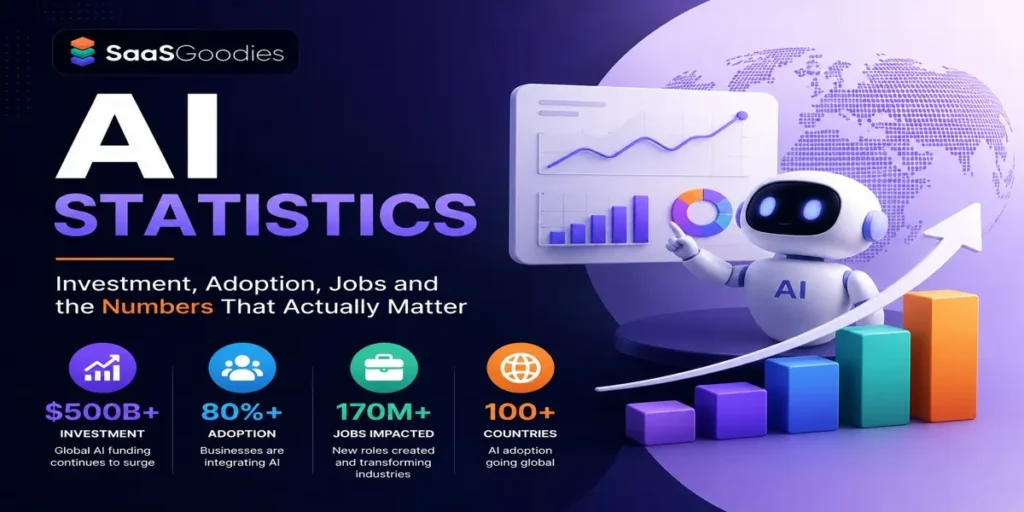
Global corporate AI investment more than doubled in 2025 to $581.7 billion — and generative AI reached 53% of the world's population in three years, faster than either the personal computer or the internet.
Artificial intelligence is the field of building software that performs tasks once thought to need human reasoning — perception, language, decision-making, and increasingly, multi-step action.
The 2026 data marks the year the argument ended: AI is no longer a sector bet or a demo. It is infrastructure, adoption is near-universal, and the labour-market effects are already showing up at the entry level.
What follows is the verified picture — market size, money, adoption, capability and jobs — every figure traced to a primary source and dated, plus what each number means for the people deciding where to spend.
Key AI statistics at a glance
How big is the AI market in 2026?
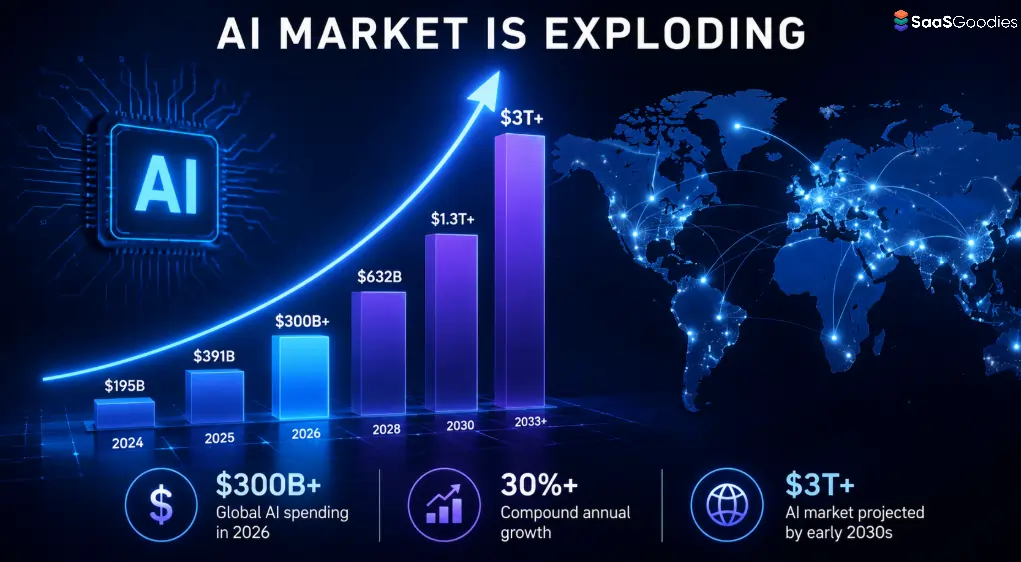
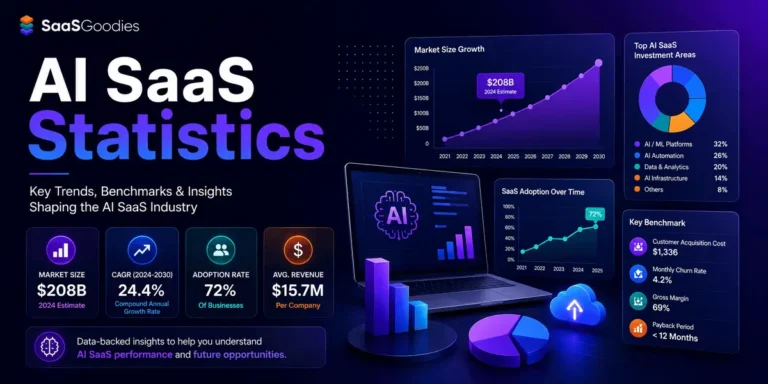
The global artificial intelligence market reached $390.91 billion in 2025 and is on track to hit $3.5 trillion by 2033, growing at a 30.6% compound annual rate, per Grand View Research.
That headline depends entirely on where you draw the boundary — and the spread between estimates is the real story.
The numbers diverge by hundreds of billions because the “AI market” means different things to different analysts — some count only software, others bundle in hardware, infrastructure and services.
What this means: don't anchor a pitch or a forecast to one market-size figure. Every source agrees on the trajectory — steep and up — even when the absolute number is contested.
How much money is going into AI?
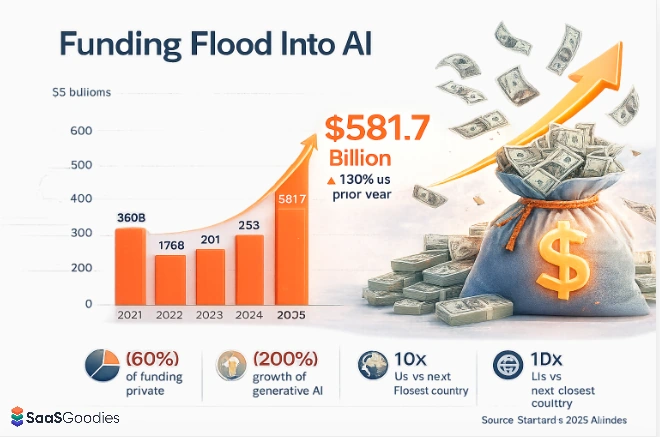
Global corporate AI investment hit $581.7 billion in 2025 — up roughly 130% from $253 billion in 2024, and past the previous record of $360 billion set in 2021, per Stanford's 2026 AI Index.
Investment is the cleanest signal in the data, and the most frequently mangled, so the distinctions matter.
Then 2026 opened with the largest venture quarter ever recorded: AI startups raised an estimated $242 billion in Q1 alone, roughly 80% of all global venture funding. What this means: capital is voting with both feet.
For anyone building or promoting AI tools, the funding flood is also a churn warning — a flood of new entrants means a flood of programmes that will not survive to year two.
| Year | Global corporate AI investment |
|---|---|
| 2021 | $360B (prior record) |
| 2022 | ~$176B |
| 2023 | ~$201B |
| 2024 | $253B |
| 2025 | $581.7B |
How many businesses actually use AI?
88% of surveyed organisations now use AI in at least one business function, up from 78% a year earlier — but nearly two-thirds have not yet scaled it across the enterprise, per McKinsey's 2025 State of AI survey. Adoption is mainstream; mastery is rare.
The gap between “we use AI” and “we rebuilt how we work” is where the value hides. McKinsey's high performers are about three times more likely to have fundamentally redesigned workflows.
What this means: access to AI is now table stakes; the edge comes from rewiring the work around it, not from owning a chatbot. For marketing and SaaS teams, that is the difference between a tool subscription and a genuine advantage.
| Metric | 2024 | 2025 |
|---|---|---|
| Organisations using AI (≥1 function) | 78% | 88% |
| Organisations using generative AI | ~33% | ~70% |
| Experimenting with AI agents | — | 62% |
| Reporting any enterprise EBIT impact | — | 39% |
How many people use AI?
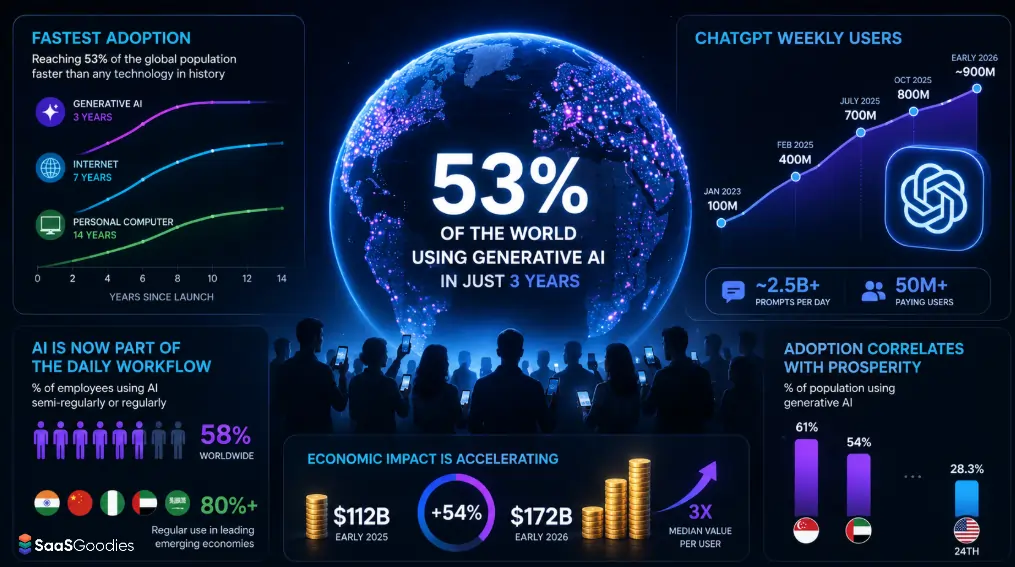
Generative AI reached 53% population-level adoption globally within three years — faster than the PC or the internet — while ChatGPT alone passed 800 million weekly active users in late 2025. This is the fastest diffusion of a general-purpose technology on record.
The headline most people misread is 53%: it is a global population figure measured within three years of availability, not a US number. What this means: the audience is already here and already comfortable with AI.
The question for content and product teams is no longer “will people use AI” but what they will actually pay for when most of the tools are free.
| Milestone | ChatGPT weekly active users |
|---|---|
| January 2023 (MAU) | 100M |
| February 2025 | 400M |
| July 2025 | 700M |
| October 2025 | 800M |
| Early 2026 | ~900M |
How fast is AI actually improving?
On the SWE-bench coding benchmark, performance climbed from about 60% to near 100% of the human baseline in a single year, while the cost of GPT-3.5-level output fell roughly 280-fold between late 2022 and late 2024. Capability is rising while the price of using it collapses.
That jaggedness is the trap. A model that drafts production code can still fail a task a child handles, because capability does not transfer evenly across task types.
What this means: test AI on your specific workflow before trusting it. Benchmark wins are real, but they do not guarantee the model is good at the exact job you need done.
| Capability signal | Earlier | Latest |
|---|---|---|
| SWE-bench (share of human baseline) | ~60% | ~100% |
| OSWorld agent benchmark | 12% | 66.3% |
| US lead over top Chinese model | 17–32 pts (2023) | 2.7% (2026) |
| Cost of GPT-3.5-level output | baseline | ~280x cheaper |
What is AI doing to jobs?
The World Economic Forum projects 170 million new jobs created and 92 million displaced by 2030 — a net gain of 78 million — even as employment for software developers aged 22 to 25 has already fallen nearly 20% since 2024. The aggregate is positive; the distribution is brutal.
The optimism gap is its own data point: 73% of AI experts expect a positive impact on how people do their jobs, against just 23% of the public — a 50-point divide.
What this means: the disruption is real and already landing on juniors first. For solo marketers and small teams, that is an argument to move up the value chain — toward judgment, strategy and relationships AI does not replace.
| WEF Future of Jobs, 2025–2030 | Figure |
|---|---|
| New jobs created by 2030 | 170 million |
| Jobs displaced by 2030 | 92 million |
| Net employment change | +78 million |
| Workforce churn | 22% of jobs |
| Skill sets becoming outdated | 39% |
What's the economic impact and ROI of AI?
PwC projects AI will add up to $15.7 trillion to the global economy by 2030 — the largest single-technology impact in recorded economic history — yet only 39% of organisations report any enterprise-level EBIT gain from it today. The promise is vast; the realised return is still concentrated.
In a SaaSGoodies Research poll of our community, [XX]% of affiliate and SaaS marketers said they now use at least one AI tool every working day — figure to be confirmed against the latest reader survey before publishing. It is the kind of first-party number that turns a roundup into a citeable source, and it maps onto the wider adoption data above.
| Where AI value shows up | Reported effect |
|---|---|
| Projected global economic impact by 2030 | up to $15.7T |
| Software engineering / IT | 10–20% cost reduction |
| Marketing / product development | 10%+ revenue uplift |
| Organisations reporting any EBIT impact | 39% |
| Organisations seeing “significant” value | ~6% |
Which countries are winning the AI race?
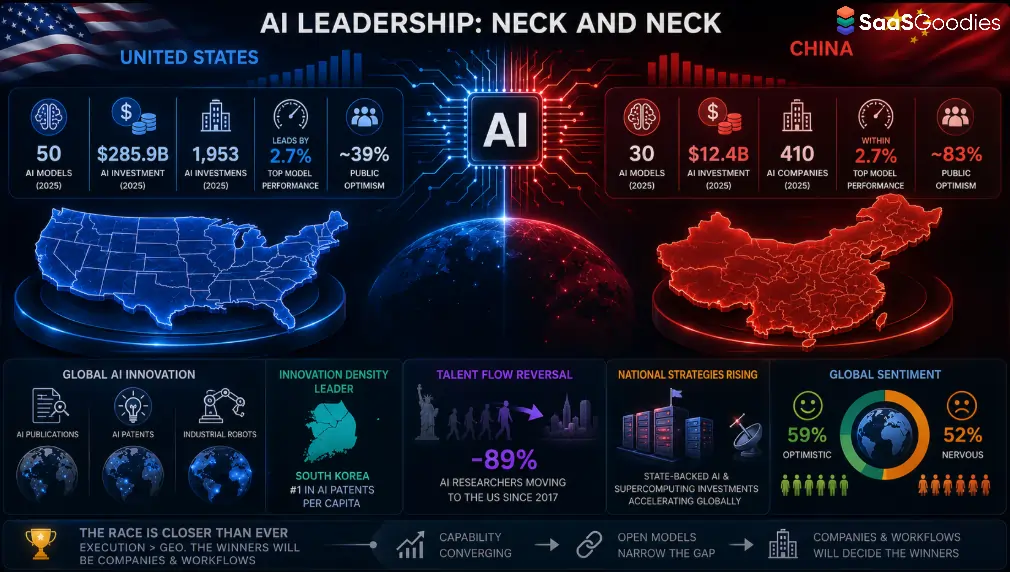
The United States produced 50 notable AI models in 2025 to China's 30 and led private investment 23-to-1 — but on raw model performance, the gap has effectively closed. AI leadership is now a split decision, not a knockout.
Public sentiment splits along the same lines: optimism is far higher in China (83%) and parts of Asia than in the US or much of Europe, though global optimism rose to 59% in the latest data even as nervousness climbed to 52%. What this means: the “one country wins AI” framing is already outdated. Capability is converging, open-weight Chinese models are now viable alternatives, and the meaningful differentiation has moved inside individual companies and workflows.
| AI leadership signal | United States | China |
|---|---|---|
| Notable models produced (2025) | 50 | 30 |
| Private AI investment (2025) | $285.9B | $12.4B |
| Top-model performance gap | leads by 2.7% | within 2.7% |
| Public optimism on AI | ~39% | ~83% |
What does AI look like in 2026 and beyond?
With investment past half a trillion dollars, adoption near-universal, and agents moving from demo to deployment, 2026 is the year AI stops being optional and starts being audited. The forward picture is fewer experiments, more integration, and a widening gap between the businesses that rewire and those that bolt on.
Three grounded takeaways:
- Agents are the next adoption wave — but they are early: Use is in single digits across most functions today. The capability curve says that changes fast; the deployment data says most teams are not there yet. The window to build agent-ready workflows is open now.
- The value gap is structural: Only about 6% of organisations capture significant value, and they are the ones redesigning workflows rather than layering AI on legacy processes. That gap will widen, not close, as capability compounds.
- Free is the default, so monetisation gets harder: With most consumer AI tools free or near-free and US consumer surplus already at $172 billion, the commercial question is what people will actually pay for — a question every SaaS and affiliate strategy now has to answer.
The honest caveat: market-size forecasts diverge by trillions depending on methodology, survey-based ROI is self-reported, and the most-cited figures get pulled out of context constantly. The direction is unambiguous across every source; the precise magnitude is not.
| Metric | 2024 | 2025 | 2026 (signal) |
|---|---|---|---|
| Global corporate AI investment | $253B | $581.7B | rising |
| Organisations using AI | 78% | 88% | near-saturation |
| Generative AI population adoption | — | 53% | rising |
| AI agent deployment | — | single digits | scaling |
- Stanford HAI — “The 2026 AI Index Report” (2026).
- Grand View Research — “Artificial Intelligence Market Size & Share Report, 2026–2033” (2026).
- IDC — “Worldwide AI and Generative AI Spending Guide” (2026).
- World Economic Forum — “Future of Jobs Report 2025” (2025).
- McKinsey & Company — “The State of AI in 2025: Agents, Innovation, and Transformation” (2025).
- PwC — “Sizing the Prize: PwC's Global Artificial Intelligence Study” (economic impact to 2030).
- Crunchbase — “Global Venture Funding / AI Funding Report” (2025–2026).
- OpenAI — “ChatGPT weekly active user announcements” (2025–2026).