
WordPress Statistics 2026: Market Share, Plugins, & Security

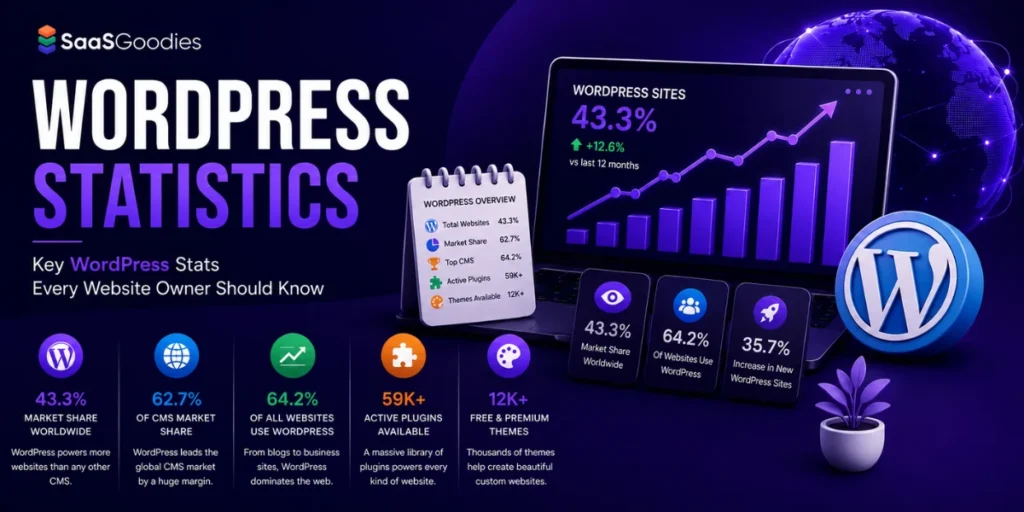
WordPress still runs the web in 2026, powering roughly 42% of all websites and about 60% of every site built on a known CMS. That is nearly nine times its closest rival.
But here is the twist we have been tracking all year: growth has stalled, and share has slipped from its 2025 peak.
Plugins remain both the superpower and the soft spot, with 11,334 fresh vulnerabilities logged last year.
Below we break down the latest WordPress market share statistics, plugin data, security numbers, and our own read on where this platform heads next.
Why We Wrote This (And Why You Can Trust the WordPress Numbers)
We build on WordPress every single day. Our free tools run on it. Our client sites run on it. We have cleaned up hacked installs, chased plugin conflicts, and shaved seconds off bloated page loads more times than we can count.
So when we pull together WordPress Statistics for 2026, we are not copy-pasting a press release. We cross-checked W3Techs, HTTP Archive, Patchstack, BuiltWith, and NetCraft. Then we filtered out the noise.
You will notice sources disagree. A lot. One says 33%, another says 43%. We explain why below, so you know exactly what each number counts.
No fake stats. No rounding tricks. Just what the data says, plus what we think it means for you.
WordPress Market Share 2026: Still King, But the Crown Slipped
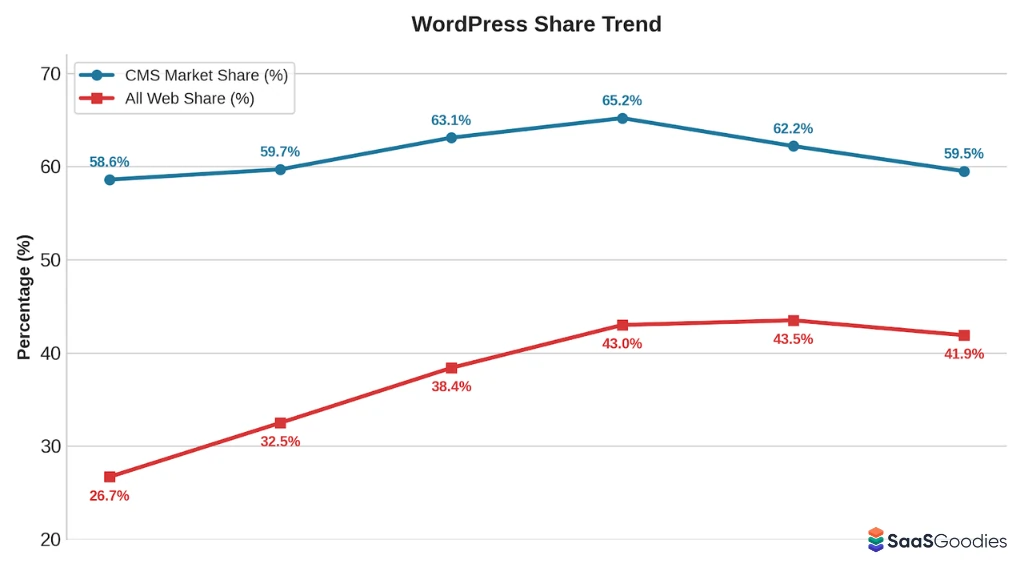
Roughly 42% of the entire internet runs on WordPress in 2026. That covers blogs, shops, news sites, and enterprise portals alike.
Among sites using a detectable CMS, WordPress holds close to 60%. More than every other platform combined. Shopify sits a distant second, near 5%, with Wix trailing around 4.3%.
Here is the part most roundups skip. WordPress peaked at about 43.6% in mid-2025. Since December 2025 the decline sped up, landing near 41.9% by mid-2026. Five straight quarters of small dips, then a sharper drop.
We are not calling this a collapse. We are calling it a plateau with a hairline crack.
| Year | Share of All Sites | Share of CMS Market | What Happened |
|---|---|---|---|
| 2016 | 26.7% | 58.6% | REST API era begins |
| 2018 | 32.5% | 59.7% | Gutenberg editor launches |
| 2020 | 38.4% | 63.1% | Covid pushes everyone online |
| 2022 | 43.0% | 65.2% | Peak CMS dominance |
| 2024 | 43.5% | 62.2% | Growth flattens |
| 2026 | 41.9% | 59.5% | First real dip in 20 years |
Why the wobble? Three forces stacked up. All-in-one builders like Wix and Squarespace got faster. AI site generators arrived. And the 2024 WordPress-WP Engine dispute spooked a chunk of the community.
SaaSGoodies Insight: A 1.6-point drop after two decades of climbing is not a death spiral. It is market saturation. Almost every site that suited WordPress already picked it. The growth now comes from emerging markets and stealing users off rivals, not converting the CMS-free web. We expect share to settle between 40% and 42% through the rest of 2026, not crater.
How Many Websites Use WordPress? The Honest Answer
This is where numbers get slippery. You will see “600 million sites” and “37 million sites” in the same week. Both can be right.
Here is the split:
We lean on the active-site figure when advising clients. Parked domains do not buy plugins or need security hardening. Live sites do.
One stat that never gets old: in 2021 WordPress became more common than “no CMS” for the first time ever. Before that, hand-coded sites outnumbered any single platform. WordPress flipped that script.
WordPress at the Top: Enterprise and Country Adoption
WordPress does not just win on volume. It wins at the top of the traffic pyramid too.
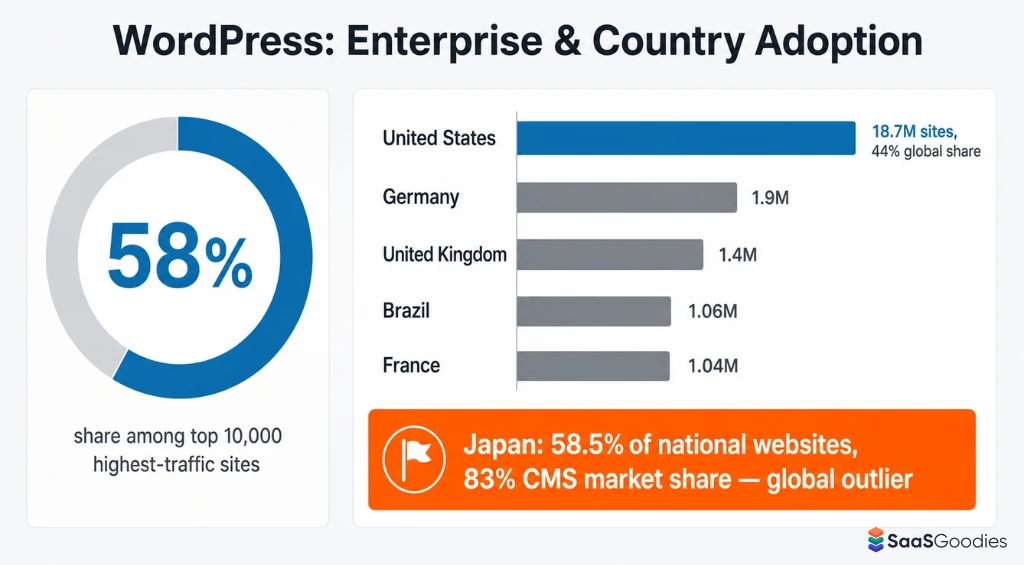
Among the 10,000 highest-traffic sites, WordPress accounts for roughly 58% of CMS usage. Wix and Shopify are almost invisible at that level. Names running WordPress include the White House, BBC, Sony, TechCrunch, and Bloomberg.
Country adoption tells its own story:
| Country | WordPress Sites | Notes |
|---|---|---|
| United States | around 18.7 million | 44% of all live WP sites |
| Germany | around 1.9 million | Strong SME base |
| United Kingdom | around 1.4 million | Steady, mature market |
| Brazil | around 1.06 million | Fast-growing region |
| France | around 1.04 million | Consistent adoption |
| Japan | 58.5% of all JP sites | 83% CMS share nationally |
Japan is the outlier worth staring at. WordPress powers 58.5% of every Japanese website and holds an 83% CMS share there. Way above the global average.
Search interest is loudest in Pakistan, Bangladesh, and Kenya. That signals where the next wave of new installs comes from. Non-English installs now outnumber English ones, across 208 locales.
WordPress Content Output: The Web's Biggest Publishing Engine
WordPress does not just host sites. It publishes content at a scale nothing else touches.
Users push out roughly 70 million new posts every month. That works out to more than 2.3 million posts a day. On top of that, WordPress.com users leave around 77 million comments monthly.
Worldwide searches for “WordPress” average about 16 million a month. That is a lot of people looking to build, fix, or learn the platform.
Some user habits worth knowing:
The user base skews toward the 25 to 44 age bracket, which makes up more than half of all users. The fastest-growing slice is 18 to 24 year olds, pulled in by the creator economy and no-code building.
WordPress Plugin Statistics 2026: The Ecosystem Nobody Can Match
Plugins are why WordPress wins. Full stop.
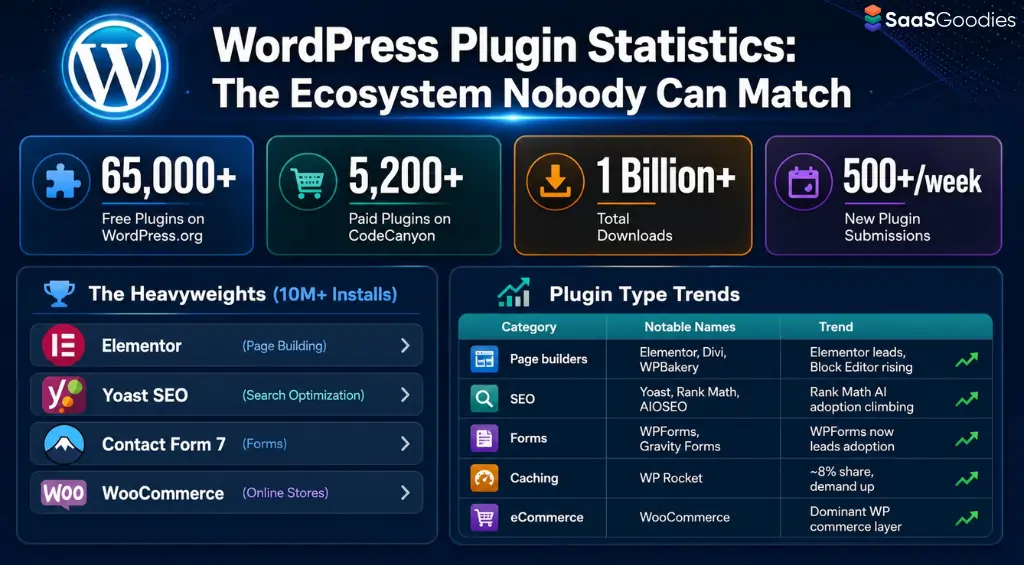
The official WordPress.org directory now lists more than 65,000 free plugins. CodeCanyon adds over 5,200 paid ones. Toss in independent shops and the real total clears 70,000, with some counts pushing past 75,000.
Total downloads crossed a billion long ago. And submissions are accelerating. The plugins team reported new submissions nearly doubled in 2025, running above 500 per week by early 2026.
The heavyweights each pass 10 million active installs:
Page builder trends are shifting under our feet. The native Block Editor keeps gaining ground while older third-party builders slowly bleed share.
| Plugin Type | Notable Names | Trend in 2026 |
|---|---|---|
| Page builders | Elementor, Divi, WPBakery | Elementor leads, Block Editor rising |
| SEO | Yoast, Rank Math, AIOSEO | Rank Math AI adoption climbing |
| Forms | WPForms, Gravity Forms | WPForms now leads adoption |
| Caching | WP Rocket | around 8% share, performance demand up |
| eCommerce | WooCommerce | Dominant WP commerce layer |
WordPress Security Statistics 2026: The Scary Part
We will be blunt. 2026 is the worst year on record for WordPress vulnerabilities. Not close to the worst. The worst, by a wide margin.
Patchstack logged 11,334 new vulnerabilities across the ecosystem in 2025. That is a 42% jump on the prior year's 7,966.
Here is the number that should reset how you think about security:
The weighted median time from public disclosure to mass exploitation was five hours.
Five hours. Your monthly “I'll update when I remember” habit does not survive that math.
More gut-punch data points:
Cross-site scripting stays the top vulnerability type at nearly 48% of all cases. And 43% of flaws can be exploited without any login at all.
| Security Metric | 2024 | 2025 | Change |
|---|---|---|---|
| New vulnerabilities | 7,966 | 11,334 | +42% |
| Highly exploitable flaws | Baseline | +113% | More than doubled |
| Flaws in plugins | around 96% | 91% | Still the core problem |
| Vulnerabilities in WP core | Handful | 6 | Core stays solid |
| Median time to exploit | Longer | 5 hours | Attackers got faster |
The 2026 wrinkle is nastier than raw counts. Attackers stopped just hunting weak plugins. They started buying or hijacking legitimate ones, then pushing malicious updates. In April 2026 more than 25 plugins were pulled from the repo in a single day after a supply-chain attack.
That breaks the old advice. “Keep everything updated” does not help when the update itself is the attack.
WordPress Performance in 2026: The Quiet Weak Spot
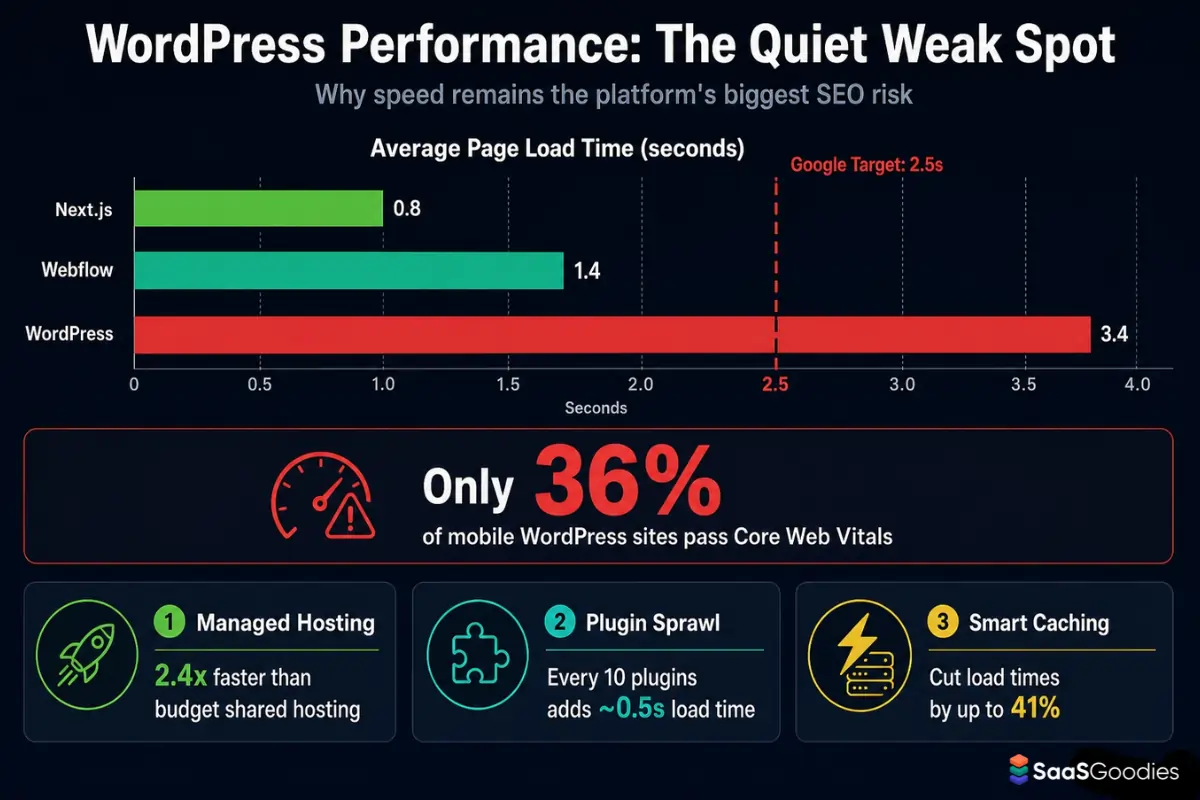
Speed is where WordPress keeps losing head-to-head evaluations. And it directly hits your rankings.
The average WordPress page loads in about 3.4 seconds. Google wants under 2.5 seconds for Core Web Vitals. Modern stacks like Next.js average 0.8 seconds. Webflow lands near 1.4.
Only about 36% of mobile WordPress sites pass Core Web Vitals. That is a rough number for a platform that lives and dies on SEO traffic.
What actually moves the needle, based on the data and our own client work:
WooCommerce Statistics 2026: WordPress Runs Online Shops Too
WooCommerce turns WordPress into a full shop, and it dominates open-source commerce.
It powers around 33% of all online stores worldwide and sits on roughly 8% of every website on the internet. That makes it the most-used eCommerce platform by store count.
The scale is genuinely wild:
Shopify leads in hosted GMV among dedicated platforms, but WooCommerce beats it on raw store count. Different games, different scoreboards. Home appliances and apparel lead the store categories, with around 220,000 shops each.
WordPress Themes 2026: The Block Theme Shift Is Real
Themes are quietly going through a bigger change than plugins.
The WordPress.org directory holds nearly 14,000 free themes. ThemeForest adds over 12,000 paid ones. Independent shops push the real total past 30,000.
The shift underneath: classic PHP themes are giving way to block themes built for Full Site Editing. Block themes on WordPress.org crossed 1,000 options in late 2024, and the majority of new theme releases now use the block format.
Best-sellers on ThemeForest all-time stay familiar. Avada leads with over a million sales, followed by names like The7, BeTheme, and Flatsome. The pattern points to multipurpose themes that play nice with page builders.
Premium themes average about $59. Theme memberships run near $145 a year, with lifetime plans around $255.
AI in WordPress 2026: The Defining Story of the Year
AI is the plot twist of 2026, and it cuts both ways.
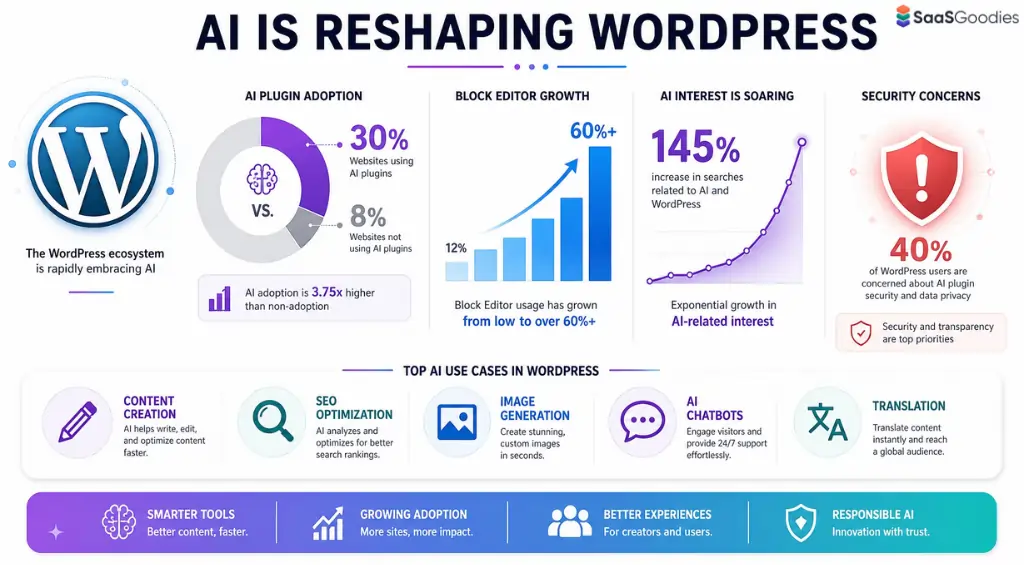
Roughly 30% of WordPress sites now run at least one AI-powered plugin. Two years ago that figure sat under 8%. That is a steep climb.
The big moment came in May 2026 when WordPress 7.0 “Armstrong” shipped with AI infrastructure baked into core. It added the Abilities API, an AI Services Registry, and a WordPress AI Client that third-party plugins now standardise around. Built by more than 900 contributors.
Common AI use cases across sites:
Full Site Editing adoption grew 145% in 2025. Block editor use has climbed past 60%, up from 37% back in 2020.
But AI also feeds the security problem. Patchstack flagged “vibe coding,” where developers ship AI-generated plugin code they cannot fully audit. When the person shipping cannot review it, flaws go live silently.
Our projection: By late 2026 more than 40% of active WordPress sites will run at least one AI plugin. The winners will be tools that add real value, not the hundredth “AI writer” clone. If you promote WordPress tools, bet on AI plugins with genuine utility and a security track record.
The WordPress Economy: A $596 Billion Machine
WordPress is not just software. It is an economy.
The total ecosystem is valued around $596.7 billion in annual economic activity. That spans hosting, themes, plugins, development services, and every business built on top of the platform.
Where the money sits:
| Category | Estimated Annual Value |
|---|---|
| Development services | about $65 billion |
| Hosting revenue | about $85 billion |
| WooCommerce ecosystem | about $15 billion |
| Plugin market | about $3.2 billion |
| Theme market | about $1.5 billion |
| Broader economic activity | about $596 billion total |
Automattic, the company closest to WordPress, generates roughly $710 million a year. An estimated 1.5 million professionals worldwide earn their primary income from WordPress work.
The managed hosting slice is booming. The global WordPress hosting market sat around $5.5 billion in 2026 and is forecast to more than double by 2033. WordPress hosting now makes up about 38% of managed hosting revenue globally.
Key Insight: No open-source project in history has generated economic activity on this scale. For affiliate marketers, that $596 billion is the real headline. Hosting, plugins, themes, and services all carry commissions. The WordPress ecosystem is one of the deepest evergreen affiliate pools that exists, and it is not going anywhere.
Version Adoption: Are People Actually Updating?
Update habits improved, but a stubborn tail refuses to move.
Around 88% of WordPress sites run version 6.x. Roughly 44% sit on the very latest release. But about 12% still run version 5.x or older, and some of those no longer get security patches.
WordPress also committed to three major releases in 2026: 7.0 in April, 7.1 in August, and 7.2 in December. That is a return to a faster cadence after a slower 2025.
That 12% running outdated core is a slow-motion security incident waiting to happen. We get why it happens. Owners fear an update breaking their theme or plugins. But running 4.x or 5.x today is like leaving your front door open in a bad neighbourhood. Use a staging site, test, then update. Do not skip it.
WordPress vs the Rivals: How the Gap Actually Looks
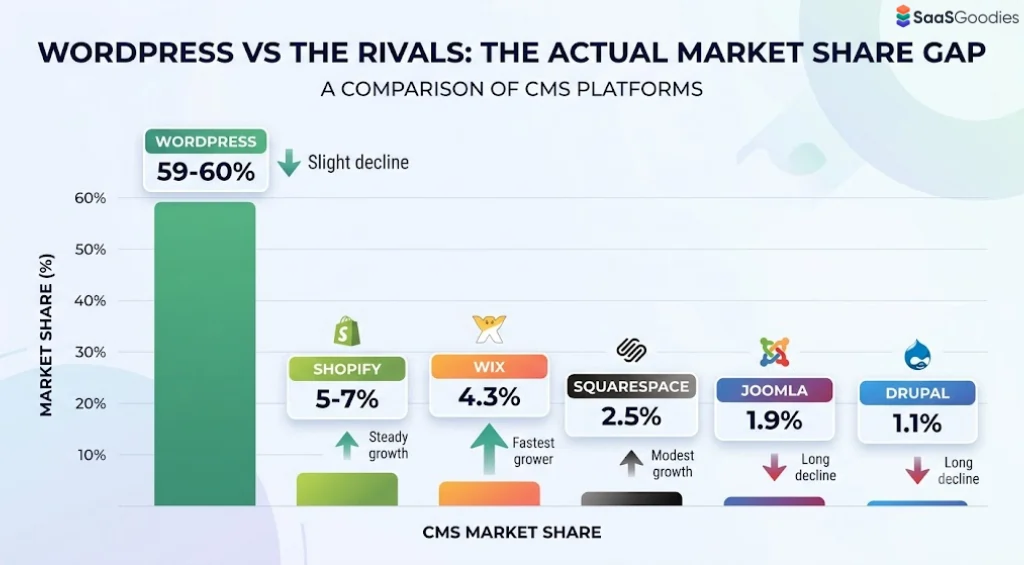
Everyone asks who is coming for WordPress. Here is the honest scoreboard for 2026.
WordPress holds close to 60% of the CMS market. The chasing pack is nowhere near.
| Platform | CMS Market Share | Direction in 2026 |
|---|---|---|
| WordPress | 59-60% | Slight decline |
| Shopify | 5-7% | Steady growth |
| Wix | 4.3% | Fastest grower |
| Squarespace | 2.5% | Modest growth |
| Joomla | 1.9% | Long decline |
| Drupal | 1.1% | Long decline |
Wix is the story here. It grew more than 30% year over year and jumped from near zero in 2015 to 4.3% now. Shopify crossed the 5% line. Meanwhile Joomla and Drupal, the two platforms most like WordPress, roughly halved their share over the decade.
The sites-without-a-CMS group shrank too. In 2013 more than 68% of sites used no CMS. By 2026 that dropped to around 29%.
Wix and Shopify are not eating WordPress. They are eating the “no CMS” pool and pulling in brand-new site creators who want speed over control. WordPress loses the beginner who wants a site in ten minutes. It keeps the person who wants to own their data, scale later, and never hit a feature wall. Two different buyers. Know which one your audience is.
FAQs About WordPress in 2026
What percentage of websites use WordPress in 2026?
WordPress powers roughly 42% of all websites and close to 60% of sites built on a known CMS. That is nearly nine times its nearest competitor, Shopify.
Is WordPress losing market share?
Yes, slightly. Share slipped from a mid-2025 peak near 43.6% to around 41.9% by mid-2026. This is the first sustained decline in over 20 years, driven by AI site builders and market saturation, not a mass exodus.
How many WordPress plugins are there?
Over 65,000 free plugins live in the official directory, plus 5,200+ paid on CodeCanyon. Counting independent developers, the real total clears 70,000.
Is WordPress secure in 2026?
Core is very secure, with only 6 vulnerabilities found all year. The risk is plugins, which account for 91% of the 11,334 flaws logged. Minimal plugins plus a virtual patching layer keeps a WordPress site as safe as any platform.
How much is the WordPress economy worth?
Around $596.7 billion in annual economic activity across hosting, plugins, themes, services, and the businesses built on it.
Does WooCommerce still lead eCommerce?
By store count, yes. WooCommerce powers roughly 33% of all online stores and sits on about 8% of every website online.
What We Think Happens Next: Our 2026-2027 Read
Time to put our own numbers on the table. These are our calls, based on the trends above and our own client work.
The short version. WordPress is not dying. It is maturing. The wild growth years are behind it, but a $596 billion ecosystem with 42% of the web does not vanish. It consolidates, hardens, and keeps paying the people who build on it well.
For anyone weighing a platform choice in 2026, the data points one way. Pick WordPress when you want control, scale, and an ecosystem that will still be here in a decade. Pick a hosted builder when speed to launch beats everything else. Most serious site owners, in our experience, land back on WordPress within a year or two anyway. The ceiling on the other platforms shows up fast.
Sources
- W3Techs, Usage Statistics and Market Share of WordPress
- HTTP Archive, Web Almanac & Tech Report
- Patchstack, State of WordPress Security
- BuiltWith, WordPress Usage Statistics
- NetCraft, Web Server Survey
- WordPress.org, Plugin & Theme Directories
- Barn2, WooCommerce Statistics
- WP Engine, WordPress Economy Study
- Statista, CMS & Web Hosting Market Data