SaaS Affiliate Marketing Statistics 2026: Who Earns Most

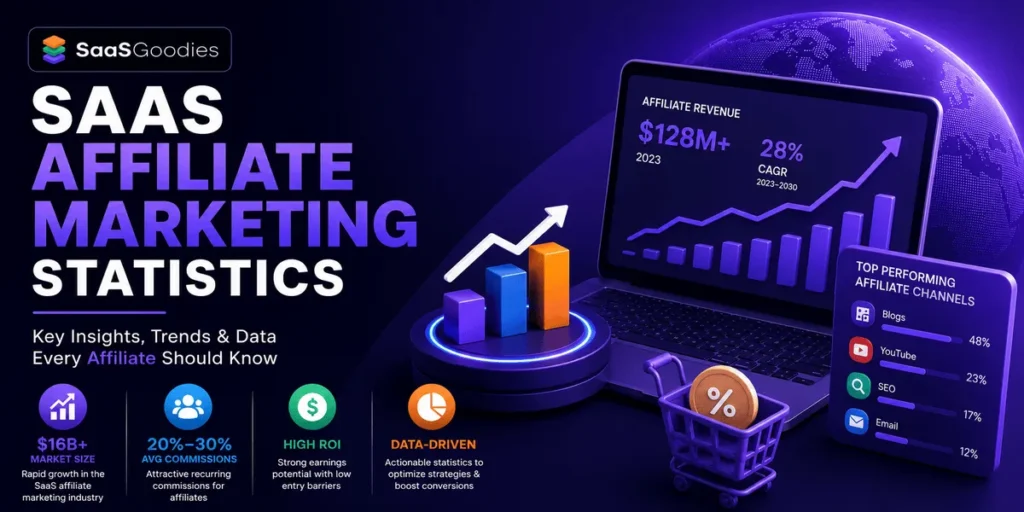
Quick answer: SaaS affiliate is the money-printer of the affiliate world right now. Global affiliate marketing spend hits roughly $19.4B in 2026, and software is the fastest-growing slice.
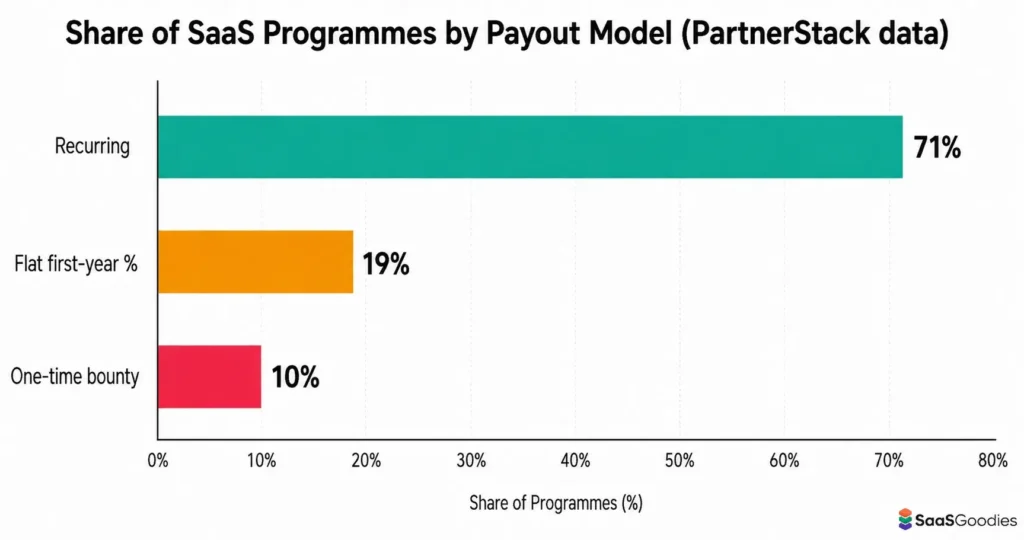
Recurring commission programmes now run about 71% of SaaS deals, paying 20-30% for a year or more. One referral can pay you for years.
We've watched this play out since 2015, and 2026 is when recurring revenue economics finally beat one-time payouts for good. Below are the numbers we trust, plus our own projections.
Let's get one thing straight. We build affiliate sites and tools for a living. We don't Google a stat and paste it.
Every number below got cross-checked against multiple 2026 reports. Where sources disagree, we say so. Where we have a hunch, we flag it clearly as our own read.
So here's the full picture of SaaS affiliate marketing statistics for 2026. Grab a coffee.
How Big is the SaaS Affiliate Money Pool in 2026?
Two things grow at once here. The software itself, and the affiliate channel selling it.
Both are enormous. And they feed each other.
The global software as a service market sits somewhere between $375B and $530B in 2026, depending on who you ask and how they count. Fortune Business Insights lands near $376B on the careful end. Precedence Research and Grand View push higher.
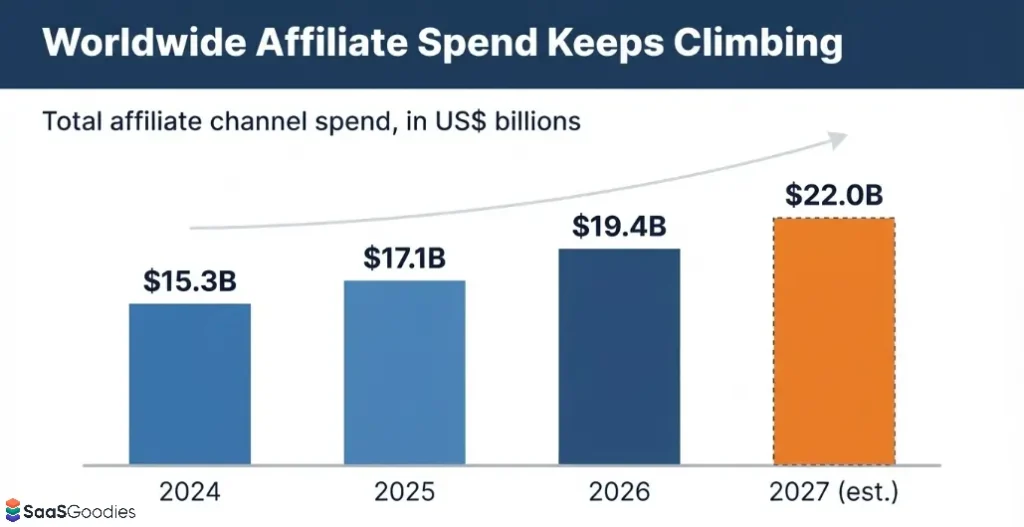
Affiliates spend rides on top of all that software revenue. Forrester pegs worldwide affiliates to spend nearly $19.4B in 2026. That channel now ranks third for performance marketing, behind paid search and paid social only.
SaaS companies worldwide
| Metric | 2025 value | 2026 value | What it tells you |
|---|---|---|---|
| Global SaaS market (narrow count) | $315.7B | $375.6B | Steady 18%+ growth, more products to promote |
| Global SaaS market (broad count) | $464.7B | $530.0B | Definitions vary; the pie stays huge either way |
| Worldwide affiliate spend | $17.1B | $19.4B | Affiliate is now a core growth channel |
| US affiliate spend | ~$12B | $13.8B | An 11-12% jump year on year |
| Affiliate platform / software layer | $22.6B | $23.8B | Tracking and partner tools keep scaling |
| US SaaS revenue | ~$130B | $141.1B | North America still leads the software map |
| SaaS companies worldwide | ~30,000 | 30,800+ | Around 1,500 new SaaS startups launch monthly |
Our take: Ignore the market-size arguing. What matters to an affiliate: more software launches every month, and each one needs voices to sell it. That flood of fresh programmes is your real opportunity, not the headline billions.
Affiliate has Graduated into a Serious Channel
For years, affiliates got treated as a scrappy side tactic. Not any more.
In 2026 it sits third among performance channels, behind only paid search and paid social. Brands lean on it because the maths works.
Read that ROI figure again. Few channels return six times their spend so reliably.
Software brands notice. That's a big reason SaaS affiliate budgets climb every year, and why partner terms stay generous.
Our take: When a channel returns $6.50 on the dollar and 80% of brands use it, the money follows. We expect SaaS brands to keep raising affiliate budgets faster than any other paid line through 2027, purely because the return beats their ad spend.
SaaS Adoption is Basically Universal Now
Here's the backdrop that makes this niche work. Almost every business on earth runs on software subscriptions.
That's not hype. It's the buying pattern behind every commission you'll ever earn.
Think about what that means for an affiliate. Buyers already trust the model. Nobody needs convincing that software subscriptions are normal.
Your job shrinks to one question. Which tool, and why this one over the next?
That's a review question. And reviews are exactly what affiliates do best.
Our take: Universal adoption removes the hardest part of the sale. You're not teaching people to buy software. You're helping them choose between options they already want. That warm intent is why software content converts so far above cold retail traffic.
Why SaaS Affiliate Pays Better than the Rest
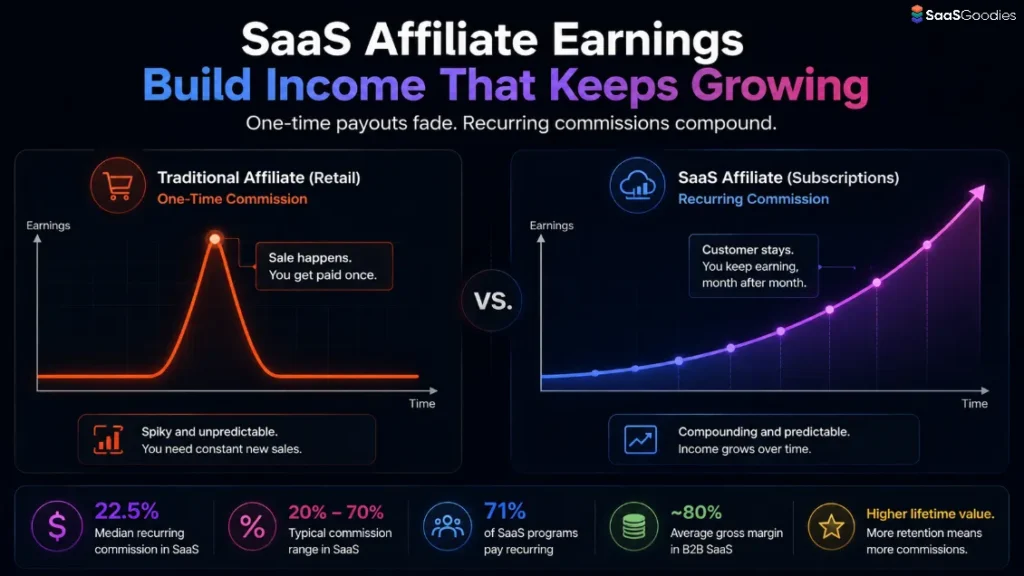
Regular affiliate marketing pays once. You send a sale, you get a cut, done. SaaS flips that. Software runs on subscriptions. So affiliates earn on subscriptions too.
That single difference changes everything about your income. Retail sale is a spike. A SaaS referral is a stream.
Here's the gap in plain numbers. The median ecommerce commission holds nearly 8.4% of order value. SaaS recurring commission rates average 22.5% of first-year revenue. Plenty of programmes run far higher.
| Vertical | Typical commission | Payout style | Income shape for the affiliate |
|---|---|---|---|
| SaaS / B2B software | 22.5% median, 20-70% range | Mostly recurring | Compounds month after month |
| AI & machine-learning tools | ~24.5% average | Recurring, 12 months+ | Highest-growth sub-niche in 2026 |
| Ecommerce / retail | ~8.4% of order | One-time | Spiky, needs constant new sales |
| Finance lead-gen | ~$52 flat per lead | Bounty | Predictable, but caps out fast |
| B2B services | ~$187 per qualified lead | Bounty | Fewer sales, bigger tickets |
| Travel | ~4.2% | One-time | High volume, thin margins |
Our take: We ran this exact comparison inside our own commission calculator. A single $40 per month SaaS referral at 25% recurring beats a one-time $60 retail bounty inside four months, then keeps paying. That maths is why our whole team pushes recurring-first.
Recurring vs One-time: The Split that Decides your Ceiling
Read this bit slowly. It's the most important stat in the whole article.
Recurring programmes generate 3.4x more partner-driven ARR over three years than one-time bounty programmes at the same acquisition cost. Same effort. More than triple the return.
The market already knows. Look at how SaaS programmes structure payouts in 2026.
Where the growth is loudest
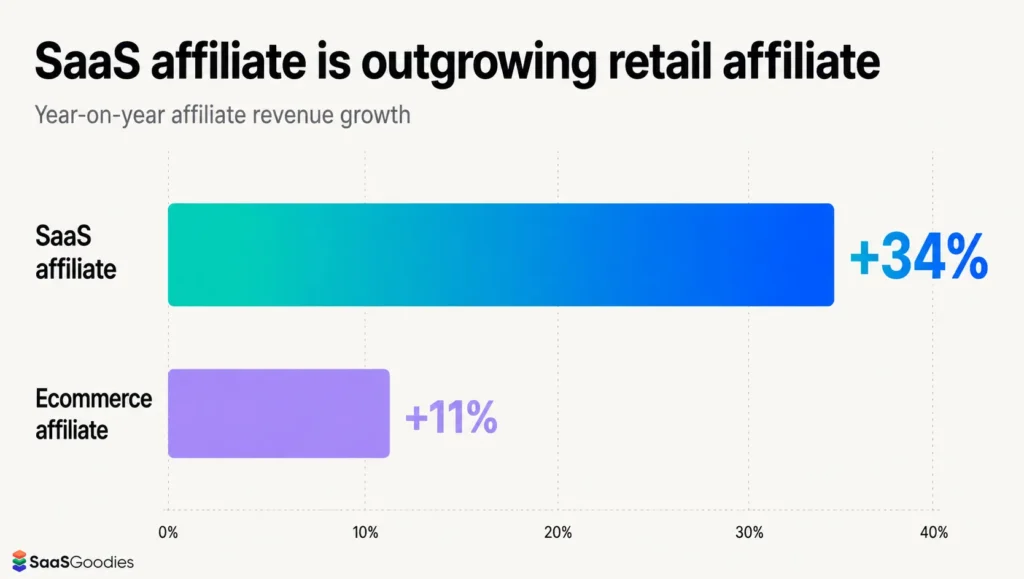
SaaS affiliate revenue tracked by PartnerStack grew 34% year on year in 2026. Ecommerce affiliate grew only 11% over the same stretch.
Three times the growth rate. That gap is not noise. It's a signal.
Analysts expect SaaS-based affiliates to keep growing near a 15.6% CAGR through 2028. SaaS affiliate revenue is on course to cross $1.8B in 2027.
Churn is the Hidden Lever Behind Every Recurring Cheque
Here's a truth most affiliate posts skip. Recurring commissions only last as long as the customer stays.
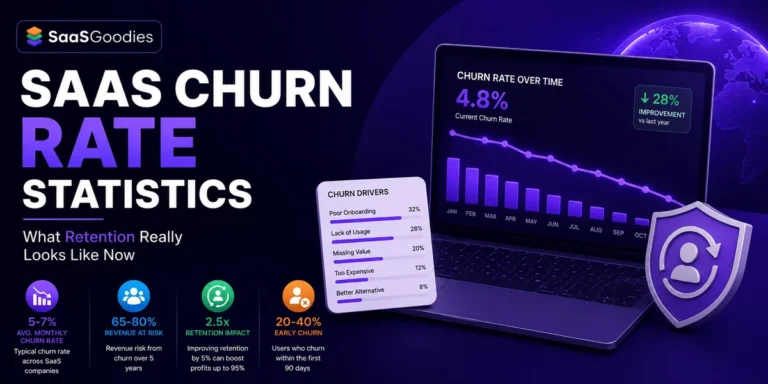
So churn is your business too, not just the vendor's. When a referred customer cancels, your monthly cheque cancels with them.
Churn varies hard by customer size. Small businesses leave fast. Enterprises barely budge.
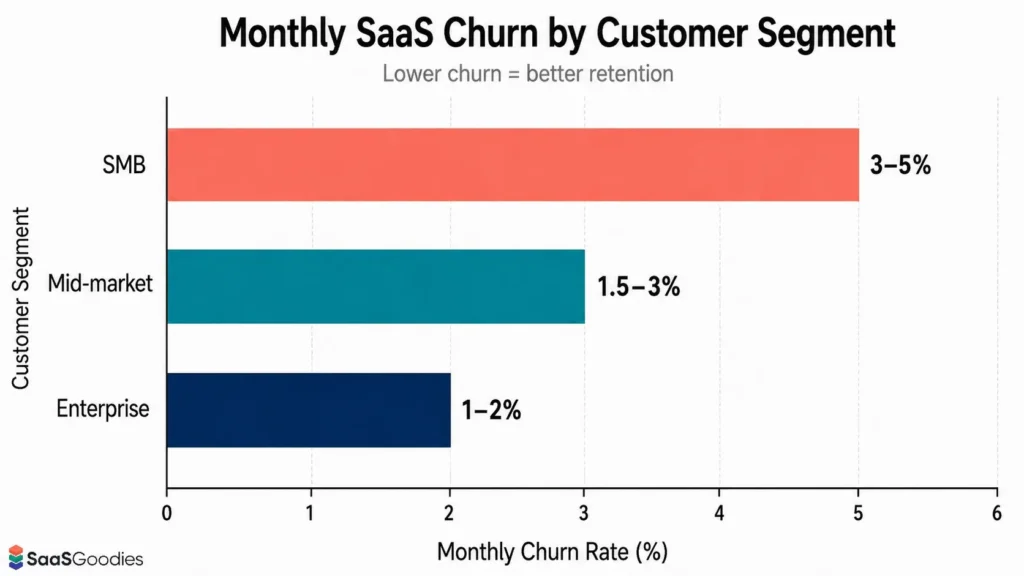
Read those numbers as commission lifespan. A 5% monthly churn means the average customer is gone in under two years.
Best-in-class enterprise tools hold churn below 1%. Those customers can pay you for years on a renewal-friendly programme.
SaaSGoodies estimate
Our rule of thumb: promote tools with sticky, high-retention products, and your effective earnings per referral roughly double versus a leaky SMB tool at the same headline rate. Retention quietly beats commission percentage. We weight our own reviews toward products people actually keep.
What SaaS Affiliates Actually Earn in 2026
Averages lie in this game. So let's break earnings apart properly.
Software affiliates pull an average near $5,967 per month across the board. But that headline hides a brutal spread.
Experience matters more than niche. Affiliates with three-plus years earn roughly 9x what beginners make. Traffic compounds, trust compounds, and recurring commissions stack on top.
| Affiliate stage | Rough monthly income | What drives it | Our read |
|---|---|---|---|
| Complete beginner (under 1 yr) | $0-$500 | Thin traffic, few programmes, no trust yet | Most quit here. Don't. |
| Building (1-2 yrs) | $500-$3,000 | Ranking content, first recurring streams | The compounding starts now |
| Established (3-5 yrs) | $3,000-$15,000 | Portfolio of recurring referrals | Recurring base covers the rent |
| Expert (6-10 yrs) | $15,000-$50,000 | Authority, email list, high-intent traffic | Software niche shines at this tier |
| Top earners (top ~4%) | $50,000+ | Multi-channel audience, agency deals | Rare, real, mostly SaaS-heavy |
SaaSGoodies estimate
Based on income reports inside our own community of 10,400+ marketers, we estimate a focused SaaS affiliate who ships one solid comparison post a week reaches a $2,000-$4,000 monthly recurring base within 18 months. Slower than the hype-sellers promise. Far more durable than a one-time bounty grind.
One more honest truth. Only 10-20% of affiliates ever make it a primary income. Around 1-5% reach six figures.
Your odds improve when you pick recurring SaaS over one-time retail. We've watched that pattern hold for a decade.
Cookie Windows and Tracking: The Quiet 2026 Shake-up
Attribution changed hard over the last two years. Privacy updates from Apple and browser makers gutted the old 30-day cookie.
Now the windows land all over the place. And they matter, because a short window steals your credit.
Good news for software folks. SaaS deals tend to run longer windows, because buyers research before they commit. HubSpot and Notion stretch to 180 days.
Tracking tech shifted too. Server side tracking jumped from 5% of programmes in 2022 to 21% in 2026. Programmes on server-side report 18-24% higher attributed conversions than cookie-only setups.
| Attribution window | Share of programmes | Best fit | Risk to the affiliate |
|---|---|---|---|
| 24 hours (Amazon-style) | Small but notable | Impulse retail buys | Brutal for slow B2B research cycles |
| 7 days or less | ~38% | Low-consideration products | You lose credit on delayed signups |
| 14-30 days | ~41% | Mid-consideration tools | Workable for most SaaS reviews |
| 60-90 days | Part of the top 21% | B2B SaaS, higher tickets | Healthy runway for free trials |
| 120-180 days | The generous minority | CRM, high-consideration SaaS | Best case; grab these programmes |
Our take
Before you promote any software tool, check two things: the cookie length, and whether renewals stay credited without a fresh click. A 90-day window with sticky renewal attribution beats a flashy 50% rate on a 7-day cookie. We reject programmes that hide these terms.
Real SaaS Programme Terms Worth Knowing in 2026
Benchmarks are useful. Actual programme terms are better. So here's what the big names pay right now.
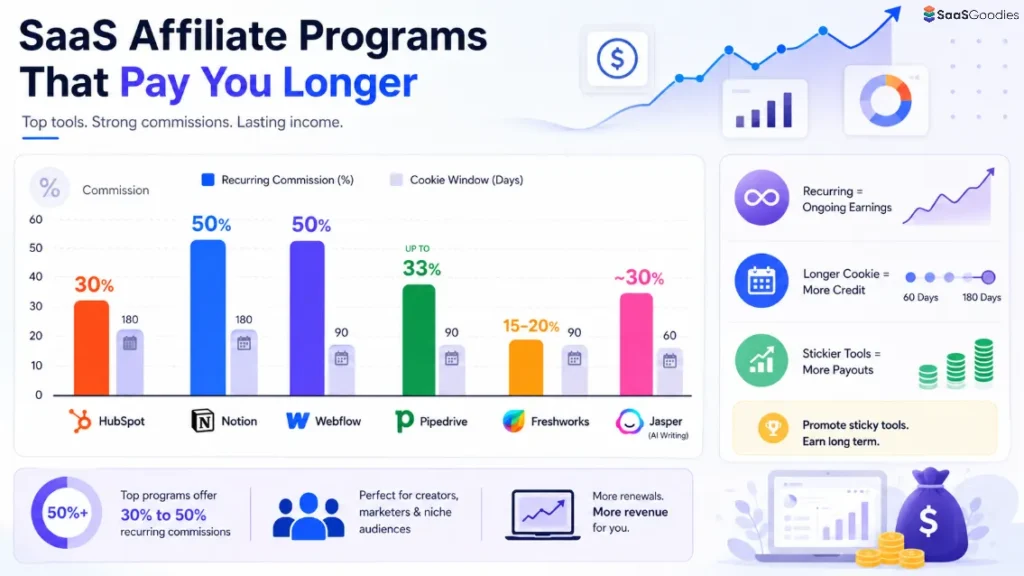
These come from live 2026 programme pages. Terms change, so always confirm before you build a campaign around one.
| Programme | Commission | Cookie window | Best audience fit |
|---|---|---|---|
| HubSpot | 30% recurring, up to 12 months | 180 days | CRM, sales and marketing content |
| Notion | 50% on paid upgrades, first 12 months | 180 days | Productivity and template creators |
| Webflow | 50% on first-year subscription | 90 days | Designers and no-code builders |
| Pipedrive | Up to 33% recurring, 12 months | 90 days | Sales ops and SMB growth |
| Freshworks | 15-20% recurring | 90 days | Support and helpdesk audiences |
| Jasper (AI writing) | ~30% recurring | 60 days | Marketers and content creators |
Notice the pattern. The strongest recurring rates cluster around tools people set up once and keep forever.
That stickiness is your friend. A referred customer who stays two years pays you far past the headline 12-month cap on renewal-friendly programmes.
The AI SaaS Boom is the Affiliate Gold rush of 2026
One sub-niche outruns everything else right now. AI software.
New AI tools launch every single week. Each one wants partners, and most pay well to get them.
AI SaaS grows roughly three times faster than traditional software. Around 95% of organisations are on track to use AI-powered apps.
Commissions reflect that scramble. AI and machine-learning tools average near 24.5%, a notch above general B2B software at 10-20%.
Why the premium? Because these companies fight hard for early market share. Generous affiliate terms buy them growth fast.
That's your window. Programmes tend to pay best when a category is young and crowded. AI is both.
Our take: We're steering a big chunk of our own 2026 content calendar toward AI tools for one reason. The launch pace means fresh, low-competition review keywords appear weekly, while commission rates stay high. That combination rarely lasts. Move while it does.
AI search is rewriting the affiliate playbook
Now the uncomfortable part. AI answers are eating some search clicks.
When a chatbot answers a query directly, fewer people click through to review sites. Affiliates who lived on pure Google traffic feel that squeeze most.
Two numbers frame the shift:
Creators come out ahead here. Creator affiliates generate 3.7x more revenue per follower than plain display affiliates. Trust travels through a face and a voice.
SaaS content holds up better than most under AI pressure. Why? Because software buyers want proof, demos, and hands-on comparisons a chatbot can't fake. Real testing still ranks.
SaaSGoodies projection
Our forecast for 2026-2027: SaaS affiliates who show real product usage (screenshots, live setups, honest teardowns) will hold or grow traffic, while generic “top 10 tools” list-spinners lose 20-40% of clicks to AI answers. First-hand experience becomes the moat. We're betting our whole editorial model on it.
Where the Affiliate Money Lives, Region by Region
Geography still shapes payouts and buyer behaviour. North America leads by a wide margin.
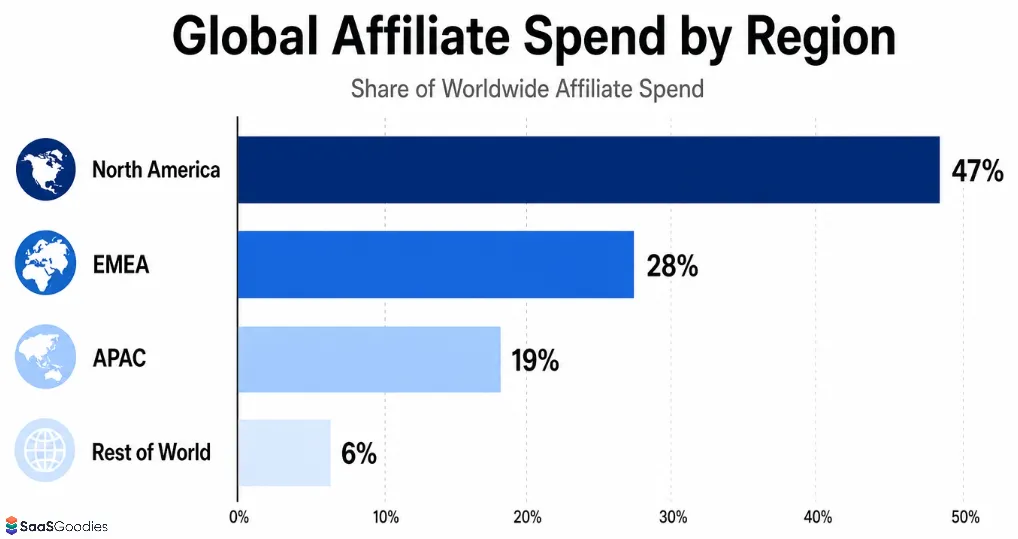
Asia-Pacific grows fastest, though. Mobile-first buyers and rising software adoption push that region ahead on growth rate, even if the total pool stays smaller for now.
Sentiment runs high everywhere. In Germany, 99% of marketers rate affiliate as effective. The global average sits at 92%. That confidence keeps budgets flowing into partner programmes.
Our 2026-2027 Projections for SaaS Affiliate
Time to put our own numbers on the table. These are SaaSGoodies estimates, built from the data above plus what we watch inside our own network daily.
We label them plainly, because guessing dressed up as fact is exactly what we hate about most stats posts.
| What we're forecasting | Our estimate | Confidence | Why we think so |
|---|---|---|---|
| SaaS share of recurring programmes | Climbs past 75% by end of 2027 | High | Recurring already at 71% and rising fast |
| Median SaaS recurring rate | Holds near 22-25% of first-year value | High | Margins support it; competition steadies it |
| AI-tool affiliate demand | Fastest-growing SaaS sub-niche through 2027 | High | New AI products launch weekly, all need partners |
| Pure-SEO affiliate traffic | Drops 20-40% for generic list content | Medium | AI answers absorb low-intent queries |
| First-hand review content | Gains ranking share and trust | High | Buyers still want proof AI can't fabricate |
| SaaS affiliate revenue (global) | Crosses $1.8B in 2027, near $2.4B by 2028 | Medium | 34% growth compounds quickly |
The honest version
Nobody knows exactly where AI search lands the affiliate world in two years. What we're sure of: recurring beats one-time, SaaS beats retail on lifetime value, and real experience beats regurgitated lists. Those three bets have held since 2015. We don't see them breaking now.
What these SaaS Affiliate Marketing Statistics Mean for You
Numbers are useless without a move. So here's how we'd act on all of this.
That's the whole game in 2026. Recurring revenue, real proof, and traffic you own.
Mistakes we watch affiliates make
After a decade in this space, the same slip-ups show up again and again. Dodge these and you're ahead of most.
None of this is complicated. It's just discipline most people skip.
We publish fresh SaaS affiliate marketing statistics every year because the data keeps proving the same point. Software is the best niche in affiliate, and it isn't close.
Quick Answers to Common SaaS Affiliate Marketing Questions
How much do SaaS affiliates make in 2026?
Software affiliates average close to $5,967 per month, but the spread is wide. Beginners often earn under $500. Established affiliates with recurring streams commonly clear $3,000-$15,000 monthly.
What commission do SaaS programmes pay?
Most land between 20% and 30% recurring. The full range runs 20% to 70%. Median across networks sits near 22.5% of first-year revenue.
Is SaaS affiliate better than retail affiliate?
For lifetime value, yes. Recurring SaaS programmes generate 3.4x more partner revenue over three years than one-time bounties at the same cost. Retail pays once. Software pays for months or years.
Which SaaS niche pays affiliates the most?
AI and machine-learning tools lead right now, averaging near 24.5% commission. They also launch fastest, so fresh review keywords stay easy to rank. CRM and marketing software pay strongly too, often with long 90 to 180-day cookie windows.
How long before a SaaS affiliate site earns real money?
Expect a slow start. Most affiliates earn under $500 in year one. From our own community data, a focused site publishing weekly reaches a $2,000-$4,000 monthly recurring base within about 18 months. Recurring commissions compound from there.
Are these SaaS Affiliate Marketing Statistics still growing?
Yes. SaaS affiliate revenue grew 34% year on year in 2026 and is projected to cross $1.8B in 2027. The software market underneath it grows near 18% a year.
- Forrester Affiliate Marketing Forecast and aggregated network data
- PartnerStack SaaS Affiliate State of the Industry
- Fortune Business Insights, Precedence and Grand View SaaS market data
- Global SaaS market size and company counts
- EMARKETER US affiliate spend forecast
- Grand View Research affiliate platform market
- SaaS-specific commission and recurring benchmarks
- SaaS commission and cookie-window benchmarks
- FirstPromoter affiliate report (ROI, mobile, adoption)
- Post Affiliate Pro industry-size analysis
- SaaS churn, margin and benchmark data
- Statista · SaaS and affiliate market data hub