Influencer Affiliate Marketing Statistics: The Shift in 2026

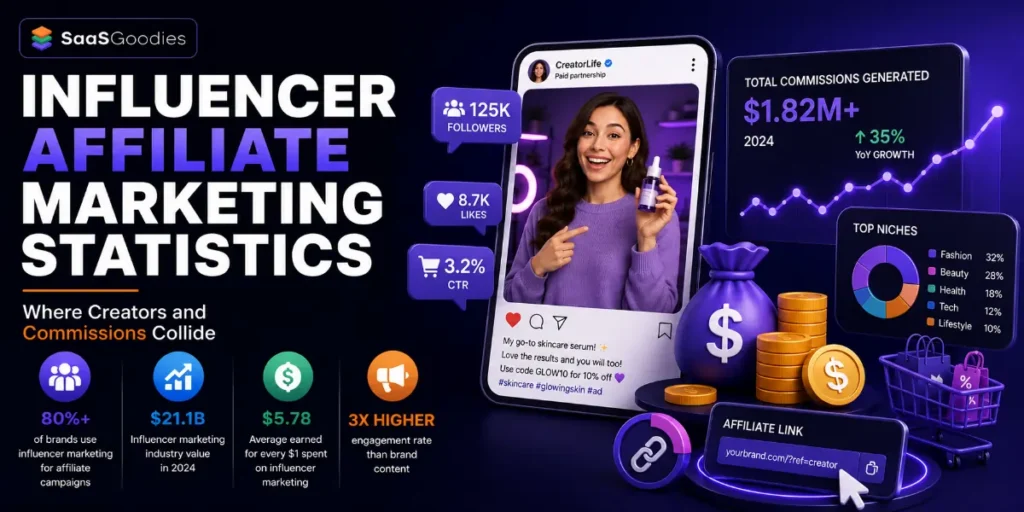
Influencer marketing and affiliate marketing have stopped being separate disciplines — the fastest-growing model in 2026 is the creator who gets paid on performance, not per post. TikTok Shop's affiliate channel alone now drives 42% of all US TikTok Shop GMV, making it the single largest sales channel on the platform.
Influencer affiliate marketing is the model where creators earn a commission on the sales their content generates — tracked through affiliate links, promo codes or native shop integrations — rather than a flat sponsorship fee.
These influencer affiliate marketing statistics highlight market growth, creator commission trends, and the platform data shaping affiliate budgets.
Every figure is cited and dated; where “market size” or “conversion rate” means different things to different sources, the range and the reason are shown, not smoothed over.
Latest Influencer Affiliate Marketing Statistics and Trends
How Big is The Influencer Marketing Industry in 2026?
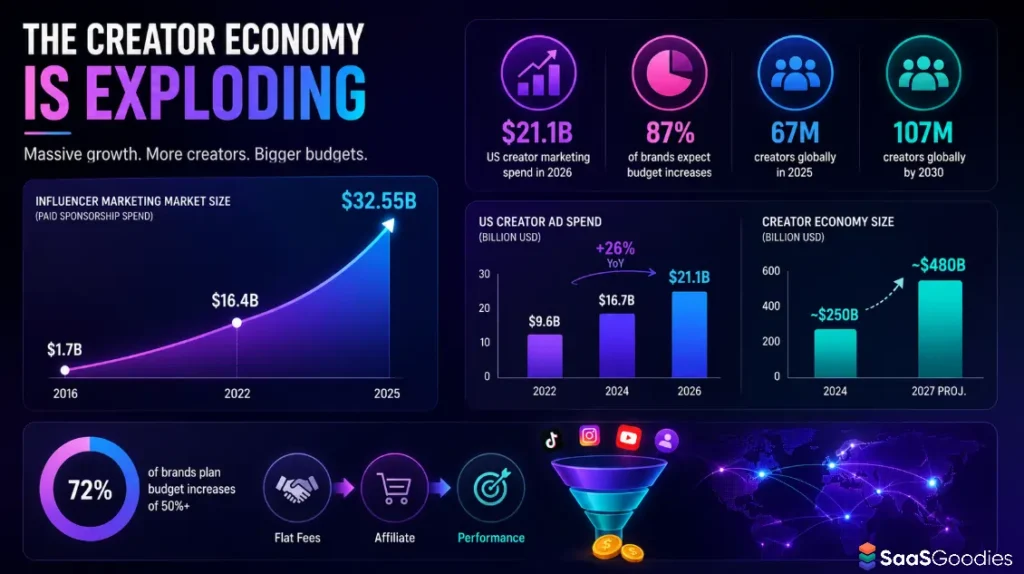
The global influencer marketing market reached $32.55 billion— but the broader creator economy it sits inside is valued at roughly $250 billion and counting, depending on what gets counted. The “market size” number swings wildly by definition, so it pays to know which one is being quoted.
| Metric | Value | What it measures |
|---|---|---|
| Influencer marketing market (2025) | $32.55B | Paid sponsorship spend |
| US creator ad spend (2025) | $37B (+26% YoY) | US creator advertising |
| Creator economy (2024) | ~$250B | Whole creator economy |
| Creator economy (2027 proj.) | ~$480B | Whole creator economy |
The growth trajectory is steep on any definition:
SaasGoodies Take: When a stat says “$32 billion,” it usually means paid sponsorship — the affiliate and commerce-driven slice is additional and often uncounted. The headline that matters for affiliates is the spend migrating from flat fees toward performance, which is where the next paragraph lives.
Why is Influencer Marketing Merging with Affiliate?
Affiliate and performance-based influencer programs reduce upfront cost and improve measurable ROI, which is why brands combining the two report a 46% lift in affiliate-based sales. The flat-fee sponsorship is being squeezed by a model where creators only get paid when they sell.
How Does TikTok Shop Affiliate Perform?
TikTok Shop's affiliate channel drives 42% of all US TikTok Shop GMV — the platform's single largest sales channel — on global GMV of $64.3 billion in 2025, projected to surpass $112 billion in 2026. This is the clearest proof that creator commerce has gone fully performance-based.
The TikTok Shop affiliate numbers:
| TikTok Shop affiliate metric | Figure |
|---|---|
| Affiliate share of US TikTok Shop GMV | 42% |
| Global GMV (2025 → 2026 proj.) | $64.3B → $112B |
| US creators monetising | 800,000+ |
| Avg US commission rate | 13.02% |
| Beauty/food conversion | 3–8% |
What this means for operators: TikTok Shop closed the loop that affiliate marketing always struggled with — no link-in-bio drop-off, purchase happens in-app. A TikTok placement that looks 20% cheaper than Instagram on CPM can deliver 3–6x more purchases per dollar once the conversion gap is counted. For affiliates, the native shop is now the highest-converting surface in social commerce.
Which Creator Tier Converts and Earns Best?
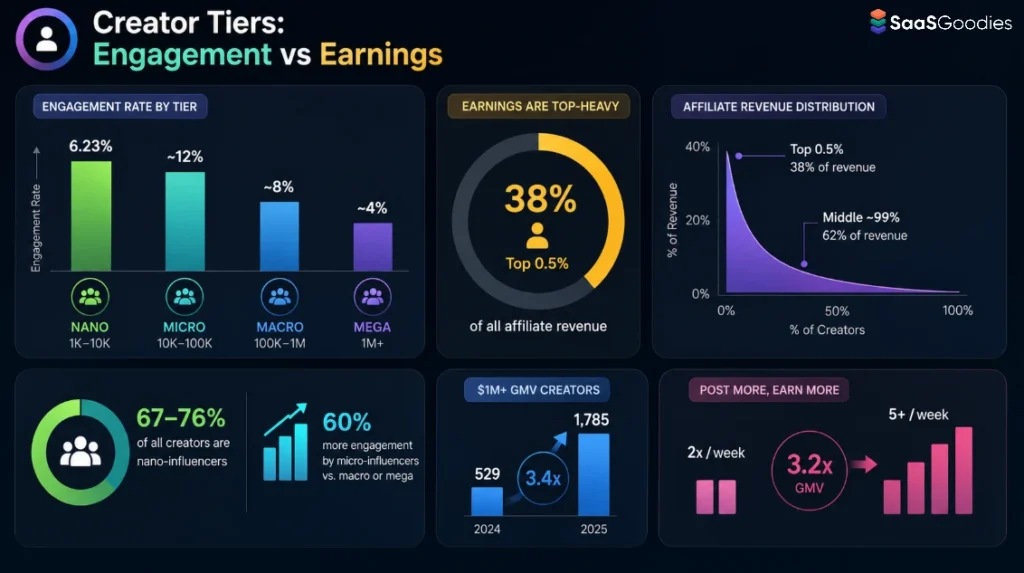
Nano-influencers post a 6.23% engagement rate against a 2.39% overall average — but the top 0.5% of creators capture 38% of all affiliate revenue, so the channel is both democratised and brutally top-heavy. Engagement and earnings move in opposite directions across tiers.
Engagement by tier:
| Creator tier (followers) | TikTok engagement | Note |
|---|---|---|
| Nano (1K–10K) | ~18% (6.23% cross-platform) | Highest engagement, smallest reach |
| Micro (10K–100K) | ~12% | Best engagement-to-cost balance |
| Macro (100K–1M) | ~8% | Reach multiplier |
| Mega (1M+) | ~4% | Mass reach, lowest engagement |
The earnings reality:
SaasGoodies Insight: the smart brand play is a portfolio of nano and micro creators for engagement and trust, not one expensive mega name. The smart creator play is volume — posting 5+ times a week drives 3.2x higher GMV than twice weekly, because it raises the odds of a viral hit. The income skew is real: affiliate creator earnings are a power law, not a salary.
What Do Creators Charge, and Where Does The Money Come From?
Flat-fee influencer pricing still spans from about $15 per TikTok post for nano creators to $13,750 for mega creators — but the trend is away from flat fees toward commission, because performance deals shift risk and improve measurable ROI. The pricing table explains why affiliate is winning.
Reported flat-fee benchmarks per TikTok post:
| Tier | Approx. cost per post |
|---|---|
| Nano | ~$15 |
| Micro | ~$75 |
| Mid-tier | ~$687 |
| Macro | ~$1,875 |
| Mega | ~$13,750 |
On the affiliate side, dedicated creator-commerce platforms have scaled fast:
Key Takeaway: a $13,750 flat fee with no sales attached is exactly the spend brands are trying to escape. Platforms like LTK, ShopMy and TikTok Shop let brands pay on results — and let creators monetise without a single brand deal. For affiliates, these are the rails the next decade of creator commerce runs on.
How Much do Consumers Actually Buy from Influencers?
86% of consumers make at least one influencer-inspired purchase a year, and the average follower spent $372 across three influencer-driven purchases in 2025. The purchase intent is real and measurable.
How are Brands Measuring and Scaling Influencer Affiliate Programs?
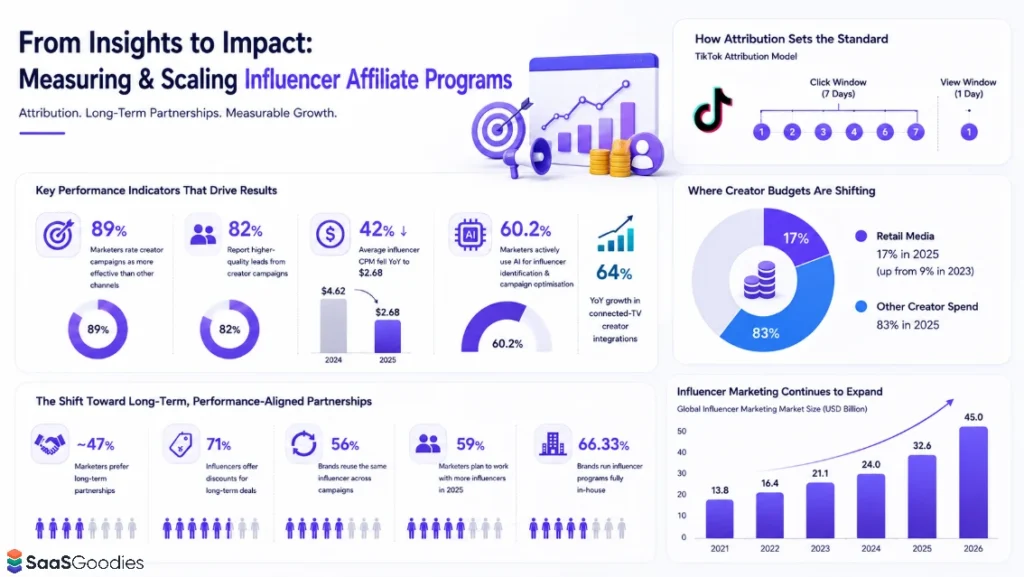
Attribution and long-term partnerships now define how serious programs run — 59% of marketers plan to work with more influencers, and the smartest deals are recurring, performance-tracked relationships rather than one-off posts. The operational layer is where affiliate skills pay off most.
Measurement and efficiency signals:
The shift to long-term, performance-aligned relationships:
| Operating signal | Figure |
|---|---|
| Marketers preferring long-term partnerships | ~47% |
| Influencers offering discounts for long-term deals | 71% |
| Brands reusing the same influencer across campaigns | 56% |
| Marketers planning more influencer partners in 2025 | 59% |
| Brands running programs fully in-house | 66.33% |
Live commerce is the fastest-rising affiliate format:
SaasGoodies Insight: the programs that win treat influencer affiliate as an owned, measured channel — clean attribution, repeat creators, and AI for discovery. Falling CPMs and in-house management mean brands can run performance creator programs at a fraction of the old cost. For affiliate operators, the long-term-partnership trend is the opening: a tracked, recurring creator relationship is just an affiliate program with a face on it.
Final Takeaways: Influencer Affiliate Marketing Statistics for 2026
| Forecast / trend | Signal |
|---|---|
| TikTok Shop global GMV (2026) | ~$112B |
| Creator economy (2027) | ~$480B |
| Brands raising influencer budgets | 87.49% |
| Global creators (2030) | ~107 million |
- Influencer Marketing Hub — “Influencer Marketing Benchmark Report 2026.”
- Sprout Social — “Influencer Marketing Statistics” (2024–25 report).
- Hamster Garage — “TikTok Shop Affiliate Statistics 2026: Benchmarks & ROI.”
- influencerfee — “TikTok Influencer Marketing Statistics 2026.”
- SQ Magazine — “Influencer Marketing Statistics” (citing IMH, Goldman Sachs, eMarketer).
- PartnerCentric — “Influencer Trust & Commerce Statistics” (survey of 1,003 Americans).
- Marketing LTB — “Influencer Marketing Statistics 2025.”
- Outfy — “TikTok Affiliate Marketing 2025” (citing WeCanTrack, Hootsuite).