Claude AI Statistics 2026: Adoption, Spending and Growth

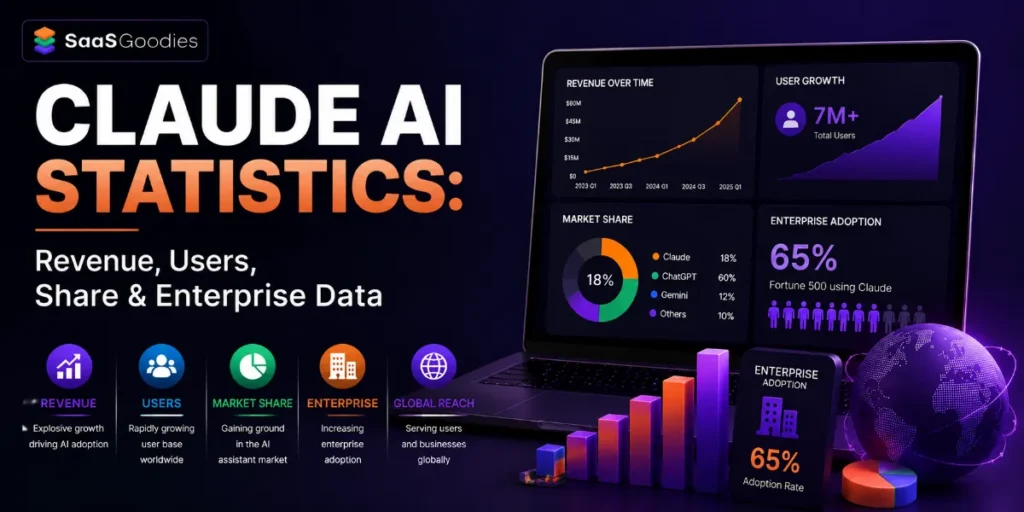
Quick answer: Anthropic reached a $47 billion annualised run rate by mid-2026, up from $1 billion at the end of 2024. Claude now holds close to 9% of global AI chatbot web traffic, 40% of enterprise LLM API spend, and 18.5% of measurable B2B AI referrals.
Claude Code alone crossed $2.5 billion. We have tracked these figures weekly since 2023, and one pattern keeps repeating. Claude lost the consumer popularity contest and won the money contest. So read these Claude AI Statistics as a budget document, not a horse race.
Claude AI Statistics At a Glance
SaasGoodies take: almost every stat post you will read leads with user counts. Wrong lead. Claude's story lives in revenue per user and API spend share, and both favour Anthropic by a wide margin.
Anthropic Revenue Growth: The Steepest Climb in SaaS History
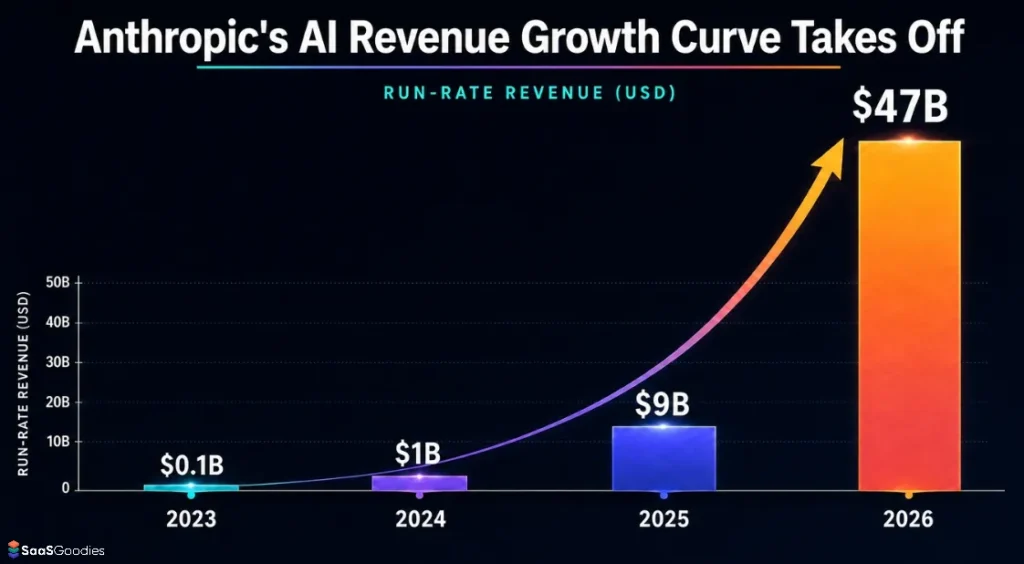
We have watched a lot of software companies scale. Nothing looks like this chart.
Run-rate revenue means the most recent month multiplied by twelve. Anthropic publishes it in funding announcements, so treat each figure as a snapshot rather than audited annual revenue.
The compounding matters more than any single number. Revenue grew more than tenfold in each of three straight years. Very few software businesses manage that once.
Third-party trackers put the mid-2026 run rate somewhere between $69 billion and $74 billion. Anthropic has not confirmed a figure above $47 billion, so we treat anything higher as an estimate.
| Year | Run-rate revenue | Valuation | Headline funding event | Business customers | Our note on the year |
|---|---|---|---|---|---|
| 2023 | About $0.1 billion | $18.4 billion | Amazon and Google strategic investment | Early access only | Claude launched this year. Enterprise share sat near 12%. |
| 2024 | $1 billion by year end | $61.5 billion entering 2025 | Series E, $3.5 billion | Tens of thousands | Sonnet 3.5 turned Claude into the default coding model. |
| 2025 | $9 billion at year end | $183 billion, then $350 billion | Series F, $13 billion | 300,000-plus | Claude Code shipped and hit $1 billion inside six months. |
| 2026 (to date) | $47 billion confirmed | $965 billion post-money | Series H, $65 billion | 300,000-plus, 1,000 at $1M+ | Anthropic passed OpenAI on revenue and valuation. |
Notice the customer count barely moves between 2025 and 2026 while revenue grows fivefold. Existing accounts got much bigger. Expansion revenue did the heavy lifting, not new logos.
That single observation should reshape how you model AI spend. Seat-based growth is not the driver. Token consumption inside accounts you already have is.
Valuation, Funding and the Anthropic IPO Timeline
Anthropic has raised roughly $132 billion across 18 rounds. The 2026 Series H alone brought in $65 billion at a $965 billion post-money valuation.
A confidential S-1 went to the SEC in mid-2026, with a Nasdaq listing targeted before the year closes. Independent forecasters put a plausible post-listing market cap above $1.1 trillion.
Our read on the multiple: a 20x revenue multiple on a business growing tenfold a year is not obviously expensive. It is only expensive if growth breaks. Watch net revenue retention in the S-1, because that number will settle the argument faster than any benchmark score.
How Many People Use Claude in 2026? Sorting the Conflicting Counts
This part of the data gets messy, and most stat posts pretend otherwise. Anthropic does not publish a consolidated monthly active user figure, so every count you see is an estimate.
We found three very different numbers circulating, and they measure three different things.
All three can be defensible. The 245 million figure almost certainly counts embedded and reseller surfaces, since Claude powers features inside more than 6,000 enterprise applications. The 30 million figure counts people who deliberately open Claude.
Mobile actives sit near 12.5 million. Mobile daily actives reached about 11.3 million during the first quarter of the year.
What the desk noticed: our working figure is 32 million deliberate consumer monthly actives, with total reach past 240 million once embedded surfaces count. If you cite one number in a pitch deck, cite the deliberate-use figure and say so. Buyers respect a defined denominator.
Claude Web Traffic Growth: From Rounding Error to 950 Million Visits
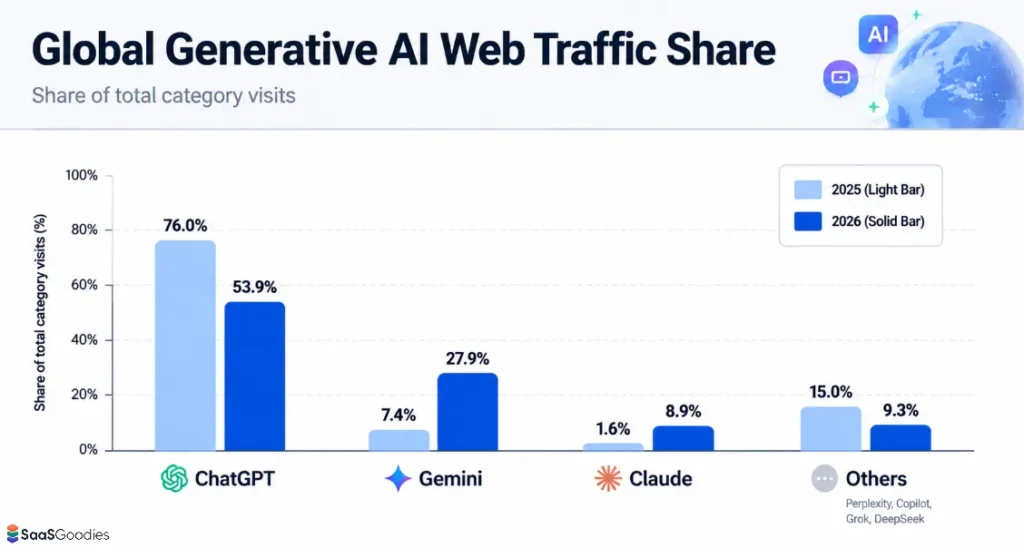
Web traffic is the cleanest signal we have, because Similarweb and Semrush both measure it independently.
claude.ai opened 2026 near 202 million visits. By the middle of the year it recorded about 952.6 million, holding near 946.7 million after that. Semrush separately measured 837.7 million a month earlier.
That desktop skew tells you something useful. Claude usage happens at a desk, inside work, often beside a code editor or a document.
Claude Market Share Against ChatGPT and Gemini
Market share depends entirely on which market you name. Claude looks small on one measure and dominant on another.
The table below lines up four separate share measures so you can see the gap for yourself.
| Platform | Global web traffic share | App user share | US web visit share | Enterprise API spend share | Coding workload share | Direction in 2026 |
|---|---|---|---|---|---|---|
| ChatGPT | 53.9% | 46.4% | 58.3% | 27% | 21% | Falling on share, flat on absolute visits |
| Google Gemini | 27.9% | 27.7% | 19.3% | 21% | 11% | Rising fast on distribution |
| Claude | 8.9% to 9.2% | 10.3% | 13.4% | 40% | 54% | Fastest gain of any platform tracked |
| Microsoft Copilot | Low single digits | Low single digits | Low single digits | Bundled | Declining | Steady through Microsoft 365 bundling |
| Perplexity | Low single digits | Low single digits | Low single digits | Minimal | Minimal | Down from a 2025 peak |
| Meta AI | Not comparable | Very high on reach | Not comparable | Minimal | 8% | Reach without deliberate choice |
Look at the two right-hand columns against the left. Claude sits fifth on consumer reach and first on paid enterprise usage. Those are not the same business.
Corporate spend data supports the same story. Ramp's AI Index placed Anthropic at 34.4% of businesses in its dataset during 2026, slightly ahead of OpenAI on 32.3%.
Our share call: we expect Anthropic to hold between 38% and 45% of enterprise API spend through the end of 2026. Google is the real threat here, not OpenAI, because distribution through Workspace costs a buyer nothing extra.
Claude Usage by Country: Where Adoption Concentrates
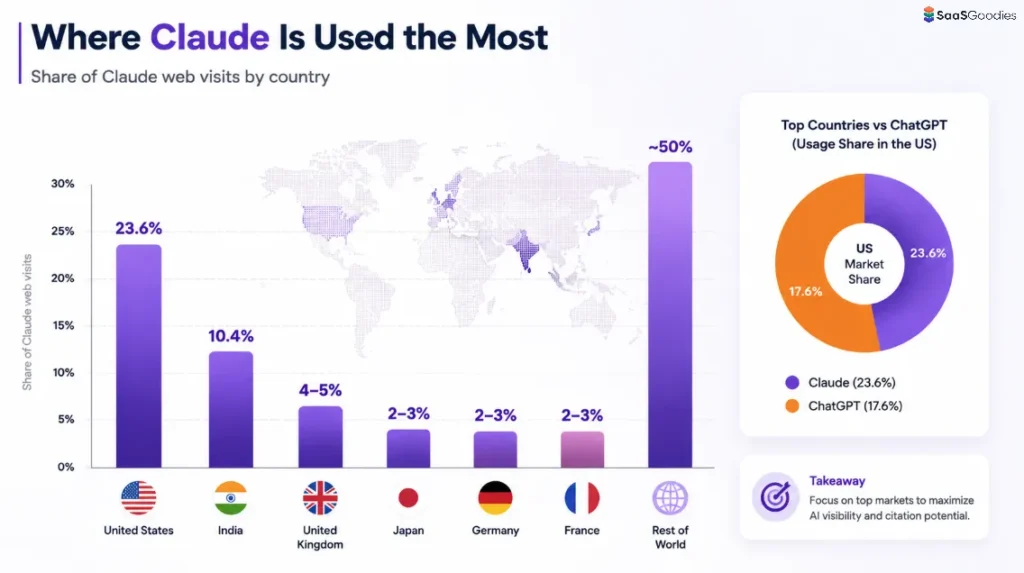
Claude is more US-weighted than either of its main rivals. That matters if you sell internationally, because your AI referral mix will look nothing like a US competitor's.
| Country | Share of Claude web visits | Comparison against ChatGPT | Dominant use pattern | What we advise on it |
|---|---|---|---|---|
| United States | About 23.6% | ChatGPT draws 17.6% from the US | Enterprise coding, legal and financial document work | Prioritise US-facing content for AI citation wins. |
| India | About 10.4% | Second largest market for both platforms | Software and web development, near 45% of that task category | Developer-facing docs pull disproportionate volume. |
| United Kingdom | Mid single digits | Similar profile to the US | Professional services and research | UK spelling in docs helps retrieval matching. |
| Japan | Low single digits | Under-indexed versus Gemini | Engineering and translation work | Localised technical pages remain under-served. |
| Germany | Low single digits | Slightly behind the UK | Industrial and compliance-heavy workflows | Compliance content earns citations here. |
| France | Low single digits | Fastest growth rate among named markets | Mixed professional and education use | Worth an early localisation test. |
| Rest of world | Around half of visits | Broad and fragmented | Education, admin and personal research | No single market justifies a dedicated build yet. |
One extra detail from Anthropic's own economic research is worth flagging. Lower-income countries lean toward full delegation of tasks, while higher-income countries lean toward collaborative use.
So the same product gets used two different ways depending on the market. Directive prompting dominates in some regions, back-and-forth iteration in others.
Claude User Demographics: Age, Gender and Session Behaviour
Claude's audience profile is unusually concentrated, and it does not match ChatGPT or Gemini.
Both ChatGPT and Gemini peak in the 25 to 34 bracket. Claude peaks younger, which we read as a student and early-career developer skew feeding into workplace adoption later.
Reality check from our desk: treat the gender split as directional only. Two credible vendors disagree by 17 percentage points, which usually means panel composition rather than real behaviour. We would not build a campaign on it.
Enterprise Adoption: 300,000 Business Customers and Rising Contract Values
Enterprise is where Claude earns its money, and the figures are unusually specific for a private company.
Anthropic reports revenue from cloud resellers such as AWS, Google and Microsoft on a gross basis. That inflates the top line against peers who report net, so keep it in mind when comparing.
Deployment results back the spend. Banner Health reports 85% of its 55,000-plus staff seeing time savings, while Carta Healthcare cut clinical data abstraction time by 66%.
Enterprise LLM API Spend: How Anthropic Took the Lead
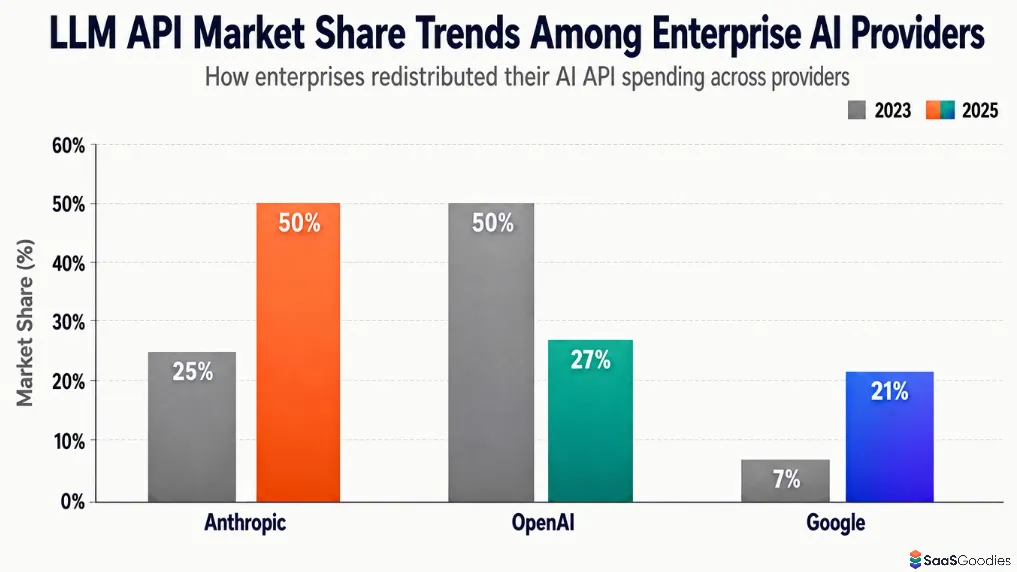
This is the single most important table in the article for anyone setting a 2027 budget.
Enterprise spending on large language models reached about $37 billion across 2025, roughly triple the prior year. Anthropic captured the largest share of it.
That last bullet is the one most vendors skip. Agent marketing has run far ahead of agent deployment, and the gap creates a real opening for anyone shipping something that actually works.
What we would bet on: the 16% agent figure roughly doubles by the end of 2027. Our estimate puts genuine agentic deployments near 30% to 35% of enterprise AI projects, driven mostly by protocol standardisation rather than model quality.
Claude Code Statistics: The Product That Bent the Revenue Curve
Claude Code deserves its own section because it explains most of the revenue jump. A single product went from launch to billions inside a year.
| Metric | 2025 figure | 2026 figure | Change | Why a SaaS operator should care |
|---|---|---|---|---|
| Run-rate revenue | $500 million within months, $1 billion inside half a year | Over $2.5 billion | Roughly 5x | Fastest software revenue ramp we have recorded anywhere. |
| Weekly active users | Growing over 10x in three months post-launch | Doubled inside the opening weeks of the year | Still compounding | Adoption curve has not flattened yet. |
| Business subscriptions | Early enterprise pilots | Quadrupled from the start of the year | 4x | Enterprise now supplies over half of product revenue. |
| Average developer engagement | Occasional assistant use | About 20 hours a week per developer | Core workflow | Habit-level usage, not experimental usage. |
| Public GitHub commit contribution | Negligible | Roughly 4%, with higher estimates circulating | New category | AI-written code is now measurable in open source. |
| GitHub repository stars | 22,000 at first count | Grew from 71,000 to 132,000 across six months | Near 2x | Developer mindshare compounding publicly. |
| Typical enterprise cost | Not established | $150 to $250 per developer per month | New line item | 90% of users stay under $30 on any active day. |
Claude Code overtook both GitHub Copilot and Cursor within eight months of general launch. Anthropic's own figure of 20 hours a week per developer is the number we find most striking.
At median developer pay, twenty weekly hours inside one tool means the tool has captured a large share of productive output. That is not occasional reach.
Pricing note from our side: price your own product against this reality. Buyers who already pay $200 a month per seat for coding assistance have recalibrated what software is worth. Cheap no longer reads as good value in developer tooling.
Claude Model Line-Up and API Pricing in 2026
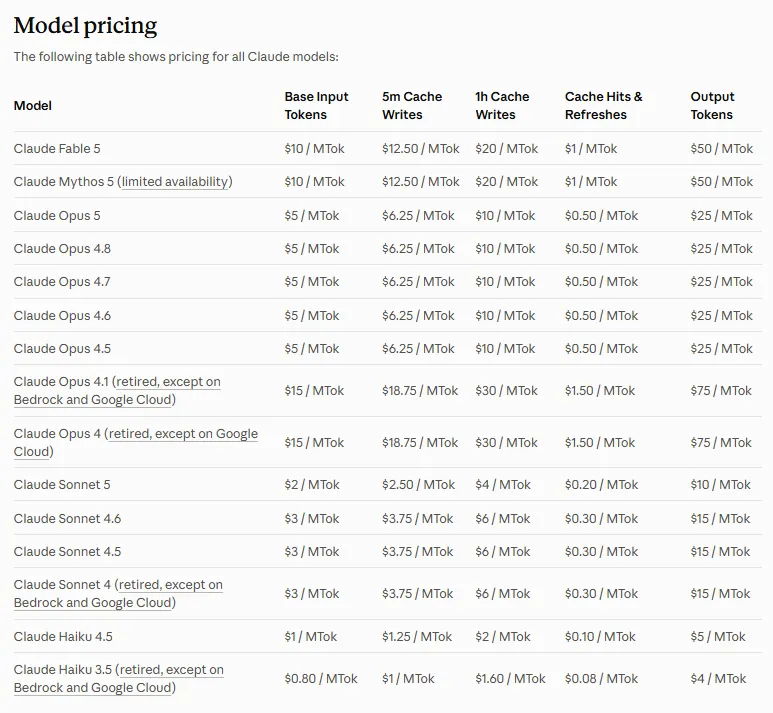
Anthropic shipped an unusual number of models in 2026. Keeping the pricing straight got harder, so we put it in one place.
| Model | Input per million tokens | Output per million tokens | Context window | Standout benchmark | Best fit workload |
|---|---|---|---|---|---|
| Claude Opus 5 | $5 | $25 | 1 million tokens | 96.0% on SWE-bench Verified | Long agentic runs where retries cost more than tokens. |
| Claude Fable 5 | $10 | $50 | 1 million tokens | Mythos-class capability | Frontier research and hardest reasoning tasks. |
| Claude Sonnet 5 | $2 | $10 | 1 million tokens | 63.2% on SWE-bench Pro | Classification, drafting and high-volume agent steps. |
| Claude Haiku 4.5 | $1 | $5 | 200,000 tokens | Fastest response profile | Routing, tagging and cheap bulk throughput. |
| Claude Opus 4.8 | $5 | $25 | 1 million tokens | 88.6% on SWE-bench Verified | Pinned production deployments needing stability. |
| Legacy Opus 4.1 | $15 | $75 | 200,000 tokens | 74.5% on SWE-bench Verified | Compatibility holdouts only, at triple the cost. |
Three cost mechanics matter more than the sticker rates, and most teams miss all three.
That third point catches people out badly. A flat per-million comparison against an older model understates your real bill by up to a third.
Straight from our tracker: route by task, not by loyalty. Send 85% of calls to Haiku and Sonnet, and keep Opus for the rest. We estimate that lands 55% to 70% below an Opus-only setup, at almost no quality cost on routine work.
Model Context Protocol Adoption: The Quietest Big Number of 2026
Anthropic open-sourced Model Context Protocol in late 2024. Adoption since then has outpaced almost any developer standard we can name.
For context, React took about three years to reach 100 million monthly npm downloads. MCP got there in sixteen months.
Anthropic, OpenAI, Google, Microsoft and AWS shipped a joint specification update in mid-2026. A twelve-month deprecation window now runs on the previous version.
The gap we keep watching: the gap between 97 million downloads and 41% production use is the whole story. Everyone is experimenting. Far fewer have shipped. If your product exposes a working MCP server with proper auth, you are ahead of roughly six in ten of your competitors right now.
What People Actually Ask Claude to Do
Anthropic publishes an economic index built on privacy-preserving analysis of real usage. It is the best public data on AI task distribution, and it keeps surprising us.
The diversification point deserves attention. Claude started as a coding tool and is broadening into product comparisons, home maintenance and sports questions.
Anthropic's own labour analysis found no clear unemployment signal in exposed occupations. It did find hiring of workers aged 22 to 25 into the most exposed roles slowing by about 14% against a counterfactual.
Claude as a Referral Channel: The GEO Number Most Marketers Missed
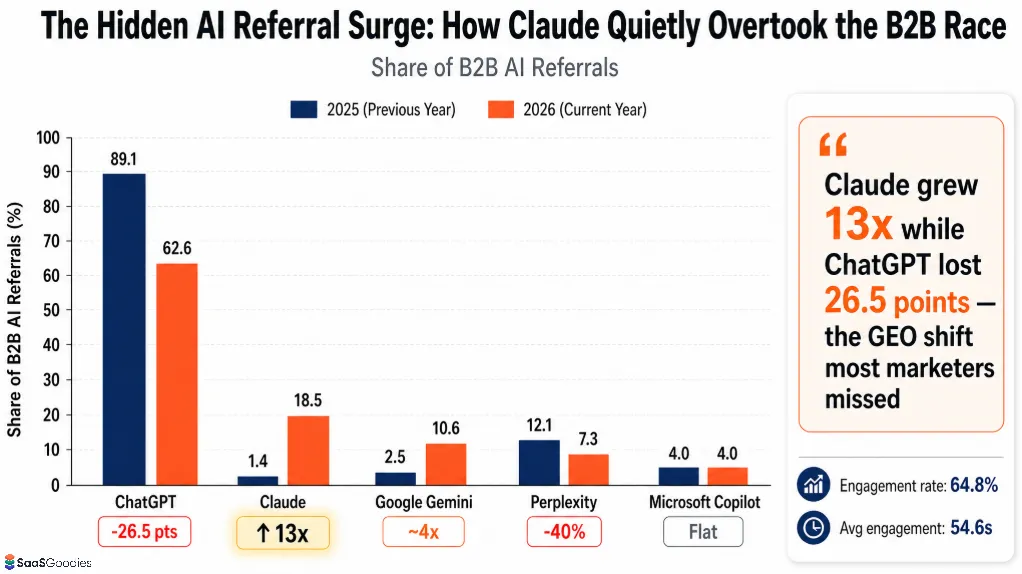
If one section of this report changes your work this quarter, make it this one.
Claude ships web search with inline citations. Every session became a potential referrer, and the compounding effect finally showed up in analytics during 2026.
| AI platform | Share of B2B AI referrals, 2025 | Share of B2B AI referrals, 2026 | Movement | Traffic quality signal |
|---|---|---|---|---|
| ChatGPT | 89.1% | 62.6% | Down 26.5 points | Still the volume leader by a wide margin. |
| Claude | 1.4% | 18.5% | Up roughly 13x | 64.8% engagement rate, 54.6 seconds average engagement. |
| Google Gemini | Low single digits | 10.6% | Roughly quadrupled | Largely invisible in standard attribution. |
| Perplexity | Peaked near 12.1% | 7.3% | Down over 40% from peak | Citation-first, so clicks carry high trust. |
| Microsoft Copilot | About 4% | About 4% | Flat | Bundled usage rarely produces outbound clicks. |
Two more figures sharpen the picture. Claude referral traffic grew nearly fourfold inside the first four months of 2026, the fastest gain of any AI source measured.
Across a hundred-brand panel, Claude referral sessions converted at about 1.2%, ahead of ChatGPT sessions on the same panel. Broader SaaS data puts blended AI referral conversion near 5.8%, above organic search and email.
The catch is absolute volume. Claude sits at roughly 0.0141% of all website traffic, up from 0.0029% as the year opened. Tiny base, steep slope.
Our GEO call: we expect Claude to reach 24% to 28% of B2B AI referrals by the close of 2026, and we expect it to hold a conversion premium over ChatGPT traffic. Our reasoning is simple. Claude sessions skew toward professionals researching purchases, and professional intent converts.
Revenue Mix and ARPU: Why Claude Earns More Per User
Claude has roughly a thirtieth of ChatGPT's user base and more revenue. Unit economics explain the whole thing.
An 8x ARPU premium is not a pricing trick. It reflects a customer base of businesses buying production capacity rather than individuals buying a monthly habit.
Numbers we would frame: every SaaS founder chasing consumer AI volume should read that ARPU line twice. Anthropic won by refusing to compete for cheap attention. Narrow beats broad when your unit costs are real.
What We Expect From Claude Beyond 2026
Now our own calls, based on the figures above plus three years of watching this market from the inside. These are estimates, not certainties.
None of these are guesses pulled from nowhere. Each extends a curve already visible in 2026 data by one step.
How SaaS Marketers Should Use These Numbers
Statistics only pay off when they change a decision. Five moves we would make this quarter, in order of expected return.
Editor's closing note: the highest-return move on that list is the second one. Getting cited by Claude and its rivals costs nothing extra if you already publish, and almost nobody has restructured content for retrieval yet. Early movers are collecting traffic their competitors cannot see in a rankings tool.
FAQs About Claude AI Statistics
What is Anthropic's revenue in 2026?
Anthropic reported a $47 billion annualised run rate during 2026, confirmed in its Series H announcement. That figure rose from $9 billion at the end of 2025 and $1 billion a year before. Independent trackers estimate $69 billion to $74 billion by the middle of 2026, though Anthropic has not confirmed any number above $47 billion.
How many users does Claude have in 2026?
Estimates range widely because Anthropic does not publish a consolidated figure. Sensor Tower puts Claude near 245 million monthly active users across all surfaces. Panel trackers estimate 30 million to 35 million on the consumer chatbot alone. Our working figure is about 32 million deliberate monthly users, with total reach past 240 million once embedded applications count.
Does Claude have more enterprise market share than ChatGPT?
Yes, on API spend. Anthropic holds roughly 40% of enterprise LLM API spend against 27% for OpenAI and 21% for Google. In coding workloads the gap widens further, with Anthropic near 54% and OpenAI near 21%. ChatGPT still leads comfortably on consumer reach.
How much does the Claude API cost per million tokens?
Claude Opus 5 costs $5 input and $25 output per million tokens. Sonnet 5 sits at $2 and $10, Haiku 4.5 at $1 and $5, and Fable 5 at $10 and $50. Cache hits cost 10% of base input, and batch requests receive a 50% discount. Models from 4.7 onward tokenise text into roughly 30% more tokens, so real bills run higher than a flat comparison suggests.
Why is Claude revenue per user so much higher than ChatGPT's?
Around 80% of Anthropic revenue arrives through enterprise and API usage priced per token. Annual revenue per monthly active user reaches about $192, against roughly $23 for ChatGPT. Businesses buying production capacity spend far more than individuals buying a monthly subscription.
Is Claude worth optimising content for in 2026?
Yes, though not as your only target. Claude drives about 18.5% of B2B AI referrals, up from 1.4% eight months earlier, and those sessions show a 64.8% engagement rate. Absolute volume stays small at roughly 0.0141% of all website traffic, so treat Claude as a fast-growing supplement to ChatGPT and Google rather than a replacement.
How fast is Claude Code growing?
Claude Code reached $1 billion in annualised revenue within six months of launch and passed $2.5 billion during 2026. Weekly active users doubled inside the opening weeks of the year. Business subscriptions quadrupled over the same stretch. The average developer now spends about 20 hours a week in the tool.
- Anthropic | Series H funding announcement and run-rate revenue disclosure
- Anthropic Economic Index | Cadences report
- Anthropic Economic Index | Learning curves report
- Claude Platform Docs | Official API pricing per model
- Statista | Claude global monthly active users
- Menlo Ventures | State of Generative AI in the Enterprise, enterprise LLM API share
- Similarweb | Generative AI market share, referral and citation data
- Momentic | Generative AI chatbot market share by web traffic
- Goodie | B2B AI referral share report, Wave 2
- Model Context Protocol | specification and SDK download figures
- Business of Apps | Claude revenue and usage statistics
- DemandSage | Claude active user and country traffic data
- Backlinko | Claude user counts and demographics
- VentureBeat | Anthropic revenue run-rate reporting
- Ramp AI Index | Corporate AI vendor adoption by spend
- Sensor Tower | State of AI report, monthly active user estimates