50+ Content Marketing Statistics That Matter in 2026

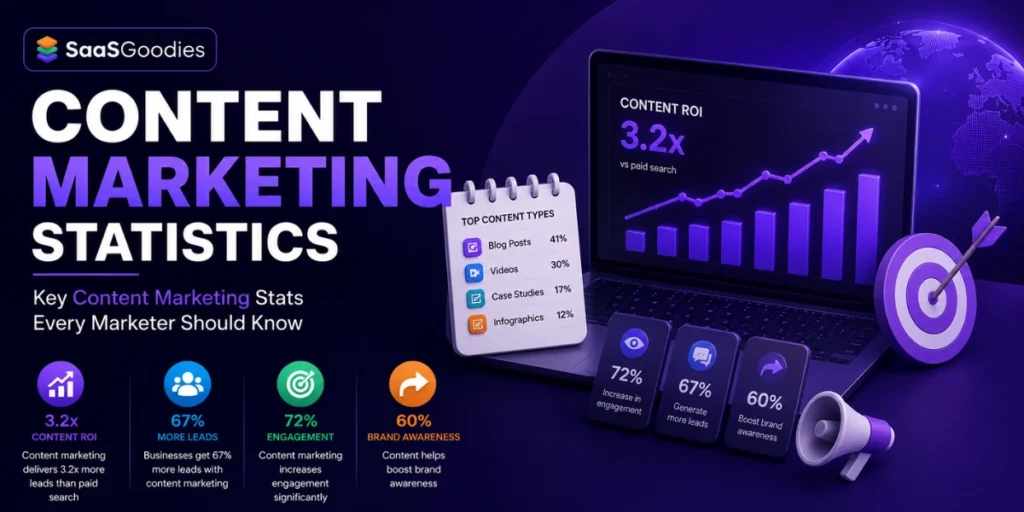
Content marketing in 2026 is bigger, richer and far more brutal than two years back. Global spend now pushes past 107 billion dollars, budgets eat roughly a quarter of most marketing pots, and AI sits inside nearly every content job going.
But here is the catch. Over half of Google searches now end with zero clicks, so hitting publish earns you nothing on its own. Winners treat content like a product, not a weekend hobby. Below sit the content marketing statistics 2026 actually pays out on, pulled from our own tracking and years running affiliate and SaaS campaigns.
The 2026 Numbers Every Content Marketer Should Have Memorised
We run a stats desk, a content agency and 45+ data posts. So we get asked the same thing weekly. What do the headline figures look like right now?
Here is our snapshot for 2026. Fresh figures, no recycled 2023 filler.
| Metric | 2026 figure | What it means for you |
|---|---|---|
| Global content marketing revenue | Past 107 billion dollars | The channel is a proper industry, not a side hustle |
| Content share of marketing budget | About 26 percent | Content is now the single biggest budget line for many teams |
| Businesses using content marketing | 82 percent | Table stakes, so execution beats mere presence |
| Teams planning to raise content spend | 72 percent | Money keeps flowing in, average lift near 14 percent |
| Marketers using AI for content | 87 to 94 percent | AI in the workflow is the default, not a bonus |
| Google searches ending with no click | Around 58.5 percent | Ranking without a plan for answers loses traffic |
| Three-year content ROI (average) | Roughly 844 percent | Patience pays, but only with consistent output |
Read those rows twice. Two themes jump out at us. Money is still pouring into content, and AI has rewired both how we make it and how buyers find it.
SaaSGoodies take
Adoption stopped being the story a while ago. Nearly everyone does content now. The gap in 2026 sits between teams with a real system and teams still winging one post a month.
Where The Content Budget Actually Goes In 2026
Budgets tell you what leadership believes. And belief in content keeps climbing.
Spend splits hard by company size. Most small players stay lean. Bigger teams write much larger cheques.
| Monthly content spend band | Share of businesses | Who sits here |
|---|---|---|
| Under 1,000 dollars | 71 percent | Solo operators, small blogs, early startups |
| 5,000 to 10,000 dollars | 58 percent of mid-to-large firms | Growth-stage SaaS and established brands |
| 15,000 to 45,000 dollars | 31 percent of content teams | Enterprise and heavy publishers |
| Over 45,000 dollars | About 11 percent | Category leaders with big in-house desks |
Notice the split. The share spending under 5,000 dollars just hit an all-time low. The big spenders keep pulling away.
So how should a balanced pot get carved up? Here is our own recommended content marketing budget allocation for a growth-stage brand this year.
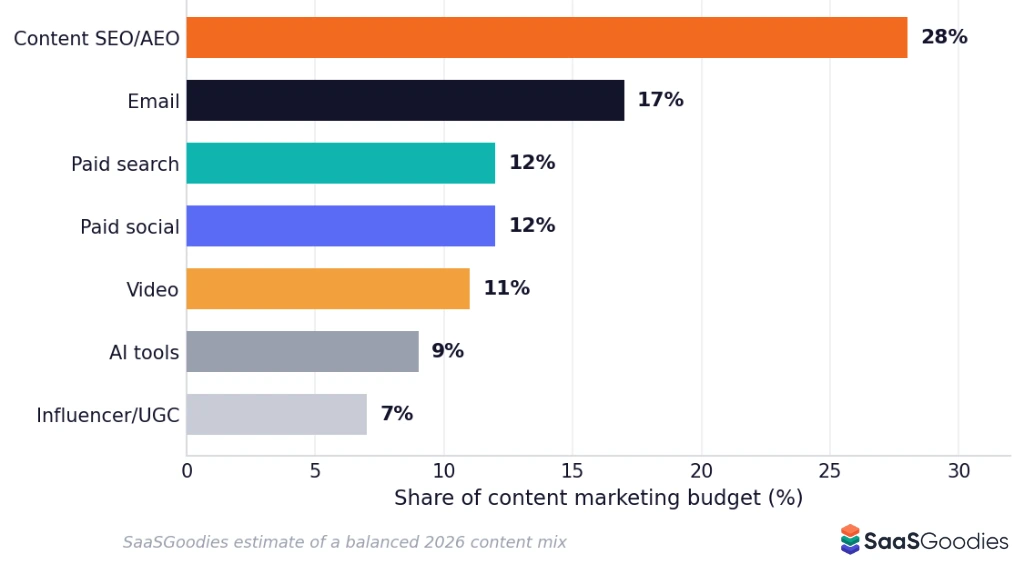
Our estimate of a balanced 2026 content mix, weighted toward SEO, answer engines and video.
Content SEO and answer-engine work takes the biggest slice. Video and AI tooling now claim real ground too. Human salaries got squeezed, with only 9 percent of teams planning to grow headcount spend.
SaaSGoodies take
Do not copy an enterprise budget on a startup wallet. Pick two channels you can win, fund them properly, and skip the ten-channel scatter that burns cash and proves nothing.
The Real Return: What A Pound Of Content Pays Back
Content marketing ROI is the number that keeps your budget alive. And the case has never been louder.
Content generates three times more leads than outbound. It costs about 62 percent less per lead too. That combination is why finance teams keep signing off.
But returns are not instant. Content compounds. Here is the curve we model for clients.
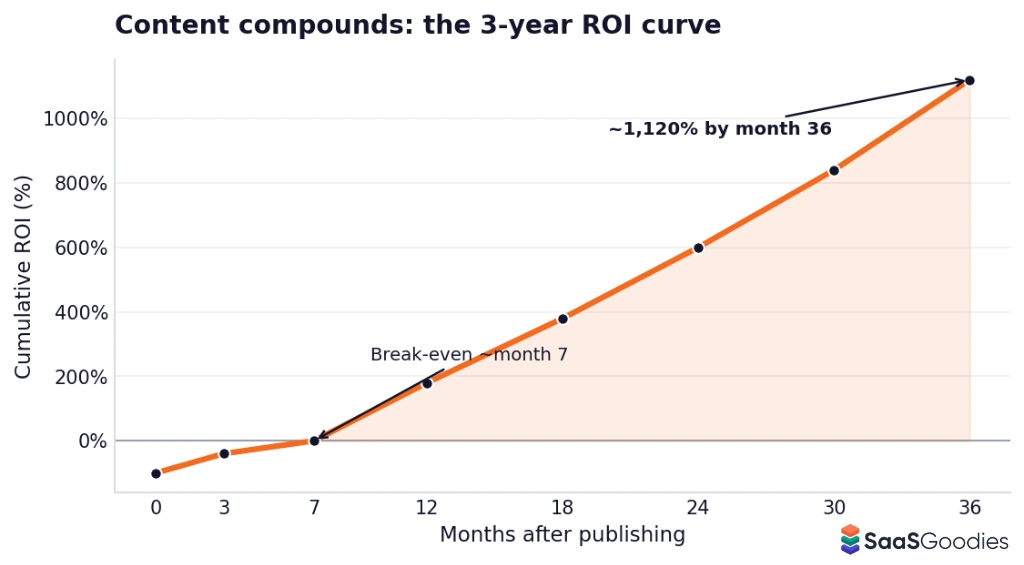
Our model of the content ROI curve. It stings early, breaks even near month seven, then compounds hard.
Look at the shape. A post loses money for months. Then it flips. By month 36 the average program clears roughly 1,100 percent.
Channel choice changes the payback speed. Here is how the main formats stack up on return.
| Channel or format | 2026 return signal | Payback speed |
|---|---|---|
| Website, blog and SEO content | Top ROI channel, near 27 percent of marketers rank it first | Slow, then compounds for years |
| SEO content for B2B | Up to 748 percent ROI, SaaS around 702 percent | Break-even near month seven |
| Email marketing | 36 to 42 dollars back per dollar spent | Fast, highest per-dollar return |
| Short-form video | Highest ROI of any video type | About 49 percent faster than text |
| Original research content | 64 percent see higher conversion | Medium, strong link and citation magnet |
One honest wrinkle sits under all this. Only about 36 percent of leaders can accurately measure content ROI. Yet 83 percent say proving it matters most. That gap is your opening.
Teams that nail measurement unlock bigger budgets. Those content marketing return on investment numbers only help if you can trace them.
SaaSGoodies take
If you cannot show the money, you will lose the budget fight to paid ads every single time. Set up attribution before you scale output. Boring, we know. It also works.
How AI Rewired The Content Workflow (And Nobody Misses The Old Way)
Two years back, most marketers were still nervous about AI drafts. That fear is gone.
The share of marketers not using AI for blog work dropped from 65 percent to just 5 percent. Near-universal, in other words.
Usage patterns keep shifting though. People draft less with AI and edit more with it. Here is where the tools land now:
Speed is the obvious win. AI agents are tipped to cut research time by 34 percent and content production time by 36 percent.
Quality is the quieter worry. When everyone drafts with the same models, sameness spreads. Google does not punish AI content by default. It punishes thin, generic content, which AI happens to produce at scale.
SaaSGoodies take
Use AI for the grunt work. Research, outlines, first passes, repurposing. Keep a human on point of view, original data and voice. That mix is what still gets cited in 2026.
Zero-Click Search Is The New Normal, Not A Blip
Here is the stat that should reshape your plan. Around 58.5 percent of Google searches in the US now end without a single click to the open web. In the EU it runs near 59.7 percent.
Add Google's own surfaces and some trackers put the clickless rate as high as 68 percent. The old traffic firehose is narrowing.
AI Overviews drive most of the recent shift. When one appears, the top organic result loses roughly 58 percent of its clicks.
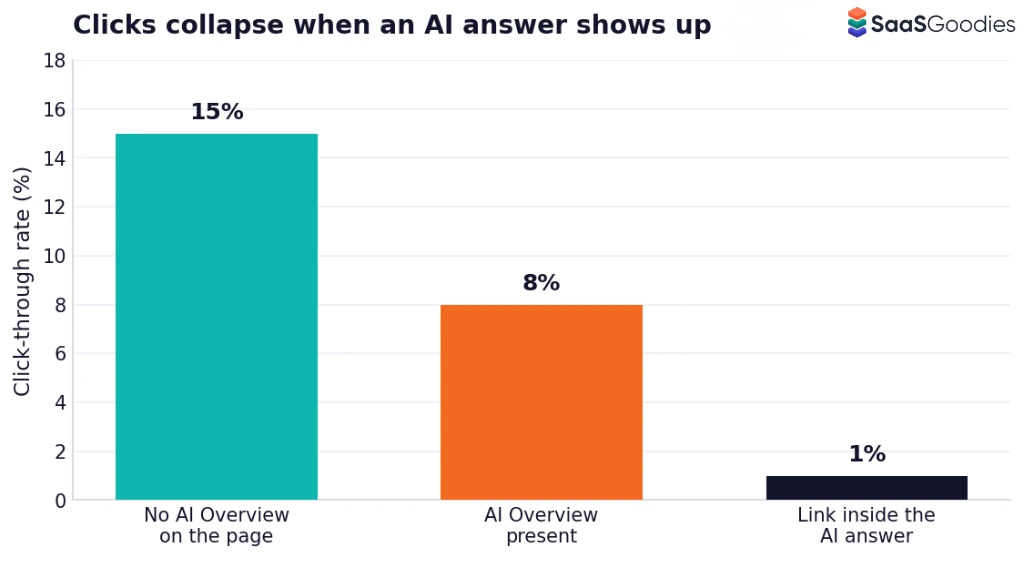
The clickless reality. An AI answer on the page roughly halves clicks, and links inside the answer barely get touched.
Look at that far-right bar. Only about 1 percent of users click a source link inside an AI summary. Being cited still matters, but clicks from it stay thin.
And this is early days. Google's AI Mode passed one billion monthly users, yet still sits near 0.34 percent of all searches. The next wave has barely started.
These zero-click search results are not a bug to wait out. They are the product Google now ships. Plan around them.
SaaSGoodies take
Stop measuring content by sessions alone. A buyer who saw your brand in an AI answer, then searched your name a week later, never showed up as organic traffic. Track brand search and citations, not just clicks.
Getting Cited By AI: The GEO And AEO Data That Matters
A new discipline grew up fast. Getting named inside AI answers is now its own job.
Two labels cover it. Generative engine optimisation aims to get your brand cited by tools like ChatGPT and Perplexity. Answer engine optimisation structures content so machines can lift a clean answer from it.
The numbers show how new and how urgent this is.
| AI search signal | 2026 figure | Why it lands |
|---|---|---|
| Marketers actively doing GEO | 43 percent | Up from near zero a year earlier |
| Brands invisible in AI search | 73 percent | Many get blocked by default bot settings |
| Marketers tracking AI citations | Only 14 percent | Most fly blind on the fastest-growing surface |
| AI referral traffic growth | About 796 percent year on year | Small base, steep climb, real intent |
| LLM visitors versus Google organic | Convert 4.4 times better | Fewer visits, far higher purchase intent |
| Overlap of top links and AI citations | Fell from 70 percent to under 20 percent | Ranking and citation are now separate games |
That last row is the big one. The pages AI cites are often not the pages ranking on page one. Around 90 percent of ChatGPT-cited pages rank position 21 or lower in classic search.
So how do you earn citations? Research points to three levers. Cite credible sources, add clear statistics, and include quotable lines. One academic test lifted AI visibility by up to 40 percent using exactly that mix.
Original data helps most of all. Sites publishing genuine expert research see organic traffic climb roughly 29.7 percent on average. Machines love numbers they cannot find elsewhere.
SaaSGoodies take
Want to win AI search visibility? Publish something only you can. Your own benchmarks, survey data or teardown numbers. This stats post you are reading is that exact play in action.
Video Keeps Eating Everyone's Lunch
Video stopped being optional a while back. Now it leads nearly every adoption chart.
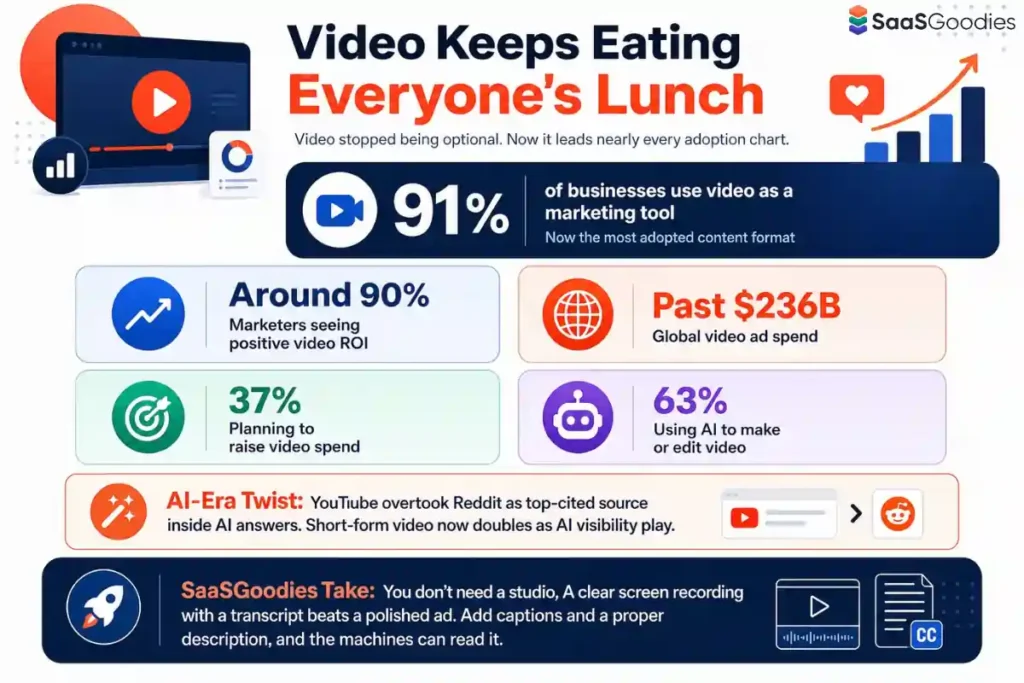
91 percent of businesses use video as a marketing tool. And 93 percent of video marketers call it important to their strategy.
Short-form still rules on return. Here is how the video picture looks this year.
| Video metric | 2026 figure | Read on it |
|---|---|---|
| Businesses using video | 91 percent | Now the most adopted content format |
| Marketers seeing positive video ROI | Around 90 percent | The return case is settled |
| Planning to raise video spend | 37 percent | Budget keeps shifting toward it |
| Global video ad spend | Past 236 billion dollars | A market of its own inside marketing |
| Using AI to make or edit video | 63 percent | Production cost dropped fast |
One AI-era twist favours video hard. YouTube overtook Reddit as the top-cited source inside AI answers in early 2026. Models like transcripts and clear explainer formats.
That means short-form video marketing now doubles as an AI visibility play. A clip earns reach and feeds the answer engines.
SaaSGoodies take
You do not need a studio. A clear screen recording with a transcript beats a polished ad that says nothing. Add captions and a proper description, and the machines can read it.
Blogging Is Not Dead, But Lazy Blogging Absolutely Is
Every year someone declares blogging finished. Every year the data disagrees.
Businesses with blogs still pull 55 percent more visitors than those without. Consistent publishers see up to 13 times the ROI of sporadic ones.
Length still counts, within reason. Here is what the blog data shows:
Now the hard truth. Roughly 90 percent of pages on Google get zero search traffic. And 53 percent of bloggers struggle to earn any at all.
Publishing volume alone is a losing bet in 2026. The bar for originality and structure keeps rising.
SaaSGoodies take
Do not chase 40 thin posts. Ship 10 strong ones with original angles, clean structure and real data. Then turn each into a video, a newsletter slot and five social posts. Fewer assets, more mileage.
B2B Versus B2C: Where The Money And The Leads Split
The two camps share principles but diverge on tactics. Format mix and buyer journey pull them apart.
Here is a side-by-side on the 2026 splits we watch most.
| Signal | B2B in 2026 | B2C in 2026 |
|---|---|---|
| Documented content strategy | 73 percent | 70 percent |
| Top performing formats | Case studies, thought leadership, original research | Short-form video, social posts, creator content |
| Buyers using LLMs to research | 94 percent | Rising fast, research-led |
| Attitude to gated content | 73 percent avoid it, prefer ungated | Less gated by default |
| Marketing budget as share of revenue | Around 9.1 percent median | Often higher on product side |
| Key distribution channel | LinkedIn, email newsletters | Instagram, TikTok, YouTube |
The B2B shift this year is stark. 94 percent of B2B buyers now use large language models to synthesise research. So the buying decision forms before any sales call.
That reframes the job. Your B2B content marketing strategy has to shape a shortlist during an anonymous research phase you cannot see. Ungated depth beats gated fluff.
On the B2C side, format leads. Creator content and social video carry first-touch research. Investment in creator content is tipped to grow around 61 percent in 2026.
SaaSGoodies take
B2B teams still gating a basic checklist behind a form in 2026 are leaking pipeline. Buyers self-educate now. Give them the good stuff free, and be the brand they already trust when they raise a hand.
The Formats Quietly Pulling Their Weight
Video and blogs grab headlines. But a few formats punch above their coverage.
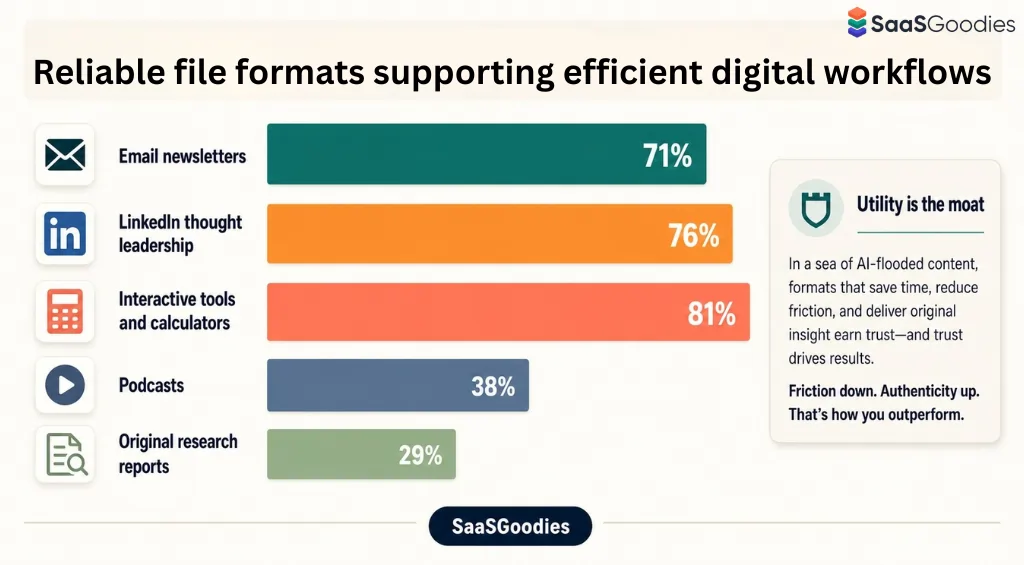
Here is where we see steady, underrated return this year:
Notice the pattern. The formats holding up all share one trait. They are hard to fake and hard for AI to flood.
Calculators need building. Research needs data. A good newsletter needs a real voice. That friction is exactly why they keep working.
SaaSGoodies take
We built free tools like our commission calculator for this reason. A useful tool earns links, citations and repeat visits that a listicle never will. Utility is the moat now.
Content Personalisation: The Gap Between Talk And Action
Everyone says they personalise. Far fewer actually do it well.
Only 21 to 22 percent of brands say they have fully wired AI personalisation across channels. So most sit in a messy middle.
And the prize is real. Firms that lead on personalisation generate about 40 percent more revenue than average players. That is not a rounding error.
Trust sets the ceiling though. 78 percent of consumers say clear labelling of AI-generated content is very important. Hide the machine and you risk the relationship.
Here is the tension in plain terms. Buyers want content that feels made for them. They also want to know a human stands behind it.
SaaSGoodies take
Personalisation does not mean 50 near-identical pages. Start with two or three real audience segments and write for them properly. Depth beats fake one-to-one every time on a small team.
Distribution Beats Production, And The Data Proves It
Here is the mistake we see most. Teams pour 90 percent of effort into making content and 10 percent into moving it.
In 2026 that maths is backwards. With clicks scarce, distribution does the heavy lifting.
Look at where reach actually comes from now:
The smart move is a repurpose engine. One strong asset becomes a video, a newsletter slot, a carousel and several social posts.
That single habit is the cheapest growth lever most teams ignore. More surface area, same core work.
SaaSGoodies take
Build the distribution plan before you write a word. If you cannot name five places a piece will live, do not commission it yet. Content nobody sees returns nothing, however good.
What We Think Happens Next: Our 2026 To 2027 Projections
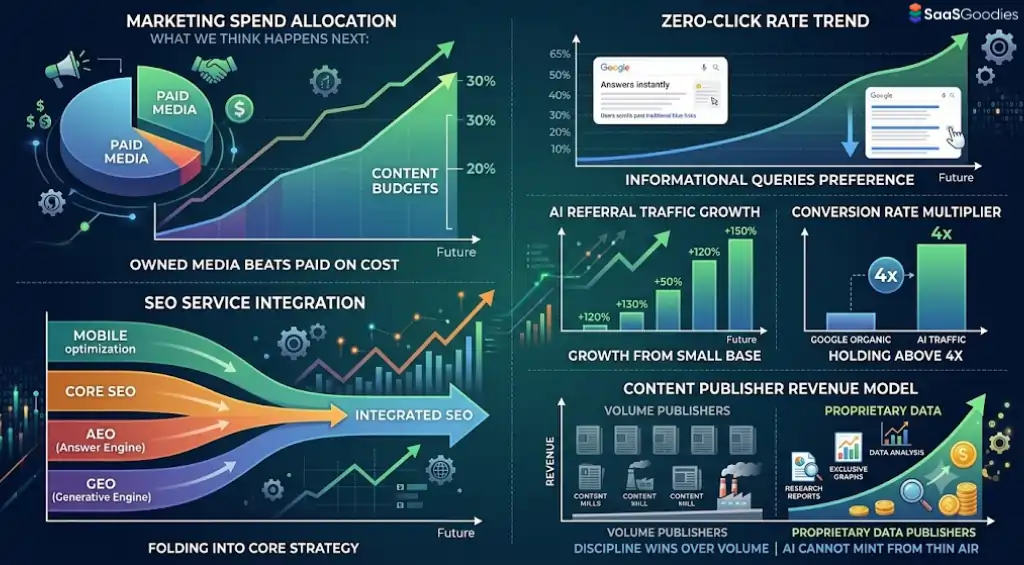
Time for our own calls. These are estimates from our desk, not gospel. But we track this daily and we will stand behind them.
Pull it together and the story is simple. These content marketing statistics reward discipline over volume in 2026. Measured, AI-assisted, data-backed programs win. Spray-and-pray loses.
SaaSGoodies take
Our honest one-liner after years in the trenches? Content still works beautifully. It just stopped being easy. The teams treating it like a product, not a content mill, are the ones we watch pull ahead.
Content Marketing Statistics 2026: Quick Answers
How big is the content marketing industry in 2026?
Global content marketing revenue pushed past 107 billion dollars in 2026. The US market alone sits near 299 billion dollars. Roughly 82 percent of businesses now run content marketing in some form.
What is a good content marketing ROI in 2026?
The average three-year return runs near 844 percent. Content typically breaks even around month seven, then compounds. A strong median revenue return sits at about 4.33 to 1.
Is blogging still worth it with zero-click search?
Yes, but only done well. Blogs still bring 55 percent more visitors. The trick is original data and answer-ready structure, since about 90 percent of pages now get zero search traffic.
How many marketers use AI for content?
Between 87 and 94 percent use AI-powered tools for content tasks in 2026. Use has shifted from drafting toward editing, research and repurposing. Only 29 percent have a formal governance policy though.
What is the difference between GEO and AEO?
Generative engine optimisation gets your brand cited inside AI answers. Answer engine optimisation structures content so machines can lift a clean reply. Both aim at visibility, not just blue-link rankings.
Which content format has the best ROI in 2026?
Email returns the most per dollar at 36 to 42 dollars. Website, blog and SEO content rank as the top overall ROI channel. Short-form video pays back fastest of the video formats.
How do you get content cited by ChatGPT or AI Overviews?
Publish original data, add clear statistics, and structure answers so a machine can lift them cleanly. Around 90 percent of cited pages rank position 21 or lower, so citation and ranking are separate games now.
Is content marketing still worth it for small businesses?
Yes, if you stay focused. Most small firms spend under 1,000 dollars a month and still win by picking one or two channels. Original angles and consistency beat a big budget spread thin.
Sources And Further Reading
We fact-checked every figure above against primary research and trusted industry data. Full source list below.
- Statista, Content Marketing market data
- Content Marketing Institute, 2026 Benchmarks and Budgets
- HubSpot, State of Marketing Report 2026
- Semrush, Content and AI search research
- Ahrefs, AI Overviews click-through study
- SparkToro and Datos, Zero-Click Search research
- Wyzowl, Video Marketing Statistics 2026
- Similarweb, Zero-Click Marketing 2026
- EMARKETER, Content Marketing 2026 report
- Siege Media, Content Marketing Statistics 2026
- Gartner, 2026 CMO Spend Survey
- Salesforce, State of Marketing 2026
- Pew Research Center, AI Overviews and search behaviour
- Litmus, State of Email 2026
Figures reflect the latest 2026 reporting available at time of writing. We refresh our stats.