Link Building Statistics 2026: What Still Moves Rankings

Here's the headline: 96.55% of all web pages get zero backlinks. Zero. So if you earn even a handful of good ones, you're already ahead of nearly everyone. That's the quiet edge backlinks still hand you in 2026.
The number one Google result carries 3.8 times more backlinks than pages ranked 2 to 10. But the game shifted this year. AI search now rewards brand mentions almost 3 times more than raw links. We pulled the freshest Link Building Statistics of 2026 and stacked our own numbers next to them.
We've been building links and writing about SEO since 2015. That's ten years of outreach, botched pitches, budget fights, and campaigns that quietly printed money.
So this isn't a copy-paste of the same five figures you've seen everywhere. We fact-checked every number, cut the fluff, and added our own data-backed link building calls where the public research goes quiet.
Let's start with the big picture.
The 2026 Snapshot: Link Building By The Numbers
Most pages on the web are invisible. That's not a slogan. It's the single most useful fact in SEO.
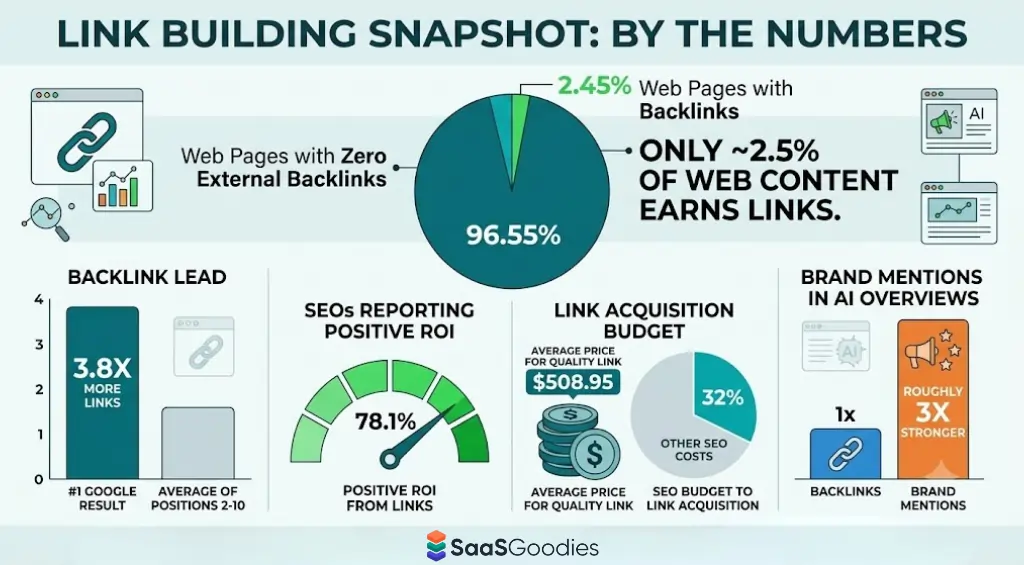
Only 2.2% of content earns links from more than one site. Around 55% of indexed pages have no referring domains at all. So the bar to stand out is lower than people think.
Here are the numbers we keep coming back to.
| Metric | 2026 figure | Why it matters |
|---|---|---|
| Web pages with zero external backlinks | 96.55% | Earning even a few good links puts you ahead of nearly all rivals |
| Backlink lead of the #1 Google result | 3.8x more than positions 2 to 10 | Links still track closely with top spots |
| Backlinks as a Google ranking factor | Top 3 signal | Google still uses links to rank and find pages |
| SEOs reporting positive ROI from links | 78.1% | Most teams make their money back and then some |
| Average price a quality backlink now commands | $508.95 | The cheap end of the market has mostly gone |
| SEO budget going to link acquisition | About 32% | The single biggest line item, ahead of content |
| Teams that grew their link budget in 2026 | 58% | Only 14% cut back |
| Brand mentions vs backlinks for AI Overviews | Roughly 3x stronger | Mentions now outrank links for AI visibility |
The story in one line: links still work, they cost more, and a second signal just joined the party.
SaaSGoodies Insight: We think the “96.55% have no links” stat is the most under-used number in marketing. It reframes the whole job. You're not fighting millions of sites. You're fighting the few thousand in your niche who actually bother. Pick your ten target pages, earn five real links each, and you've already beaten most of the internet.
Do Backlinks Still Move Rankings In 2026?
Short answer: yes. And we can prove it with more than correlation.
A controlled disavow test showed what happens when links vanish. Removing backlinks from test pages dropped organic traffic by 13.3% to 18%. Putting them back recovered 99% to 144% of that traffic. So this isn't guesswork. Links carry weight.
A few ranking-side numbers worth pinning up:
Long content still pulls its weight too. Articles above 3,000 words earn roughly 3.5 times more links than short posts. Content over 2,000 words attracts about 77% more backlinks than thin pieces.
That last point is why statistics pages like this one exist. They're link magnets.
Content That Earns Links Without You Asking
Some content pulls links on its own. You build it once, and it keeps working while you sleep. That's the dream, and the data shows which formats deliver it.
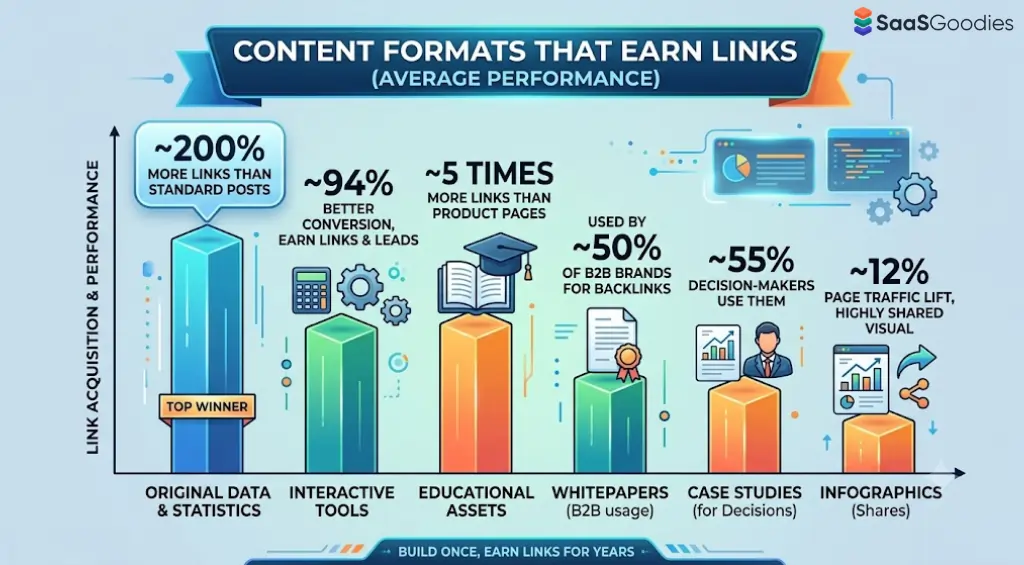
Original research is the clear winner. Pages built on original data and statistics attract around 200% more links than standard posts. That's why we keep publishing numbers.
The rest of the top link-earning formats break down like this:
Notice the pattern. None of these are sales pages. They're free value that other people want to reference. That reference is your link.
There's a hard business case here too. Sites holding a profile of 30 to 35 quality backlinks pull an average of 10,500 or more visits a month. So a modest, clean profile does real work.
SaaSGoodies Read: If we could only build one thing per quarter, it'd be a data study. Every stats page we've shipped became a passive link engine within months. The upfront work is real. The payoff keeps compounding long after the content marketing calendar has moved on. Build the asset once, earn the links for years.
What A Quality Backlink Actually Costs Now
Prices climbed hard. The average cost per link crossed $500 in 2025 and held there.
The number SEOs are willing to pay for one quality backlink now sits at $508.95. About 76% will pay $300 or more. Nearly half will go past $500. The bottom of the market, the cheap dozen-links-for-pennies stuff, has shrunk to about 6% of buyers.
Cost splits sharply by tactic. Here's what each method runs in 2026.
| Link building tactic | Cost per link (2026) | Typical DR earned | Effort level |
|---|---|---|---|
| HARO / expert quotes | $15 to $50 | 60 to 85 | High time, low cash |
| Niche edits (link insertions) | $141 to $361 | 40 to 70 | Low, no new content |
| Guest posting | $220 to $609 | 30 to 65 | Medium, needs writing |
| Digital PR / editorial | $1,250 to $1,500+ | 70 to 85 | Very high, pitch journalists |
| Original data study | $500 to $5,000 | 70 to 85 | Highest, creation heavy |
White-label rates sit lower for agencies buying in bulk, roughly $110 to $300 per link. Monthly packages swing from around $697 to nearly $20,000 depending on client count and difficulty.
From Our Desk: We reckon the true 2026 average for a genuinely useful editorial link lands nearer $450 to $600, not the $150 some vendors quote. If a price looks too good, it's a private blog network wearing a nice suit. We've seen those links get sites penalised. Pay for traffic-bearing placements or don't bother.
How Much Marketing Teams Spend On Links
Link building stopped being a side task. It's now a proper budget line.
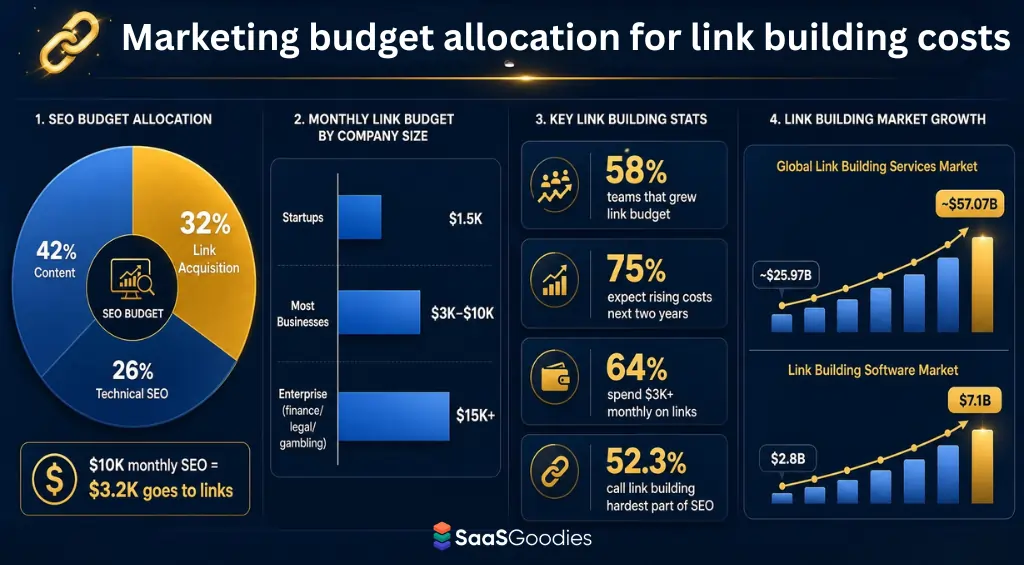
Teams put about 32% of total SEO spend into link acquisition. That's the biggest slice, ahead of both content and technical work. On a $10,000 monthly SEO budget, roughly $3,000 to $3,600 heads straight to links.
Budgets by size shake out like this:
The direction of travel is up. 58% of teams grew their link budget in 2026 versus 2025. Only 14% trimmed it. And 75% expect costs to keep rising over the next two years.
A related shift: about 64% of teams now spend $3,000 or more a month on links. The days of a $200 monthly link budget moving the needle are gone.
Why do teams keep paying? Because the alternative costs more. 52.3% of marketers call link building the single hardest part of SEO. Hard tasks with high payoff attract budget. Simple as that.
There's a reason spending holds firm. The global link building services market sat at roughly $25.97 billion in 2025. It's on course to reach $57.07 billion by 2030. The software side alone hit $2.8 billion in 2025, tracking toward $7.1 billion by 2034.
Our Projection: the effective cost of a top-tier editorial link climbs another 20% to 30% by 2028. AI-written pitches are flooding editor inboxes right now. Editors respond by raising the bar, which raises the price. The teams locking in relationships and rates this year will look very smart in two years' time.
Which Link Building Tactics Win In 2026
One method pulled clear of the pack. Digital PR is the tactic SEOs now trust most.
34% of professionals name digital PR link building their single best-performing method. That's nearly double guest posting. Rate it by pure effectiveness score and digital PR hits 48.6%, roughly three times ahead of guest posts.
Here's how the main methods compare on adoption and results.
| Tactic | Named best-performing | Adoption | Placement success rate |
|---|---|---|---|
| Digital PR | 34% | 45.6% | 5% to 15% |
| HARO / expert quotes | 21% | Wide | 5% to 7% per response |
| Guest posting | 18% | 64.9% | 38.9% effectiveness rating |
| Link exchanges | 0% | 43.8% | Low, and risky |
| Niche edits | 6% | Growing | Varies |
| Broken link building | Low | Niche | 2% to 5% |
| Skyscraper technique | Medium | Niche | About 11% |
Notice link exchanges. Nearly 44% of teams still swap links, yet not a single surveyed pro named it their best method. That's a habit worth dropping.
Digital PR wins on quality too. The average campaign earns links from 42 referring domains at an average DR of 61. Guest posts rarely reach that quality profile.
Quality now beats volume almost everywhere. Around 94% of link builders say quality matters more than quantity. And 93.8% prioritise relevance over sheer numbers.
Cold Outreach Reply Rates: The Honest Version
This is where dreams meet the inbox. Most pitches get ignored.
The long-standing benchmark says only 8.5% of outreach emails get any reply. Newer data is harsher. Some 2026 samples put cold reply rates as low as 3.43%. Inboxes are fuller and spam filters are stricter.
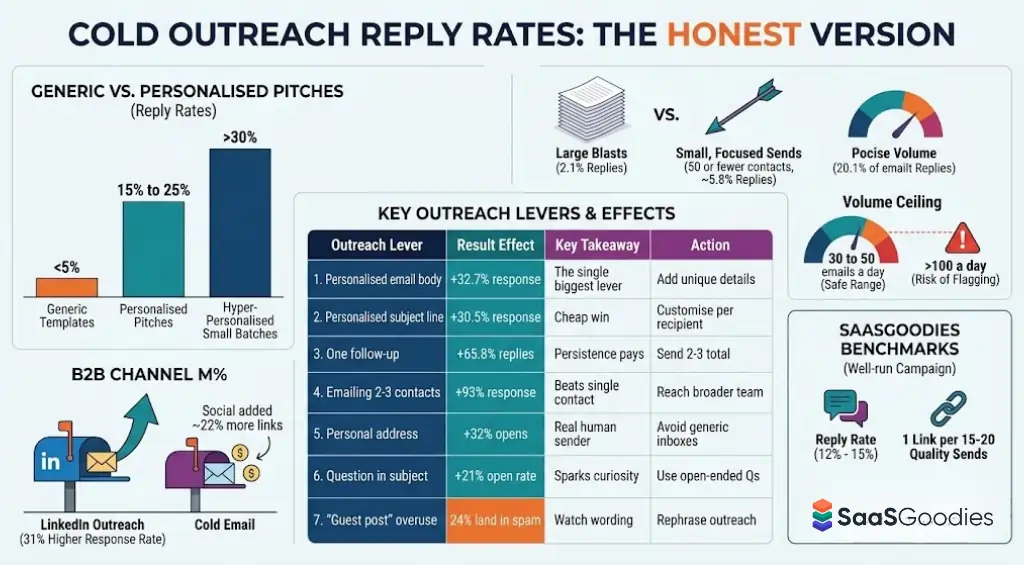
Personalisation is the whole ball game. Generic templates limp in below 5%. Personalised pitches land 15% to 25%. Tight, hyper-personalised small batches clear 30%.
The mechanics of a better reply rate are well measured.
| Outreach lever | Effect on results | Our read |
|---|---|---|
| Personalised email body | +32.7% response | The single biggest lever |
| Personalised subject line | +30.5% response | Cheap win, do it first |
| One follow-up | +65.8% replies | Persistence pays, once |
| Emailing 2 to 3 contacts | +93% response | Beats a single named contact |
| Personal address vs generic inbox | +32% opens | Send from a real human |
| Question in subject line | +21% open rate | Curiosity still works |
| Overusing “guest post” type terms | 24% land in spam | Watch your wording |
| Average time to secure one link | About 3.1 months | Patience is a strategy |
A word on follow-ups. Two to three is the sweet spot. Push past three and reply rates fall while spam complaints nearly triple. More is not better here.
Batch size matters more than most teams admit. Small, focused sends of 50 contacts or fewer average around 5.8% replies. Large blasts drop to about 2.1%. So smaller and sharper wins.
There's a volume ceiling too. The safe range is 30 to 50 outreach emails a day. Push past 100 and you risk getting flagged by email providers, which quietly kills your deliverability.
One more nugget for B2B teams. LinkedIn outreach pulls a 31% higher response rate than cold email in B2B niches. Social adds around 22% more links a month for teams that use it.
Key Insight: Our internal benchmark for a well-run campaign is a 12% to 15% reply rate and one link for every 15 to 20 quality sends. If you're below that, your list is too broad, not your copy. Tighten targeting before you touch the template. Ninety per cent of the time, the fix is the list.
Anchor Text Ratios That Keep You Safe
Anchor text is where confident marketers still get sites penalised. The rules tightened.
Branded anchors are the most common at 36.4%, and they correlate with better rankings. Exact-match anchors are the danger zone. Sites with more than 15% exact-match anchors are 3.2 times more likely to catch a Penguin penalty.
Modern spam systems read your whole profile, not each link alone. So one clean link inside a spammy pattern won't save you.
Here's the safe distribution we aim for on client profiles.
| Anchor type | Safe share of profile | Notes |
|---|---|---|
| Branded (your name, your URL) | 40% to 50% | Safest, most natural, builds trust |
| Generic (“read more”, “this guide”) | 20% to 30% | Looks organic, low risk |
| Partial match (“SaaS SEO tools”) | 15% to 25% | Useful, keep it measured |
| Exact match (“link building statistics”) | 1% to 5% | High value, high risk, go easy |
| Naked URL and other | 5% to 10% | Rounds out a natural mix |
The nofollow question also settled down. Since 2019, Google treats nofollow as a hint, not a hard rule. Top-10 pages carry an average mix near 60% dofollow and 40% nofollow. And 78.8% of SEOs believe nofollow links affect rankings indirectly.
So a profile that's 100% dofollow looks engineered. A natural mix looks like a real brand.
The AI Search Shift: Mentions Now Outrank Links
This is the story of 2026. A second currency joined backlinks, and for AI answers it's worth more.
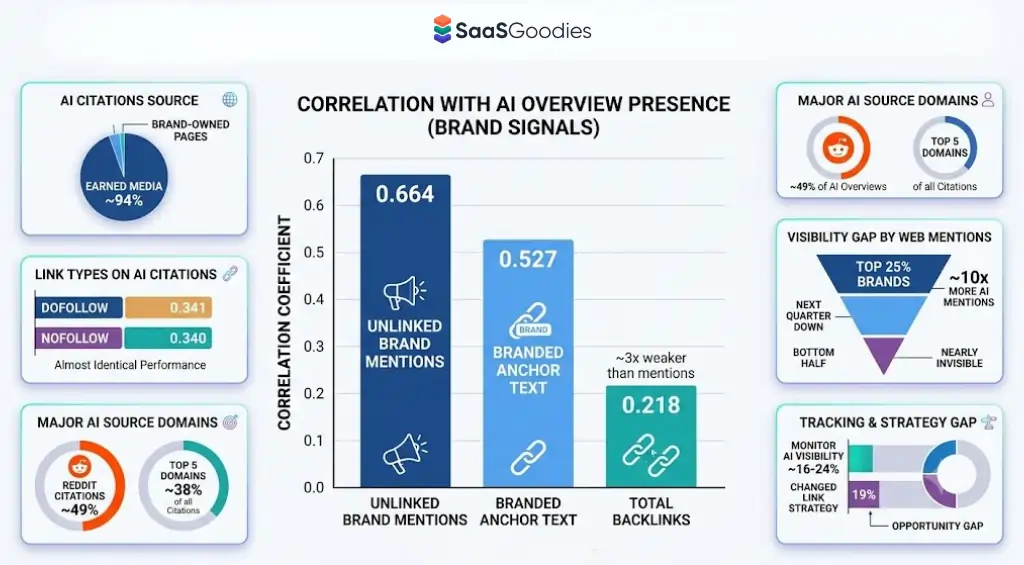
A 75,000-brand analysis measured which signals predict presence in AI Overviews. Unlinked brand mentions led at 0.664 correlation. Branded anchor text followed at 0.527. Total backlinks came last of the named factors at 0.218.
So brand mentions correlate roughly 3 times stronger than plain backlinks for AI visibility.
A few more numbers that changed how we plan campaigns:
Where do AI engines pull their sources? Not from brand blogs. Reddit alone is cited in roughly 49% of Google AI Overviews. The top five domains account for about 38% of all AI citations. And 44% of AI-search users now call AI their main source of insight, ahead of traditional search at 31%.
The gap between winners and losers is brutal here. Brands in the top 25% of web mentions earn around 10 times more AI Overview mentions than the next quarter down. Brands in the bottom half are close to invisible to AI.
Yet almost nobody tracks this. Only about 16% to 24% of brands monitor their AI search visibility. And just 19% have changed how they build links because of it. That gap is an opportunity.
How AI Tools Changed The Link Building Job
AI didn't kill link building. It changed who's doing the boring parts.
Around 86% of marketing professionals now use AI SEO tools, and backlink automation sits among their top three uses. So the prospecting grind is getting handed to software.
But adoption inside the actual outreach workflow is still low. Only about 6% of SEO experts have folded AI into their link-building process for prospecting and quality checks. That's a wide open door.
AI-assisted outreach, meaning pitches personalised with AI but still sent by a human, lifts efficiency around 3 times with no real drop in reply rate. The winning setup is AI for research, humans for the relationship.
Here's the catch nobody mentions. The same AI that speeds up your outreach is flooding every editor's inbox with generic pitches. So AI raises your output and your competition at once. The edge goes to teams who use AI for speed and keep the human judgement where it counts.
We use AI daily for prospecting, list cleaning, and first-draft angles. We never let it send the final pitch. The math is simple. AI gets you to the inbox faster, but only a real, specific, human note gets the reply. Automate the grind, protect the craft.
Link Building ROI By Industry In 2026
Now the number your finance team cares about. Does it pay?
Across all channels, SEO returns a median 748% ROI, the highest of any tracked channel. Link building specifically shows positive ROI for 78.1% of teams. And brands that invest consistently grow organic revenue about 2 times faster than content-only teams.
Return depends heavily on deal size, so it splits by industry.
| Industry | SEO / link ROI | Break-even window |
|---|---|---|
| Real estate | Highest tracked | Fast, high deal value |
| Financial services | Very high | Medium |
| B2B SaaS | 702% | About 7 months |
| Legal services | 526% | Around 14 months |
| Ecommerce | Strong, volume driven | Medium |
Consistency beats bursts. Steady link acquisition over 12 months or more delivers about 4.2 times more ranking improvement than the same links crammed into a short push.
The lead quality is the quiet reason ROI stays high. SEO leads driven by strong rankings close at around 14.6%. Outbound and traditional leads close at just 1.7%. So a link doesn't only lift traffic. It brings warmer buyers.
Experience compounds too. Practitioners who do this daily build around 3.57 times more links than beginners. That gap widens as standards tighten.
And a slightly awkward truth: 74.3% of link builders pay for links, while 92% believe their competitors do the same. So the “we only earn links naturally” line is mostly for the audience.
Digital PR: The Method Everyone's Betting On
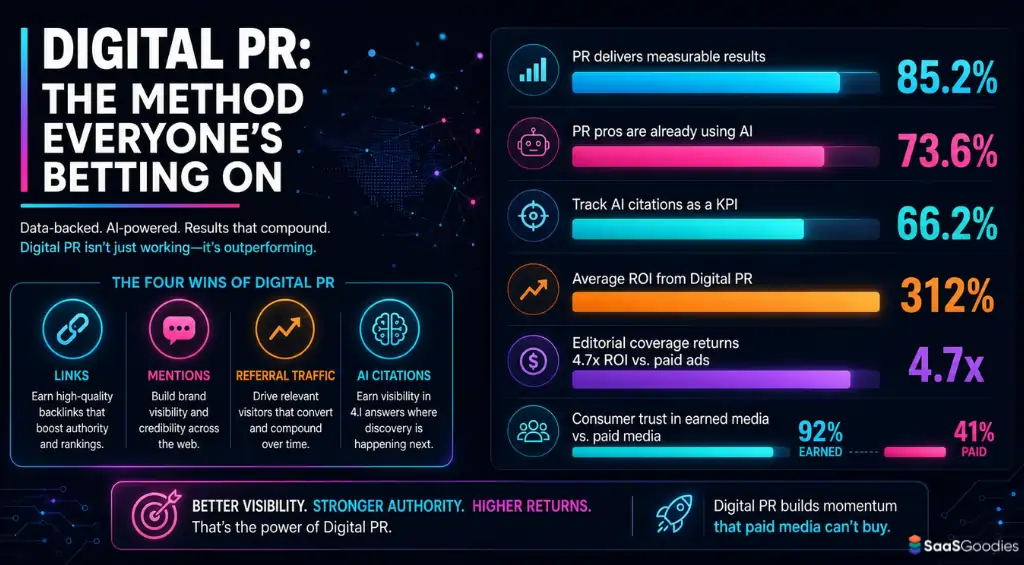
Digital PR earned its own section because the money is following it.
The digital PR services market sat around $12.3 billion in 2023. It's tracking toward $25.4 billion by 2032, more than doubling. Adoption backs that up.
Key digital PR numbers for 2026:
Digital PR does two jobs at once. It earns the link and the named brand mention in the same placement. Given the AI shift above, that double hit is exactly why it's winning.
SaaSGoodies Perspective: We think digital PR is the closest thing to a cheat code in 2026, and also the hardest to fake. You can't shortcut a real story. But land one data-led campaign on a DR 70+ publication and you get links, mentions, referral traffic, and AI citations from a single pitch. That's four wins on one invoice. Nothing else in link building does that.
What We Think Happens Next
Time for our own calls. These are SaaSGoodies estimates, based on ten years of doing the work, not repeating a survey.
If we had to bet one dollar on a single move for 2026, it's this. Build one linkable data asset per quarter and pitch it like a story. That one habit feeds links, mentions, and AI citations all at once.
That's the through-line across every one of these Link Building Statistics. The tactics change. The reward for being genuinely useful and genuinely visible does not.
Sources
- Statista, SEO and digital marketing market data
- Ahrefs, backlinks and AI Overview correlation studies
- Backlinko, 12 million outreach email study and ranking analysis
- Semrush, backlinks and AI search visibility study
- Authority Hacker, State of Link Building survey
- Moz, anchor text and ranking factor research
- Pitchbox, outreach personalisation data
- editorial.link, cost per link and budget survey
- Reporter Outreach, State of Link Building 2026 survey of 500 SEOs
- First Page Sage, SEO ROI by industry analysis
- BuzzStream, link building pricing and tactics data
- Research and Markets, link building services market forecast