SEO Statistics 2026: AI Overviews, Zero-Click & Organic CTR

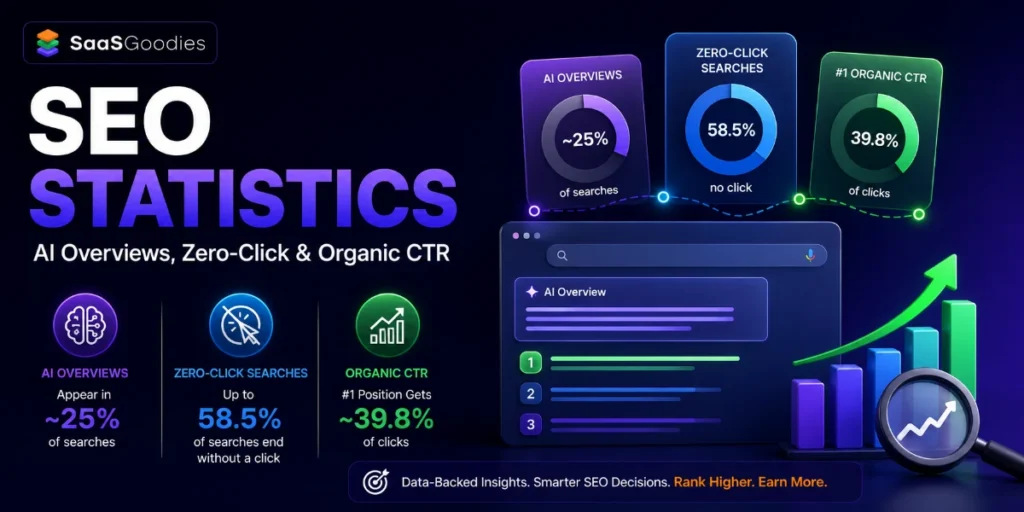
SEO in 2026 is defined by one force — AI search — and the headline is stark: 58.5% of US Google searches already end without a click, and when an AI Overview appears, position-one organic click-through can fall by up to 58%.
SEO is the practice of earning visibility in search results; in 2026 that increasingly means being cited by an AI answer, not just ranking below it.
But the “SEO is dead” narrative is wrong: organic search still drives roughly 53% of all web traffic, and Google sends 345x more clicks than ChatGPT, Gemini and Perplexity combined.
Key SEO Statistics At a Glance
How Many Searches End Without a Click?
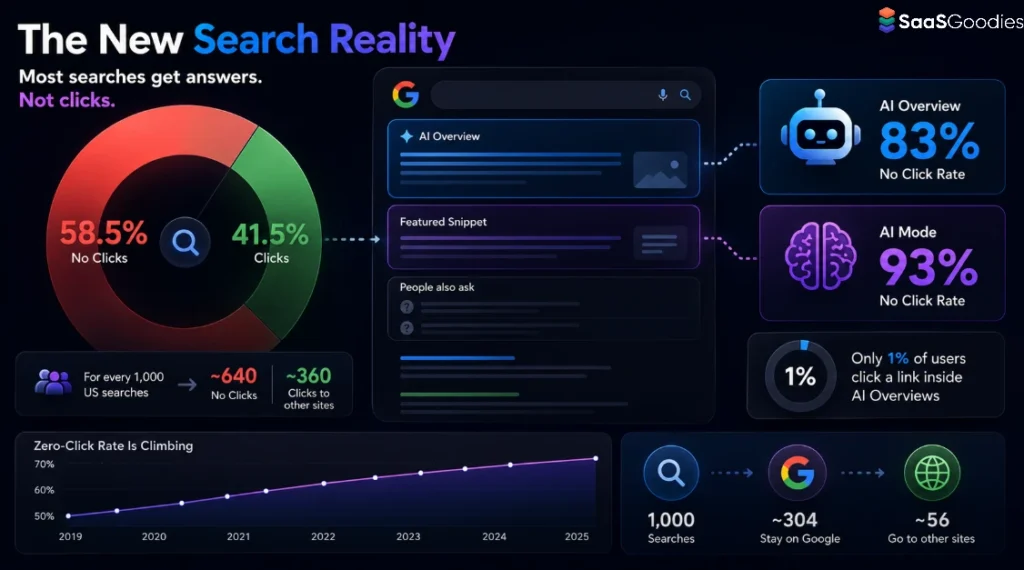
58.5% of US Google searches end without a click — a figure that climbs to 83% when an AI Overview is present and 93% in AI Mode, confirming that more than half of all search now resolves on the results page itself. Zero-click is the defining metric of modern SEO.
| Context | Zero-click rate |
|---|---|
| All US Google searches (baseline) | 58.5% |
| EU Google searches | ~59.7% |
| All searches (2026) | ~60–65% |
| AI Overview queries | 83% |
| AI Mode sessions | 93% |
The zero-click reality means traffic-focused SEO metrics now capture less than half the picture. The important nuance is that this trend started long before AI — AI Overviews are an accelerant, not the origin.
For marketers, the takeaway is that rankings without click-through monitoring give an incomplete view: a page can hold position one and still lose traffic to an answer sitting above it.
How much do AI Overviews Reduce Clicks?
This is the most misquoted figure in SEO: AI Overviews reduce organic CTR by anywhere from 18% to 61% — and those numbers aren't contradictory, because Pew, Ahrefs and Seer each measured something different. Understanding which is which is the whole game.
| Study | CTR impact | What it measured |
|---|---|---|
| Digital Applied | −18% average | Aggregate organic CTR |
| Pew Research | 15% → 8% (47% rel.) | User click behaviour, 68,879 searches |
| Ahrefs | up to 58% | Position-1 CTR, 300k keywords |
| Seer Interactive | 61% | Organic CTR on AIO queries |
The “AI Overviews cut clicks by X%” stat is meaningless without knowing the base. Pew's 47% is a relative drop in overall click behaviour; Ahrefs's 58% is position-one specific; Seer's 61% is AIO-query specific.
They describe the same phenomenon from different angles. When a competitor's page cites one of these as the number with no context, that is the tell. The honest read: the damage is real, concentrated on informational queries, and lighter on transactional ones.
How Common are AI Overviews Now?
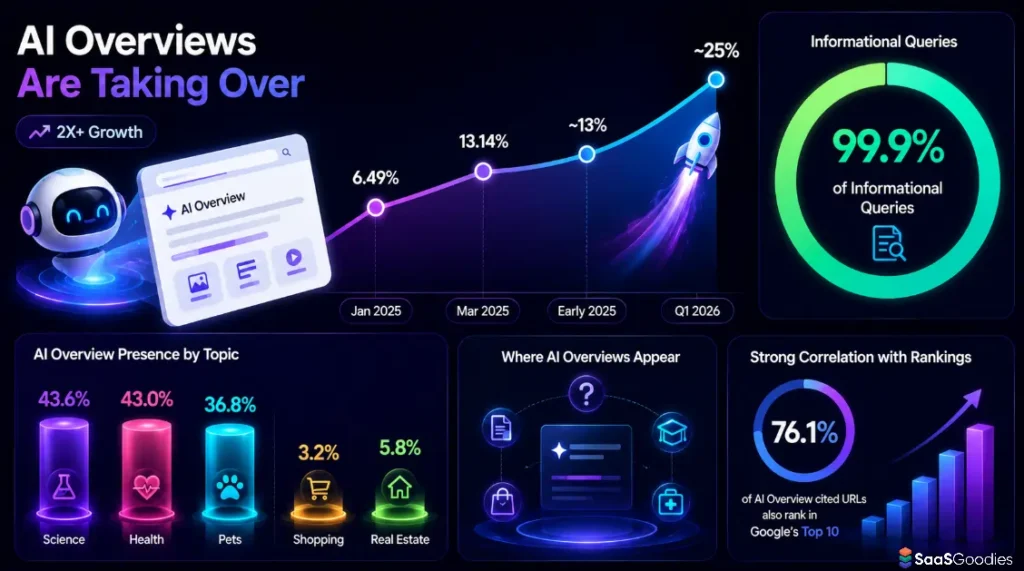
AI Overviews have gone from a niche feature to a default — appearing on roughly 13% of searches in early 2025, climbing to about 25% by Q1 2026, and reaching 99.9% of informational keywords. Coverage depends heavily on query type.
| Measurement | AIO prevalence |
|---|---|
| Early 2025 | ~13% |
| Q1 2026 | ~25% |
| Informational keywords | 99.9% |
| Highest sector (Science) | 43.6% |
| Lowest sector (Shopping) | 3.2% |
AIO prevalence is a moving target — 13%, 25%, 48% and 55% all circulate for 2026 because the measurement date and query mix differ.
The actionable pattern is sectoral: informational and YMYL queries are nearly saturated with AI Overviews, while shopping and transactional queries are barely touched.
The strategic implication is to shift informational content toward formats AI can't easily synthesise — comparisons, demos, first-hand data — and protect transactional pages where AIO is rare.
Does SEO Still Drive Traffic and ROI?
Despite the AI disruption, organic search still drives roughly 53% of all web traffic, returns 8x ROI (double PPC), and 92% of marketers plan to hold or raise SEO budgets in 2026 — the “SEO is dead” narrative isn't supported by the data. Organic remains the dominant channel.
SEO is being reshaped, not killed — organic still dwarfs AI-tool referral traffic by 345x, and the ROI case remains strong.
The harder truth is the 96.55% figure: the vast majority of published content is invisible, and AI Overviews widen the gap between pages with genuine authority and everything else.
The winners are the ones with topical authority and original data — exactly what AI engines prefer to cite.
What's the Click-through Rate by Ranking Position?
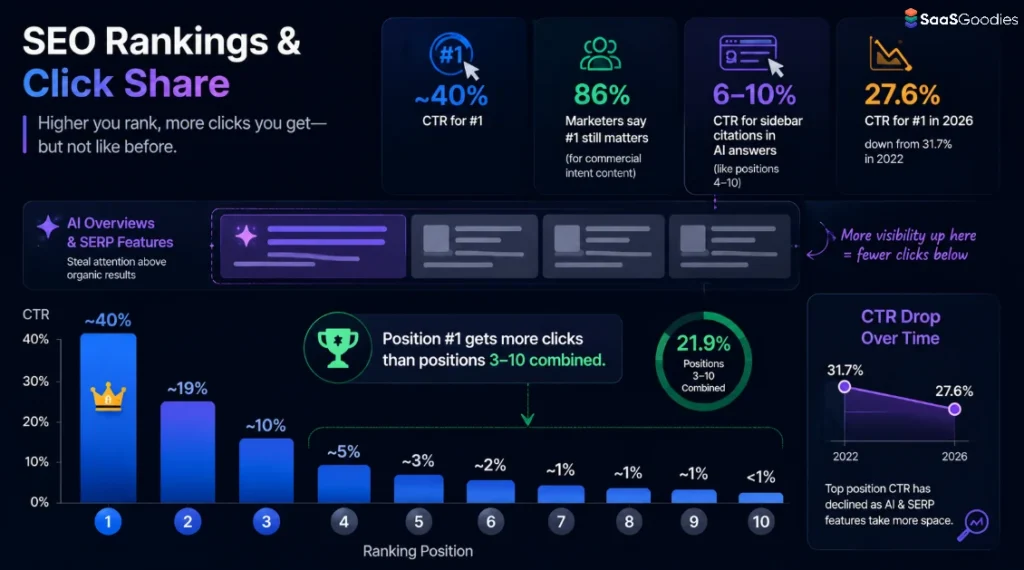
The #1 organic result still earns roughly 28–40% of clicks depending on the study — and position one alone gets more clicks than positions three through ten combined — but every position's CTR has fallen as AI Overviews and SERP features absorb clicks above the organic listings.
The top spot still matters; it just delivers less than it used to.
| Position | CTR (SE Ranking 2025) |
|---|---|
| #1 | 39.8% |
| #2 | 18.7% |
| #3 | 10.2% |
The position-one CTR figure ranges from 27.6% to 39.8% across studies because the keyword sets and SERP layouts differ — quote the one whose methodology matches the use case.
The durable insight is the steepness of the curve: clicks concentrate massively at the top, so the gap between position one and position five is enormous. As AIO erodes the top, earning a citation inside the AI answer (6–10% CTR) becomes a meaningful alternative to a mid-page organic slot.
How do People Behave Inside AI Search?
Inside Google's AI Mode, 88% of users accept the AI's shortlist without checking other sources, the AI's top pick becomes the user's pick 74% of the time, and 75% of sessions end without anyone leaving the pane — a fundamental shift in how decisions get made. The AI doesn't just answer; it decides.
The 88%-take-the-shortlist and 74%-top-pick figures are the most strategically important numbers in AI search, because they mean the battle is now to be in the AI's consideration set, not merely visible nearby.
The divergence between AI Overviews (76% of citations rank top 10) and ChatGPT/Perplexity (only ~20%) matters enormously: ranking well in Google earns AIO citations, but LLMs require a separate play built on broad, contextually relevant mentions across the web.
Which Industries are Hit Hardest — and Which are Winning?
AI Overviews are hitting verticals unevenly — Healthcare, Finance and News are losing the most organic traffic, while SaaS and Local Services are the two clear bright spots actually seeing organic growth. Where you compete shapes how much AI search costs you.
The sector you operate in largely determines your AI-search exposure. YMYL and news publishers face structural pressure as AI answers their queries directly, while SaaS and local businesses retain defensible ground — SaaS through deep topical clusters that AI Overviews under-serve, local through map-based intent AI can't easily satisfy.
For affiliates in SaaS niches, this is encouraging: the category is among the more resilient, provided the content is built on genuine authority rather than thin guides.
What these SEO Statistics Mean for 2026
| Forecast / trend | Signal |
|---|---|
| AI Mode daily users | 75 million |
| Ads in AI Overviews | 25.5% (+394%) |
| US AI search ad spend (2026→2029) | $2.08B → $25.93B |
- Omnibound — “AI SEO Statistics (2026)” (Pew, Ahrefs, Seer, SparkToro, Gartner).
- Position Digital — “150+ AI SEO Statistics for 2026” (Ahrefs, Semrush, Seer, Growth Memo).
- Digital Applied — “AI Search and SEO Statistics 2026” & “Zero-Click Search Statistics 2026” (Conductor, eMarketer).
- ClickRank — “SEO Benchmarks 2026: CTR, Traffic & AI Standards” (BrightEdge, SparkToro).
- BizIQ — “SEO Statistics 2026” (SE Ranking, NP Digital, Ahrefs, HubSpot, BrightEdge).
- SQ Magazine — “AI SEO Statistics 2026” (Ahrefs, Aira, SparkToro, Originality.ai).
- Goodfirms — “SEO Statistics: AI Search, Rankings, Zero-Click Trends.”
- Pasquale Pillitteri — “Google AI Mode and Zero-Click 2026” (Bain, Semrush, Pew, Conductor).