Affiliate Commission Rate Statistics and Benchmarks (2026)

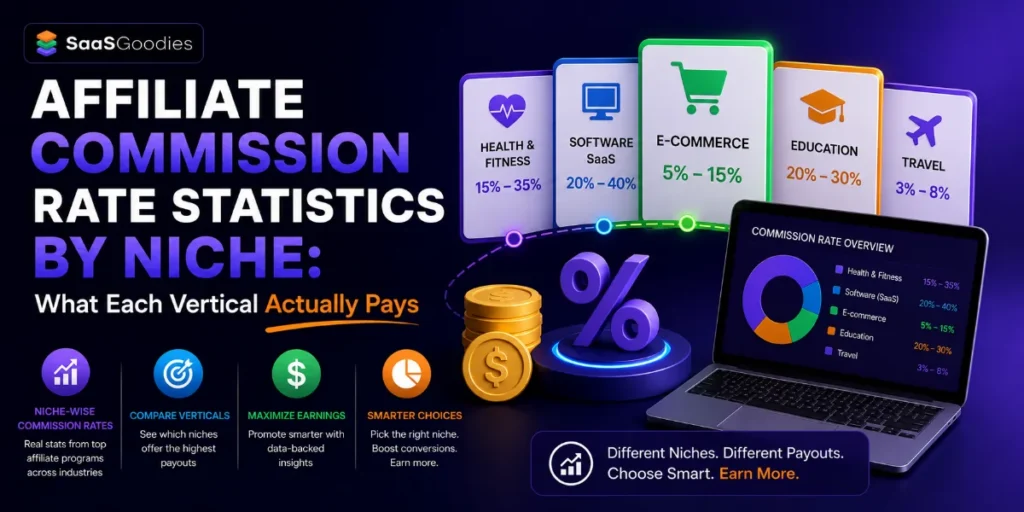
Affiliate commission rates in 2026 span an enormous range — from 1% on flight bookings to as much as 75% on some web hosting products — but the raw percentage tells operators almost nothing on its own.
An affiliate commission rate is the percentage of a sale, or the flat fee per lead, that a merchant pays a partner for a referred conversion.
What actually decides earnings is the full economics behind that number: average order value, conversion rate, cookie duration, refund rate, and — above all — if the commission repeats every month.
This Affiliate commission rate statistics report covers commission benchmarks across the major verticals, separates the high-percentage traps from the genuinely high-value niches, and flags what is shifting in 2026.
Key Affiliate Commission Rate Statistics for 2026: Quick Overview
What is a Typical Affiliate Commission Rate in 2026?
A typical affiliate commission runs 5–30% of the sale, with digital products at the top (20–50%) and thin-margin physical goods at the bottom (5–20%). The number is driven almost entirely by gross margin: a business with 60% margins can pay far more than one running at 20%.
The broad split by product type:
The percentage only makes sense against the price point. A 10% commission on a $2,000 product pays $200; the same 10% on a $50 product pays $5. Chase the dollar per conversion and the lifetime value, not the headline percentage.
Which Niches Pay the Highest Affiliate Commissions?
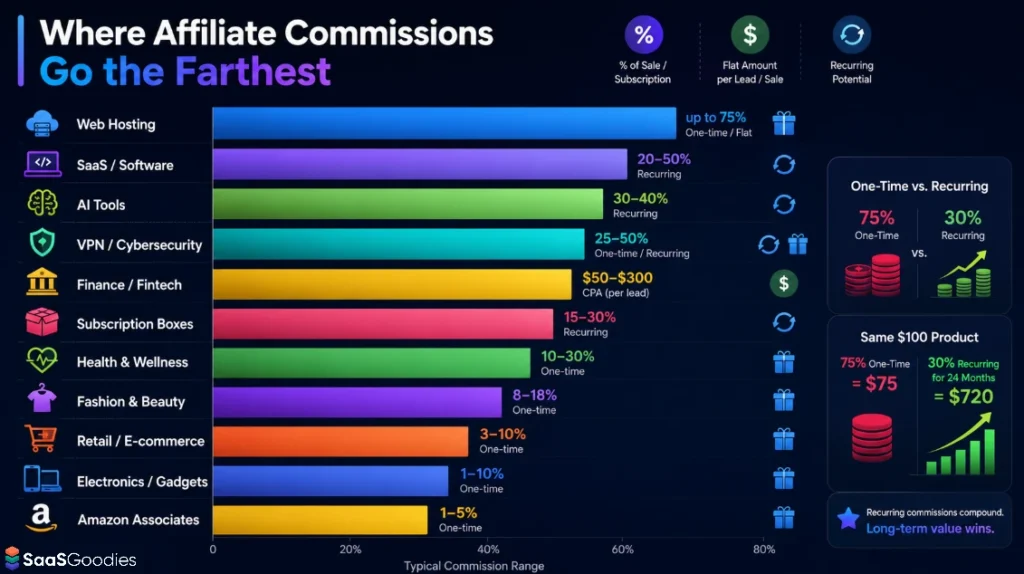
SaaS delivers the highest long-term earnings per referral through recurring commissions, finance pays the most per single lead, and web hosting leads the flat-rate table — each wins on a different metric. “Highest paying” depends entirely on which axis is measured.
Commission benchmarks by vertical:
| Niche | Typical commission | Model |
|---|---|---|
| Web hosting | up to 75% (often flat per sale) | One-time / flat |
| SaaS / software | 20–50% (up to 70%) | Recurring |
| AI tools | 30–40% | Recurring |
| VPN / cybersecurity | 25–50% | One-time / recurring |
| Finance / fintech | $50–$300 per lead | CPA |
| Subscription boxes | 15–30% | Recurring |
| Health & wellness | 10–30% | One-time |
| Fashion & beauty | 8–18% | One-time |
| Retail / e-commerce | 3–10% | One-time |
| Electronics / gadgets | 1–10% | One-time |
| Amazon Associates | 1–5% (most categories) | One-time |
A few specifics worth pinning down:
SaasGoodies Insight: the highest percentage (hosting at 75%) is one-time; the highest lifetime value (SaaS at 20–50% recurring) compounds. A 75% one-time hosting payout on a $60 plan is $45 once.
A 30% recurring SaaS commission on a $100/month tool that a customer keeps for two years is $720. This is the SaaSGoodies thesis in one line: recurring SaaS affiliate commissions beat flashy one-time rates on anything with decent retention.
Recurring vs One-time: Which Commission Model Wins?
Recurring commissions only beat one-time payouts when the product retains customers — but when it does, the gap is enormous, which is why 62% of experienced affiliates now prioritise recurring offers. Retention is the hidden variable that decides everything.
| Model | Wins when… | Risk |
|---|---|---|
| Recurring (SaaS, subscriptions) | Product retains customers 12+ months | Early churn wipes out the advantage |
| One-time / flat (hosting, finance, retail) | High ticket or high per-lead value | No compounding income |
SaasGoodies Recommendation: before promoting a recurring program, check the product's retention and refund rate — not just the commission percentage. A high recurring rate on a leaky-bucket product is a mirage. Low-refund categories like AI tools and well-retained SaaS are where recurring genuinely compounds.
How Much do Affiliates Earn by Niche?
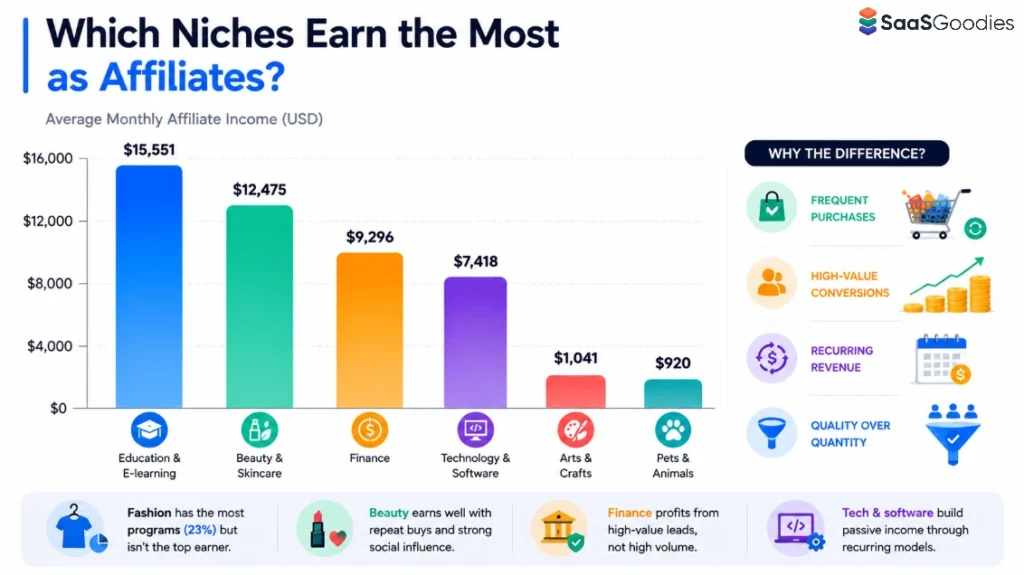
Education and e-learning is the highest-earning affiliate niche at roughly $15,551 a month, while arts, crafts and pets sit near the bottom around $920–$1,041. Average income tracks commission structure and audience purchase frequency, not just rate.
Average monthly affiliate income by niche:
| Niche | Avg monthly income |
|---|---|
| Education & e-learning | ~$15,551 |
| Beauty & skincare | ~$12,475 |
| Finance | ~$9,296 |
| Technology & software | ~$7,418 |
| Arts & crafts | ~$1,041 |
| Pets & animals | ~$920 |
Supporting context on niche structure:
SaasGoodies Insight: the highest-earning niches reward either repeat purchase (beauty), high lead value (finance), or recurring revenue (SaaS/education). Low earners are typically low-ticket, low-frequency categories. Niche selection is a commission-structure decision dressed up as a passion decision.
How Long are Affiliate Cookies — And Why Does it Matter?
A 30-day cookie window is the safe default, but the best SaaS programs stretch to 180 days or offer lifetime tracking — and cookie length can matter more than the commission rate for long consideration cycles. The cookie is how long after a click the affiliate still gets credit.
Key Takeaway: for high-consideration purchases (SaaS, finance, B2B), a 180-day or lifetime cookie can be worth more than a few extra commission points — buyers rarely convert on the first click. A generous rate behind a 24-hour cookie is often worse than a modest rate behind a 90-day one. Read the cookie before the percentage.
How do Commission Rates and Earnings Vary by Region?
North America commands about 40% of the global affiliate market and pays the highest effective commissions, because product prices and rates both run higher there than in developing markets. Geography shapes both the percentage offered and the dollar value behind it.
Regional market share and signals:
| Region | Share of global market (2024) | Note |
|---|---|---|
| North America | ~40% | Highest prices and rates |
| Europe | ~30% | Mature, compliance-heavy |
| Asia-Pacific | ~23% | Fastest-growing |
Supporting context:
The same 10% commission is worth far more on a US or Western European sale than on one in a lower-price market, because 10% of a higher basket is more dollars.
Affiliates targeting high-income geographies earn more per conversion at identical rates. As budgets rise and click volume climbs, the competition for those high-value clicks intensifies — which is exactly why durable, recurring programs matter.
What's Shifting in Affiliate Commissions for 2026?
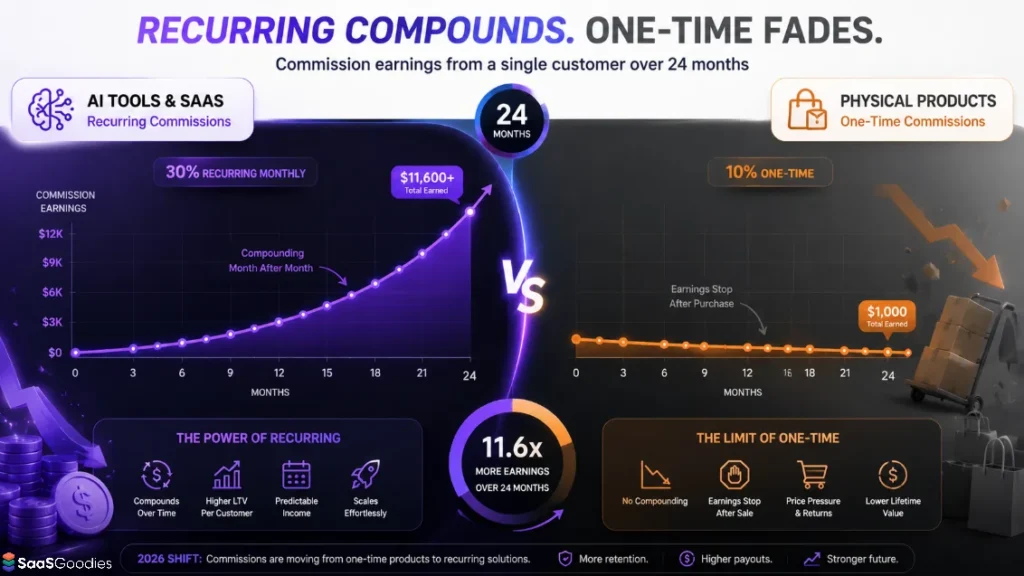
Physical-product rates are under pressure while AI-tool programs launch with strong 30–40% recurring rates, and Amazon is quietly lifting effective payouts through Creator Connections. The money is migrating toward recurring software and compliant, mainstream verticals.
| Trend | Direction |
|---|---|
| AI-tool commissions | New tier, 30–40% recurring |
| Physical-product rates | Falling (margin pressure) |
| Amazon effective rates | Rising via Creator Connections |
| Electronics revenue (US) | −40% YoY |
The trend lines all point the same way — toward recurring SaaS and AI tools, and away from thin-margin physical goods. Affiliates anchored entirely in electronics or general retail are fighting falling rates and falling revenue at once. The defensible position is recurring software with strong retention.
What Affiliate Commission Rate Statistics Reveal About 2026 Earnings
- Post Affiliate Pro — “Affiliate Commission Rates 2025 Guide” / “Typical Affiliate Commission Rates.”
- AFFNinja — “Affiliate Commission Rates by Niche: 2026 Full Breakdown.”
- AffiliateBooster — “Affiliate Commission Rate Benchmarks by Niche 2026.”
- Impact.com / Udonis — commission ranges by category (citing Impact, Cognitive Market Research).
- BlogCD — “Affiliate Commission Rates 2025: Complete Guide.”
- ReferralCandy — “Affiliate Commission Rates by Industry 2026.”
- Drews Review — “Affiliate Marketing Statistics 2026” (income by niche).
- Marketing LTB — “Affiliate Marketing Statistics 2026” (vertical revenue growth).